

In the UAE’s fast-paced market, branding transformation goes beyond a new logo. It’s about redefining your message, values, and digital presence to stay relevant. With daily online shopping up by 320% since 2020 and e-commerce expected to hit AED 99.1 billion by 2025, brands must evolve or risk being left behind.
Key takeaways:
- Repositioning: Stand out by redefining your market role.
- Meeting Expectations: Align with UAE consumers’ demand for personalisation and digital-first solutions.
- Long-Term Growth: Build a brand identity that reflects future ambitions.
Examples like Etisalat’s shift to e& in 2022, which grew its brand value by 701%, and Mashreq Bank’s digital-first rebranding highlight how transformation drives success. The process includes aligning core values, updating visual identity and guidelines, refining messaging, and adopting a digital-first strategy. Done right, it can boost revenue by up to 23% and secure your place in a competitive market.
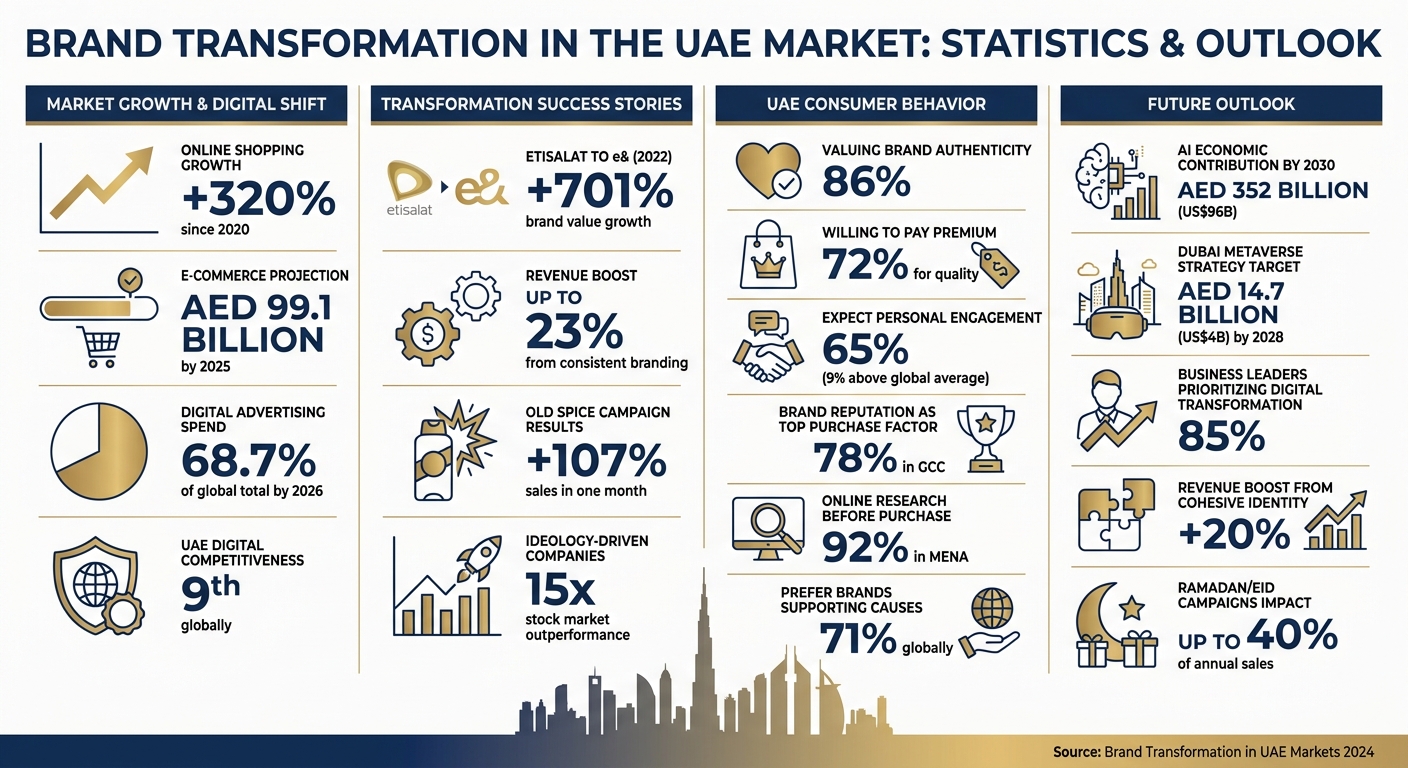
UAE Brand Transformation Statistics and Impact Metrics 2024-2030
Starting with Core Values and Beliefs
To truly transform your brand, start by reflecting on your organisation’s core values. These aren’t just catchy slogans for marketing – they’re the principles that define your brand’s identity. Take Patagonia as an example: in November 2016, the company pledged its Black Friday sales to environmental causes, aiming to raise between AED 7.3–14.7 million. Instead, they garnered a staggering AED 36.7 million, proving how deeply their “save our home planet” mission resonated with customers. This kind of authenticity is especially impactful in markets like the UAE, where 86% of consumers place high importance on genuine brand values.
In the UAE, aligning with core values yields measurable success. Research highlights that companies driven by a strong ideology outperform the stock market by 15 times over a century. However, the challenge lies in avoiding generic claims – like the 55% of Fortune 100 companies that list “integrity” as a core value without backing it with meaningful action. A strong value system must guide behaviour and set your brand apart.
Identifying Your Brand’s Core Beliefs
To uncover your brand’s true values, conduct thorough internal research. Interview employees across various roles and levels to identify what Patrick Lencioni, CEO of The Table Group, calls “the source of a company’s distinctiveness.” Genuine values demand commitment – they shape decisions, limit choices, and define your brand’s unique position.
A practical tool to define your brand’s personality is the Three-Word Rule. Choose three adjectives that encapsulate your brand’s essence and ensure they resonate with UAE audiences. Fashion branding expert Joey Ng explains:
“Find your niche and define in very few words what makes your brand distinctive. If something doesn’t fit those original three words – even though you might like it – scrap it.”
This approach ensures your branding decisions remain aligned with your identity. Document these values in a brand guidelines manual to maintain consistency, as consistent branding can increase revenue by up to 23%.
Once your core beliefs are established, ensure they align with the evolving expectations of your UAE customer base.
Matching Values with Customer Expectations
Clearly defined values are the foundation for aligning your internal vision with external market demands. Start with a dual audit: internally, evaluate whether stakeholders’ visions match operational practices; externally, gather insights from UAE consumers through surveys, focus groups, and sentiment analysis. These efforts reveal key trends – 72% of UAE shoppers are willing to pay more for premium quality, and 65% expect brands to engage with them personally, which is 9% higher than the global average.
Operationalising your values is critical. They should guide your actions, not just your marketing. For instance, Sephora ended its partnership with Olivia Jade Giannulli after a college admissions scandal, demonstrating its commitment to the value of “respect for all.” In the UAE, this means respecting local customs, traditions, and religious values. Before rolling out your values broadly, test them with smaller customer segments to avoid misalignment. Use a clear positioning framework, such as:
We offer [PRODUCT/SERVICE] for [TARGET MARKET] to [VALUE PROPOSITION]. Unlike [THE COMPETITION], we [KEY DIFFERENTIATOR].
This clarity ensures your values translate into meaningful customer relationships. After all, 71% of global consumers prefer brands that support causes they care about – a sentiment that’s equally powerful in the UAE.
sbb-itb-6cae99a
Updating Visual Identity: Design and Implementation
Once you’ve established your core values, the next step is to bring them to life through visual elements. Your visual identity – logos, colours, typography, and supporting graphics – creates the first impression users form, often within just 50 milliseconds of encountering your brand online. In the UAE’s diverse market, which hosts over 200 nationalities, these visual choices need to strike a balance between global appeal and local relevance, all while honouring Emirati heritage. This alignment ensures your visuals truly reflect your brand’s essence.
Core Elements of Visual Identity
A strong visual identity goes far beyond just a logo. Start with a primary logo and create secondary and monochrome versions to suit different applications. Build a strategic colour palette that adheres to WCAG 2.1 AA contrast standards, ensuring accessibility. Additionally, select bilingual typography that harmonises Arabic and English scripts, reflecting the UAE’s multicultural audience.
To complement these core elements, consider incorporating iconography, motion graphics, and even sensory branding elements – think of Netflix’s iconic “Ta-dum” sound. Modern brands often adopt a digital-first approach, ensuring their logos perform well across mobile devices, dark mode settings, and even tiny favicon sizes. Always test your visuals across various formats and sizes before finalising them. As Charlotte Muzzi from Shopify explains:
“A brand refresh is an update to one or more elements of a company’s brand identity. It’s a strategic approach designed to align a company’s brand image with its current offerings and reflect its response to shifting market conditions and customer needs.”
In the UAE, luxury branding trends for 2026 lean towards minimalism infused with regional depth. This means clean, simple designs paired with understated typography and subtle regional touches, rather than overly flashy aesthetics. This approach resonates with themes of innovation and sustainability championed by initiatives like UAE Vision 2030, helping to build trust and confidence among local consumers.
How to Roll Out Visual Changes
Even the best design work falls flat if it’s not implemented consistently. To ensure a smooth transition, start by conducting a thorough brand audit. Document all existing assets – such as business cards, social media profiles, and signage – in a centralised system. Then, establish a clear cutover date to retire outdated materials and avoid any confusion in the market.
Begin the rollout internally. Host town halls and training sessions to ensure employees understand the new identity and can act as brand ambassadors. Next, phase the public rollout: update digital platforms first, followed by advertising campaigns, and finally, physical assets. If you’re changing domains or URLs, use 301 redirects for every page to maintain search rankings, and notify Google using the “Change of Address” tool in Search Console.
Store all new assets in a centralised, version-controlled repository, and create a detailed brand book. This guide should outline usage rules for every touchpoint, and include a “do not use” folder for retired elements to prevent inconsistencies. A soft launch with key stakeholders can help identify any issues before the official public reveal. By following this structured approach, you ensure consistency – and consistent branding has been shown to boost revenue by up to 23%.
Changing Brand Voice and Messaging
After refreshing your visual identity, the next step is refining your brand voice to create a seamless narrative across all channels. While an eye-catching visual identity grabs attention, a consistent brand voice keeps it. In the UAE, where 92% of MENA consumers research a brand online before making a purchase, your messaging plays a crucial role in shaping first impressions. But it’s not just about the words you choose. The UAE, home to over 200 nationalities, is a unique blend of cultures, and 78% of GCC consumers cite brand reputation as the top factor influencing their purchase decisions. To succeed, your messaging must strike a balance between global appeal and local authenticity, presenting your brand as both culturally aware and forward-thinking.
Building a Consistent Brand Voice
A unified brand voice begins with defining core personality traits that guide all communications. Think of descriptors like “confident yet approachable” or “modern but respectful.” These traits act as a foundation for your messaging. Consistency is key – whether it’s your website, social media, email campaigns, customer service, or even product packaging, the tone should align across all platforms. While the level of formality can shift depending on the context, the underlying voice should remain steady.
“The biggest branding mistake in MENA is treating Arabic as an afterthought. If your Arabic brand identity looks like a translation of your English one… you are signalling to Arabic-speaking customers that they are secondary.”
To ensure alignment, create detailed messaging guidelines. These should include your brand’s personality traits, tone preferences, and specific examples of how to describe your business. Train your team to embody the brand story in every customer interaction. Regular brand audits – ideally every 30 days – can help identify and correct inconsistencies early on. In GCC markets, consistent branding can lead to 20-30% price premiums, reflecting the perceived value of a strong, cohesive identity.
Tailoring Messages for UAE Audiences
In the UAE, a bilingual-first strategy is essential. Arabic messaging should match the depth and personality of your English content, rather than being an afterthought or a mere translation. This requires creating an Arabic logotype and verbal identity from scratch, ensuring it reflects the same level of care and sophistication.
For maximum impact, use Gulf Arabic for localised resonance and Modern Standard Arabic for formal communications. Adjust your tone based on the audience: B2B messaging should be formal and respectful, while B2C communications can be more personal and inviting. On social media, it’s okay to adopt a casual, dialect-driven approach, but your website and print materials should maintain a more polished tone.
Here are some practical tips:
- Use fonts optimised for Arabic readability.
- Collaborate with native Arabic speakers to refine your messaging.
- Avoid auto-RTL (right-to-left) tools for layouts; instead, have native Arabic designers ensure everything flows naturally.
- Test the Arabic pronunciation of English brand names with native speakers to avoid unintended meanings.
Cultural timing is another critical factor. Ramadan and Eid campaigns can drive up to 40% of annual sales for many brands in the region. Additionally, founder stories resonate well in the UAE’s relationship-driven market, where 83% of consumers prefer brands that demonstrate cultural relevance. This trust-based approach, where reputation and word-of-mouth often outweigh traditional advertising, strengthens your connection with the market and solidifies your brand’s transformation.
Digital-First Brand Transformation
Adopting a digital-first strategy strengthens your brand’s core values and modern visual identity. In the UAE, a country ranked 9th globally for digital competitiveness and boasting the highest internet penetration rate, digital platforms are where brands thrive – or fail. With projections showing 68.7% of global advertising spend shifting to digital by 2026, your online presence is no longer a side note – it’s the headline act. But here’s the catch: half of all users spend only 2–5 seconds engaging with digital content before moving on. This makes it critical for your digital transformation to be precise, fast, and consistent across all touchpoints.
This shift isn’t just about aesthetics. AI models such as ChatGPT, Gemini, and Perplexity now bridge the gap between brands and consumers. If your digital identity isn’t structured for AI – through tools like Schema.org markup, Knowledge Graph entries, and structured data – you risk being invisible to these systems. A quote from Digital Strategy Force, Trust Engineering Division, puts it plainly:
“A rebrand that changes your logo but leaves your Knowledge Graph entry pointing to an outdated entity description is invisible to every AI model on the planet. The machines are not looking at your design system. They are reading your data layer.”
– Digital Strategy Force, Trust Engineering Division
To succeed, your transformation must address five layers: visual identity, messaging, structural elements (like your website’s architecture), entity data (Schema markup), and citation consistency (ensuring your brand is consistently represented across platforms). While the first two layers are visible to humans, the last three are what AI systems rely on to recommend – or ignore – your brand.
Updating Digital Touchpoints
Once you’ve established a machine-readable digital identity, the next step is to ensure every customer touchpoint reflects your updated brand. This involves mapping out all digital touchpoints – your website, social media profiles, email templates, and more – to ensure consistency. Why? Because 84% of marketers admit their campaigns feel generic, often due to inconsistent updates across platforms. And in a market where 95% of consumers prioritise trust when choosing a brand, consistency isn’t just important – it’s essential.
Start with the platforms that matter most. Your website and primary social media channels are your biggest drivers of visibility, so prioritise those before tackling secondary materials like invoices or proposals. Create a brand standards guide that includes hex codes, font details, and messaging examples to ensure clarity during the rollout. After 30 days, conduct a brand audit to identify and fix any inconsistencies.
For the structural and entity layers, refine your website’s information architecture. Group content into logical clusters to help AI understand your expertise. Audit your Schema.org markup to ensure it reflects your current brand identity. Then, test how AI models like ChatGPT or Gemini respond to your brand. If the responses are vague or incorrect, your entity layer needs work. Finally, ensure your brand signals on owned platforms match third-party sources like Wikidata, LinkedIn, or industry directories to reinforce citation consistency.
Using New Technologies
While optimising existing channels is crucial, emerging technologies are reshaping the future of digital branding. The UAE’s strong focus on AI – highlighted by the appointment of 22 Chief AI Officers across government departments in June 2024 – shows the direction the market is heading. AI is expected to contribute AED 352 billion (US$96 billion) to the UAE’s economy by 2030. Brands integrating AI into customer service, personalisation, and content creation are positioning themselves for long-term success.
But AI isn’t the only game-changer. The Dubai Metaverse Strategy aims to add AED 14.7 billion (US$4 billion) to the economy and create 40,000 virtual jobs by 2028. Early adopters are already making waves. For example, the Ministry of Health and Prevention launched “Meta Health” in 2025, the world’s first virtual customer happiness centre. Similarly, the Dubai Virtual Assets Regulatory Authority (VARA) set up its headquarters in “The Sandbox” metaverse, and Investopia hosted the first financial summit entirely in the metaverse. These initiatives highlight how immersive technology is becoming a legitimate touchpoint for brands.
To implement these advancements, consider the following:
- Use local cloud services like AWS, Microsoft Azure, or Oracle to comply with the UAE’s data residency laws.
- Leverage AI for automating customer service and delivering personalised content.
- Explore augmented reality for retail and real estate applications, such as virtual try-ons or product visualisations.
- Prioritise cybersecurity. The UAE has the highest rate of malware incidents in the GCC, and the cybersecurity market is projected to reach AED 16.6 billion (US$4.51 billion) by 2025. Adopting the UAE Information Assurance Standards can safeguard your digital infrastructure and maintain customer trust, especially in a time when 20% of users cite unregulated AI content as a reason for declining trust.
Measuring Results and Avoiding Mistakes
Tracking brand transformation involves focusing on perception, behaviour, performance, and internal metrics. As SurveyMonkey aptly states:
“If a metric can’t influence a decision next week, it’s just noise.”
Metrics for Tracking Progress
Start by establishing a baseline 1–2 weeks before your launch. This helps measure brand recall and intent effectively. Use the SMART framework – Strategic, Market-driven, Actionable, Repeatable, and Touchpoint-inclusive – to guide your approach. Keep an eye on both aided and unaided brand awareness to see how well customers recognise your brand, with and without prompts.
Key metrics to monitor include:
- Net Promoter Score (NPS): Gauges customer loyalty.
- Website Traffic and Social Engagement: Reflects behavioural changes.
- Retention Rates: Tracks customer satisfaction over time.
- Financial Indicators: Revenue growth, market share, and Customer Lifetime Value (CLV) show the monetary impact.
Perform monthly reviews and deeper quarterly analyses to uncover trends. Segment results by market, customer persona, or tenure to identify where your brand is thriving or needs reinforcement. Be patient – sales impacts can surface within 1–6 months, but true brand equity shifts often take 3–5 years.
For instance, Old Spice’s 2010 campaign, “The Man Your Man Could Smell Like”, targeted female buyers (responsible for 60% of body wash purchases). Within a month, sales jumped by 107%, and their market share doubled from 3% to 6%.
While tracking progress is critical, steering clear of common mistakes is just as important.
Common Brand Transformation Mistakes
Even the best metrics won’t save a brand transformation derailed by key missteps. One frequent error is mistaking transformation for a simple design update. A striking example is Jaguar’s November 2024 rebranding, where they replaced their iconic “growler” logo with a minimalist wordmark and released a promotional video that featured no cars. The result? A staggering 97% drop in European sales, a decline in positive sentiment from 23% to 8%, and the eventual dismissal of their design chief, Gerry McGovern.
Another major pitfall is launching without ensuring internal alignment. Employees, as your brand’s primary ambassadors, must be informed and onboard with the changes. Without their buy-in, the customer experience can become fragmented and inconsistent. Invest in educating and training your team before unveiling the transformation to the public.
It’s worth noting that about one in three standalone rebrands fails to meet expectations. This often happens when companies rush the process or discard too much of their established brand identity. Learn to differentiate between “newness” complaints, which usually subside as customers adjust, and deeper functional issues that may require revisiting or reversing the changes.
Conclusion: Building a Future-Ready Brand
Transforming a brand is not a one-off task – it’s an ongoing process. The strategies outlined – defining core values, updating visual identity, refining messaging, and embracing a digital-first approach – work best when they are part of a unified plan. This approach positions brands to navigate future market changes effectively.
In the UAE, brands must strike a balance between bold innovation and respecting local traditions. As Sanjay Raghunath, Chairman & Managing Director of Centena Group, aptly puts it:
“The buzzword now is execution, more than planning and strategy. The speed and consistency of execution will determine success. AI usage must be directly tied to productivity and customer value.”
This focus on execution ties directly to the strategies discussed earlier, ensuring that transformation efforts are both impactful and measurable. Real-world examples show that successful transformations involve more than just updating a logo or tagline – they require a complete operational overhaul.
Looking ahead to 2026, brands in the UAE must align with the nation’s sustainability goals and maintain a consistent presence across all platforms. With 85% of UAE business leaders prioritising digital transformation and brands seeing a 20% boost in revenue when they maintain a cohesive identity, the importance of adaptability is clear. By building systems that can grow with technological advancements and cultural shifts, businesses can stay relevant and responsive while preserving the core identity shaped through thoughtful transformation.
FAQs
How do I know if we need a rebrand or just a refresh?
A brand refresh involves updating elements such as visuals, messaging, or tone while maintaining your core identity. This approach works well when your brand still aligns with your market but could use a modern touch. On the other hand, a rebrand goes much deeper, transforming your strategy, values, and positioning. It’s necessary when your brand no longer represents your business direction or fails to connect with your audience. To choose the right path, assess how relevant, aligned, and engaging your current brand is.
How can we keep our brand consistent in Arabic and English?
To maintain brand consistency in both Arabic and English, it’s essential to blend linguistic, cultural, and visual components effectively. Create a bilingual brand identity that honours cultural subtleties while accommodating both right-to-left (RTL) and left-to-right (LTR) scripts. Incorporate imagery, language, and messaging that resonate with the local audience and uphold trust. Ensuring alignment in tone, visuals, and content across both languages fosters a cohesive brand experience tailored to the UAE’s diverse and multicultural community.
What should we update online so AI can recognise our new brand?
To make sure AI systems recognise your rebranded identity, start by updating all visual assets – this includes your logos, colour schemes, and design elements – across your website, social media profiles, and any other digital content. Revamp your metadata, keywords, and structured data to align with your new branding. Consistency is key, so ensure your brand messaging stays uniform across all platforms. Finally, use tracking tools to monitor how effectively AI systems are identifying and integrating your rebrand. This will give you better control and visibility over the process.
Related Blog Posts

BRAND HUSL
We’re a collective of brand strategists, designers, and unapologetic truth-tellers who’ve spent over two decades turning chaos into clarity for businesses across the globe. From global names to fearless startups, we’ve built brands that stick, scale, and sell—without the fluff. Everything we create is rooted in strategy, storytelling, and ROI, because good branding isn’t just pretty—it’s powerful.