

Local market insight is critical for creating effective brand strategies in the UAE. With its diverse population (80% expatriates) and strong cultural traditions, understanding local preferences, behaviours, and regulations is essential. Brands that align their messaging with the UAE’s unique values and legal frameworks can build trust and connect meaningfully with their audience. Here’s why local insights matter:
- Cultural Relevance: Campaigns must respect Islamic values and local traditions. For instance, Adidas’s “I’m Possible” campaign resonated by addressing regional challenges for women in sports.
- Economic Understanding: The UAE’s high disposable income supports both premium and value segments. Trends like “trading up” in food and tech highlight consumer priorities.
- Geographic Nuances: Strategies must vary between cities like Dubai (cosmopolitan, innovation-driven) and Abu Dhabi (traditional, family-focused).
- Regulatory Compliance: Strict laws govern advertising, requiring brands to align with guidelines to avoid fines or suspensions.
- Digital Focus: Over 70% of marketing budgets target digital channels, but success demands cultural sensitivity and legal adherence.
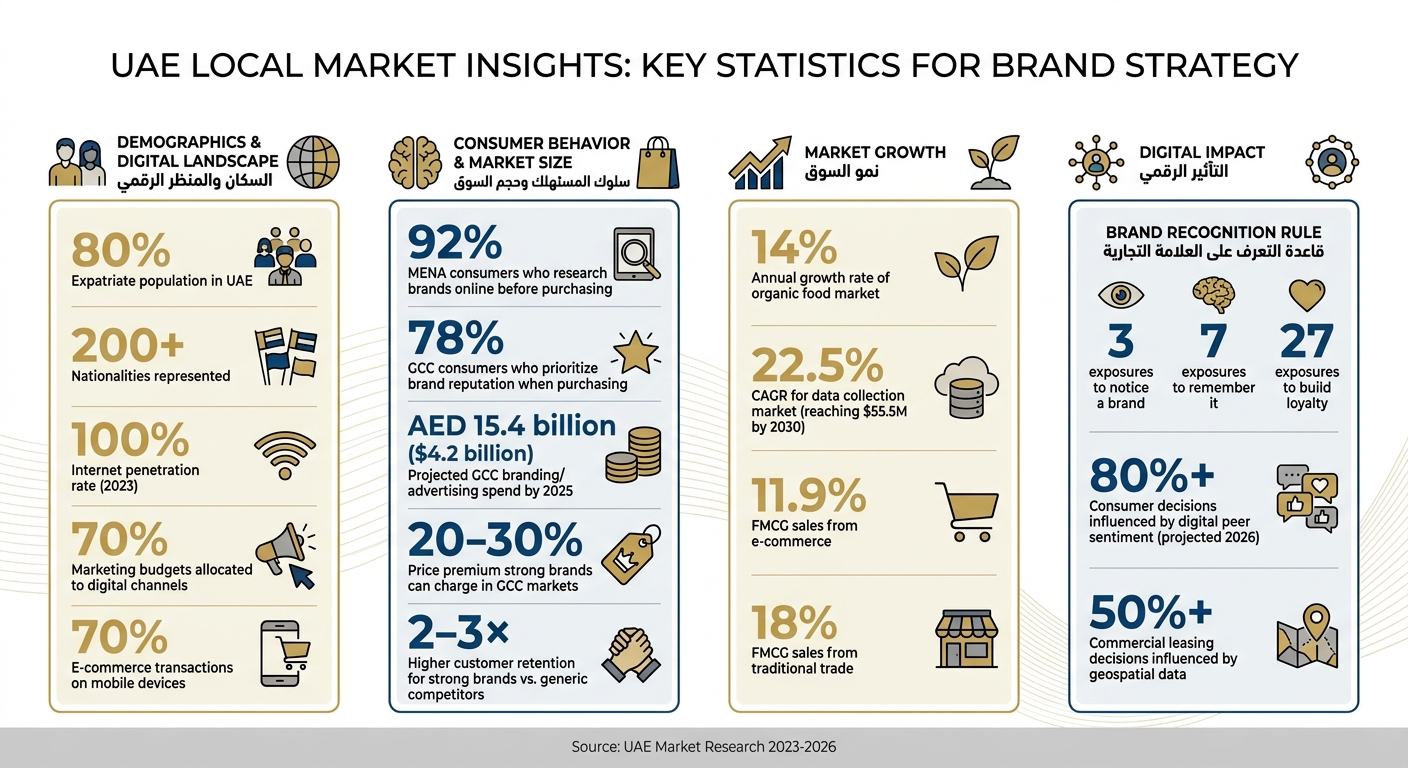
UAE Market Insights: Key Statistics for Brand Strategy Success
What Are Local Market Insights?
Local market insights delve into the cultural, economic, and geographic elements that shape consumer behaviour. In the UAE, these insights are critical. With expatriates making up about 80% of the population, brands face the unique challenge of connecting with a highly diverse audience while honouring local traditions and Islamic values.
These insights go far beyond simple demographics. They reveal how people make choices, what earns their trust, and why they prefer one brand over another. For example, understanding “wasta” – the influence of personal connections – is essential. In the UAE, brand success often hinges on building long-term relationships.
“Building a brand in the UAE is as much about building relationships as it is about the product itself.” – myNZTE
The UAE is known for its brand-conscious culture, where premium and luxury products are often seen as markers of status and quality. This reflects cultural values, economic realities, and personal identity. Brands that understand these subtleties can connect meaningfully with consumers, while those that don’t risk being seen as out of touch. This is why transcreation – adapting tone, imagery, and cultural context – is far more effective than simple translation.
This understanding lays the groundwork for exploring how culture, economy, and geography influence consumer decisions in the UAE.
Cultural Values and Consumer Behaviour
Islamic values, modesty, and family traditions are deeply ingrained in the UAE’s consumer behaviour. To resonate with this audience, messaging must align with Arab identity and respect cultural norms, including gender roles and religious sensitivities.
The younger generation, especially, is discovering brands through digital platforms like TikTok and Snapchat. But having a digital presence isn’t enough. Brands must also comply with strict regulations from the National Media Council, which enforces transparency in marketing and restricts discussions on sensitive topics like religion and politics. Non-compliance can lead to fines, account suspensions, or even licence revocations.
Global brands like Starbucks have successfully localised their offerings by introducing Arab-inspired products and designing stores that reflect traditional regional architecture. Building credibility in the UAE often means focusing on personal relationships, exclusivity, and private events rather than broad, mass-market campaigns.
Economic Factors and Spending Habits
The UAE’s high GDP per capita and significant disposable income create a market where both premium and value segments thrive. Sectors like FMCG and Tech & Durables have seen strong growth, with key categories expanding by over 20%, reflecting diverse consumer spending habits.
In the UAE, “trading up” is a noticeable trend, especially in food and technology. For instance, the organic food market is growing at an estimated 14% annually, driven by a shift towards eco-friendly choices. Similarly, premium Tech & Durables products are outperforming standard ones, growing at 7.5% compared to 6.0%. As Andrey Dvoychenkov, General Manager at NielsenIQ APP, notes:
“Saudi consumers prioritise value in groceries but will splurge on premium technology, whilst UAE shoppers show strong growth at both ends of the spectrum.”
E-commerce now accounts for 11.9% of FMCG sales, while traditional trade still holds 18%. This balance highlights the importance of an omni-channel strategy. Digital platforms are essential for convenience and product discovery, but physical stores remain key for fresh goods and experiential shopping. The integration of entertainment – like indoor ski slopes and aquariums in malls – further connects shopping with lifestyle experiences.
Regional Differences and Geographic Targeting
Regional nuances also play a significant role in shaping brand strategies across the UAE. While Dubai and Abu Dhabi are both major markets, they require distinct approaches.
Dubai, as a cosmopolitan hub, is ideal for testing new international concepts. It’s fast-paced, driven by tourism, and open to innovation. Creative campaigns, metaverse initiatives, and AI-driven consumer engagement thrive here.
On the other hand, Abu Dhabi, the administrative capital, is more traditional and private. Brands here need a formal and respectful tone, focusing on heritage, government relations, and family-oriented messaging. Campaigns often prioritise resilience and reputation over flashy tactics.
Beyond these two emirates, regions like Ras Al Khaimah offer flexibility, particularly within their free zones. Brands must also distinguish between expatriate and Emirati consumers. While expatriates often lean towards convenience and international familiarity, Emiratis value brands that respect local heritage and deliver high-quality products.
sbb-itb-6cae99a
How to Collect and Interpret Local Market Data
Gathering market data in the UAE requires methods that align with its diverse demographics and cultural sensitivities. With 100% internet penetration as of 2023 and a population representing over 200 nationalities, brands must adopt strategies that respect privacy, cater to language diversity, and consider regional nuances.
The UAE’s data collection and labelling market is expected to hit $55.5 million by 2030, growing at a CAGR of 22.5%. This growth reflects the increasing reliance on data-driven strategies. However, success hinges on selecting the right tools and interpreting findings through a localised perspective.
Market Research and Demographic Analysis
Online surveys are often the go-to method due to widespread internet access and the region’s preference for anonymity. As highlighted by the TGM Marketing Team at TGM Research:
“Online surveys can offer a greater sense of anonymity compared to face-to-face interviews. This is particularly valuable in a political climate where there might be concerns about privacy.”
Mobile-first design is critical. With 70% of e-commerce transactions happening on mobile devices, surveys must be optimised for smartphones to minimise drop-off rates. Platforms like Qualtrics (165,225 visits in March 2026) and The Panel Station (108,170 visits) dominate this space, offering support for both Arabic and English, including right-to-left script compatibility.
Timing is another crucial factor. Avoid scheduling data collection during prayer times or peak fasting hours in Ramadan. Incentives like e-vouchers for Majid Al Futtaim malls or high-end electronics resonate more with local audiences than generic rewards. Additionally, research materials should steer clear of imagery involving alcohol, pork, or gambling to avoid cultural insensitivity.
Ethnographic research offers a deeper dive into collective decision-making, which is common for major purchases in the UAE. Categories like automotive and electronics often involve multiple family members. Focus groups and bulletin board studies can uncover how cultural values influence these decisions.
Once demographic data is collected, advanced tools can refine the insights further by analysing behaviour and motivations.
Tools for Behavioural and Psychographic Analysis
While surveys and demographic studies provide a foundation, modern tools help uncover the “why” behind consumer behaviour. Social media listening, powered by Natural Language Processing (NLP), is essential for analysing conversations across Arabic, English, Hindi, and Urdu. By 2026, digital peer sentiment is projected to influence over 80% of consumer decisions in UAE urban centres.
Geospatial analytics is another powerful tool, using mobile location data and satellite imagery to track movement patterns. This is particularly useful for retail site selection and outdoor advertising. In fact, such data influences over 50% of commercial leasing decisions in high-growth areas like Dubai Hills and Al Quoz Creative District.
Here’s how demographic and location-based segmentation differ in their strategic applications:
| Feature | Demographic Segmentation | Location-Based (Geospatial) Segmentation |
|---|---|---|
| Primary Data Points | Age, nationality, income, education, family size | Foot traffic, district-level demand, proximity to hubs |
| UAE Context | Essential for targeting 200+ nationalities and specific expat vs. local groups | Vital for identifying high-growth areas like Dubai Hills or Al Quoz Creative District |
| Methodology | Online surveys, census data, loyalty card registrations | Mobile location pings, satellite imagery, POS transaction locations |
| Strategic Use | Customising messaging and product features to cultural preferences | Optimising logistics, retail placement, and outdoor advertising |
| Trend | Moving towards behavioural “clusters” beyond just nationality | Influencing over 50% of commercial leasing decisions |
Expert elicitation through Delphi panels is another effective approach. Engaging government advisors and industry experts can help businesses navigate the UAE’s unique regulatory environment and business landscape. This qualitative method complements quantitative data, especially when entering new markets or adapting to regulatory changes.
Compliance is non-negotiable. All data collection must adhere to Federal Law No. 45 of 2021 on the Protection of Personal Data and the ICC/ESOMAR International Code. Ensure that tools and brokers are licensed by local authorities like the DFSA (Dubai), ADGM (Abu Dhabi), or SCA (Mainland UAE). As Kais Ben Hadj Salah, Co-Founder & Director at MindMarket, points out:
“The biggest mistake we see global brands make is treating the Middle East as a homogeneous market. Each country – and even cities within countries – has its own distinct consumer personality.”
To overcome fragmented public databases across Emirates, centralising data from resources like the Dubai Statistics Centre and proprietary panels is key. This integrated approach ensures strategies are based on accurate, comprehensive insights rather than incomplete assumptions.
Using Local Insights in Your Brand Strategy
After gathering and analysing local market data, the next step is to use those insights to shape a brand identity that resonates with UAE audiences. This goes beyond surface-level tweaks – it’s about creating a brand that feels aligned with the region’s diverse population while honouring its cultural essence.
Adjusting Visual Identity and Messaging for Local Audiences
In the UAE, visual identity requires a balance between global appeal and local sensitivity. Bilingual branding is a must, and it’s more than just translating text. Your Arabic branding should carry the same weight and prominence as its English counterpart.
Bob Sabra, CEO & Founder of Hovi Digital Lab, puts it perfectly:
“The biggest branding mistake in MENA is treating Arabic as an afterthought. If your Arabic brand identity looks like a translation of your English one… you are signalling to Arabic-speaking customers that they are secondary.”
Typography is key. Pair Arabic and English fonts with complementary visual styles – like Noto Sans Arabic and Inter – to maintain consistency. For bilingual logos, consider stacking Arabic above English or placing them side-by-side with a visual divider. Arabic script often requires slightly larger sizing for clarity.
Colour choices should reflect cultural significance. Gold conveys luxury, blue symbolises trust, and national colours evoke pride. Be mindful with green and purple, as they carry specific religious and market associations.
When it comes to messaging, tone matters. In B2B contexts, a more formal and respectful voice is expected, while B2C communications can be friendlier and more relatable. Avoid direct translations of casual English phrases; instead, focus on values like hospitality, family, and heritage – key aspects of UAE culture. Messages should also align with the UAE’s forward-thinking and ambitious outlook.
Visual content must respect modesty standards. Models should be dressed modestly – covering shoulders and knees – and assets should avoid symbols like pigs, alcohol, or religious imagery from other faiths. This not only ensures compliance but also demonstrates respect for the 92% of MENA consumers who research brands online before purchasing.
The “3-7-27 rule” is a helpful guide: customers need about 3 exposures to notice a brand, 7 to remember it, and 27 to trust it enough for loyalty. In the UAE, trust is built on relationships, reputation, and word-of-mouth rather than just advertising. Strong brands in GCC markets can charge price premiums of 20–30% and achieve 2–3× higher customer retention compared to generic competitors.
These tailored visual and verbal elements naturally lead into a broader strategy framework.
Working with Brand Husl for Strategy Development
After refining your visual and messaging elements, a well-rounded strategy is crucial to fully integrate local insights. Brand Husl excels at transforming these insights into cohesive brand strategies tailored to the UAE’s unique market. Their process combines thorough brand audits with strategic development to ensure your identity connects with both the 80% expatriate population and the Emirati cultural core.
The journey starts by determining where your brand stands between “rooted in culture” (heritage) and “forward-looking” (modernity). From there, Brand Husl develops a complete visual identity – covering logo design, typography, and colour palette – that works seamlessly in Arabic and English. This extends to marketing templates, signage, packaging, and digital branding, ensuring consistency across all touchpoints.
A digital-first approach is essential. Brand Husl ensures your identity is effective across platforms like WhatsApp, social media, and Google Business Profiles – key channels for first impressions in the UAE. Their guidelines provide clear direction for maintaining brand consistency while allowing flexibility for local moments and real-time engagement.
The cost of a comprehensive branding strategy typically ranges from AED 50,000 to AED 200,000+ (approximately $14,000–$55,000+). This includes bilingual identity, website design, and detailed guidelines, reflecting the complexity of creating a brand that adheres to UAE regulations while appealing to a diverse population.
Key performance indicators include brand search volume, social listening share of voice, and Arabic-language sentiment analysis. With AED 15.4 billion (around $4.2 billion) projected for branding and advertising in the GCC by 2025 – and 78% of GCC consumers listing brand reputation as their top purchase driver – nailing your brand strategy is crucial for staying ahead in this competitive market.
Implementing Local Insights Across Brand Touchpoints
Once your strategy is in place, it’s time to weave local insights into every interaction with your customers. In the UAE, where over 70% of marketing budgets are directed toward digital channels, brands need to strike a balance between physical and digital touchpoints. At the same time, it’s crucial to respect cultural norms and adhere to regulatory guidelines. This holistic integration strengthens the bond between your brand and the UAE’s diverse audiences.
Adapting Packaging, Signage, and Digital Channels
Even in a market that leans heavily on digital, physical touchpoints remain vital. Take Starbucks, for example. They’ve embraced the UAE’s heritage by designing stores inspired by traditional local architecture, creating spaces that feel connected to the region. Their use of Arabic calligraphy on packaging and products highlights how global brands can respect local tastes while maintaining their identity.
Nike and Nestlé take a proactive approach by establishing local teams to create region-specific concepts from the ground up. This kind of investment in local expertise not only avoids cultural missteps but also builds stronger, more authentic relationships.
When it comes to packaging and signage, compliance with the Emirates Authority for Standardisation and Metrology (ESMA) is non-negotiable. Dual-language designs are essential, ensuring Arabic text is just as clear and visually prominent as its English counterpart. Colour choices should also resonate with local preferences to enhance cultural relevance.
On the digital front, precision is key. With the UAE’s high social media usage, platforms like TikTok, Snapchat, and Instagram are critical touchpoints. However, content must comply with local regulations to avoid penalties. Timing campaigns around the lunar calendar, particularly during Ramadan, can maximise engagement, especially during Suhoor and Iftar.
Localising these touchpoints effectively creates a deeper connection with communities, as explained below.
Strengthening Community Connection and Trust
With your brand strategy refined, the next step is to foster trust within the community. In the UAE, trust is deeply rooted in relationships.
“The UAE is a relationship-based market where trust is the foundation of any business deal.”
Earning this trust goes beyond consistent messaging – it requires genuine involvement in the community.
Incorporate user-generated content and interactive formats like polls or Q&A sessions to encourage two-way communication. Research shows that 92% of consumers trust recommendations from individuals over brands. Including customer reviews and testimonials on your website can increase return visits by up to 20%. Always seek permission before sharing user content to maintain respect and reinforce trust.
Participating in local CSR initiatives or sponsoring community events demonstrates a commitment that extends beyond profit. Aligning with sustainability themes, such as those highlighted during COP28, can also enhance your brand’s reputation through ESG-focused communications.
It’s also important to tailor your approach to regional differences. For example, Dubai tends to favour creative campaigns involving AI and metaverse experiences, while Abu Dhabi often leans towards business-to-government communications and strategic resilience. Use straightforward language and avoid overly technical terms to ensure clarity across touchpoints.
To measure the impact of your efforts, track metrics that reflect community engagement and cultural alignment:
| Metric | Measurement Method | Impact of Localisation |
|---|---|---|
| Cultural Sentiment Score | Social listening for local dialects and cultural references | Tracks alignment with Arab identity and values |
| Influencer Engagement Rate | Interaction levels on posts by regional influencers | Reflects trust and connection through local voices |
| Regulatory Compliance Rate | Frequency of ad approvals versus rejections by the NMC | Ensures brand safety and avoids penalties |
| ESG Engagement | Tracking interactions with sustainability-related content | Shows alignment with societal goals like COP28 themes |
| Store Footfall/Retention | Comparing traffic in Arabised vs. standard store designs | Measures the success of physical localisation efforts |
Tracking and Improving Your Brand Strategy
Metrics for Measuring Success
To measure how well your localised brand strategy is working, it’s essential to track both quantitative and qualitative indicators. In the UAE, where around 80% of the population actively uses social media, monitoring engagement on platforms like Instagram, TikTok, and Facebook can reveal how well your messaging resonates with your audience.
On the financial side, keep an eye on metrics like Average Order Value (AOV) – which often exceeds AED 150 in the region – Customer Lifetime Value (CLV), and conversion rates. For brand awareness, tools like unaided recall and aided recognition surveys can help you see how easily UAE consumers recognise your brand compared to competitors.
The Net Promoter Score (NPS) is especially relevant in the MENA region, where 78% of GCC consumers prioritise brand reputation when making purchases. Aiming for an NPS of 50 or higher is a solid goal in this market. Additionally, use social listening tools to track your share of voice, ensuring your brand presence outpaces your top three competitors. Another key metric is direct traffic in Google Analytics 4 – target at least 20% of total traffic to demonstrate strong brand recall.
Operational metrics are equally important. For example, regularly monitor compliance approval rates with ESMA and ensure your products maintain visibility on platforms like Amazon.ae and Noon. Meeting regulatory standards not only boosts your professional image but also ensures smooth market access.
These metrics provide a clear picture of your strategy’s success and highlight areas that may need adjustment.
Using Data to Refine Your Strategy
Once you’ve identified the right metrics, the next step is to use this data to fine-tune your brand strategy. The insights you gather can help you adapt your messaging and tactics to better align with local market needs.
Regular data analysis is key to keeping up with shifting trends. After launching a campaign, conduct reviews to compare its performance against your original objectives. Establish feedback loops to continuously capture customer sentiment, using tools specifically designed for Arabic markets rather than relying on translations of Western tools. This ensures you account for regional nuances.
Segment your data by emirate and demographic group to uncover unique preferences. For instance, audiences in Dubai might respond differently to a campaign than those in Abu Dhabi or Sharjah. Use tools like Google Trends and Search Console to monitor brand search volume, aiming for a 10% increase quarter-over-quarter. Analyse traffic sources to identify the channels that bring in the most engaged visitors.
If sentiment analysis highlights areas where trust is lacking, tweak your messaging or visual identity to address these concerns. Make sure your Arabic and English content are visually balanced to avoid alienating Arabic-speaking audiences.
To stay relevant in the UAE’s dynamic market, assign “brand guardians” for specific regions. These individuals can use local data to adjust campaigns while preserving your brand’s core identity. This agile approach allows you to make real-time updates based on performance data, ensuring your brand remains aligned with market conditions and customer expectations.
Conclusion
In the UAE’s ever-evolving market, understanding local perspectives is key to creating a brand that resonates. Moving away from standard global approaches to embrace region-specific creativity is what sets successful brands apart. Campaigns that capture the essence of local culture and values are what make a lasting impression.
Brands are now reshaping their strategies by blending creativity with cultural awareness. The most effective ones realise that thriving in the UAE is about more than just leveraging advanced technology – it’s about building trust through a deep understanding of the culture. This involves more than mere translation; it’s about celebrating Arab identity, respecting Islamic traditions, and navigating a unique regulatory environment.
Take Emirates, for instance. In August 2021, they showcased daring creativity by filming a flight attendant on top of the Burj Khalifa to mark the UAE’s removal from the UK’s travel red list. This bold move struck a chord with local audiences, perfectly complementing the UAE Government Campaign message:
“The Emirates are open for ideas as long as those ideas are impossible.”
FAQs
How do I localise my brand without losing global consistency?
To make your brand resonate locally while keeping its global identity intact, centre everything around your core brand essence – its purpose and significance. Tailor this essence to fit local nuances, like the cultural and consumer behaviours of the UAE, ensuring it feels relevant and genuine. By viewing your brand values through the perspective of the local market, you can maintain a global image while connecting meaningfully on a local level.
What UAE rules can get my ads rejected or fined?
In the UAE, failing to secure the mandatory Advertiser Permit on time can lead to fines of up to AED 10,000. Similarly, running promotional campaigns without the necessary permits may result in comparable penalties. To steer clear of these fines, it’s crucial to adhere to local advertising regulations.
How can I tailor strategy for Dubai vs Abu Dhabi?
To create an effective strategy for Dubai and Abu Dhabi, it’s crucial to understand what sets these two cities apart. Dubai thrives on its cosmopolitan vibe, with a strong focus on luxury, innovation, and global appeal. On the other hand, Abu Dhabi places greater importance on cultural heritage, tradition, and stability.
When targeting Dubai, emphasise modernity, cutting-edge trends, and a sense of global sophistication. For Abu Dhabi, lean into themes of authenticity, tradition, and a deep respect for its heritage. Incorporating local insights, such as consumer preferences and economic trends, can help fine-tune your message so it resonates with the distinct audiences in each city.
Related Blog Posts

BRAND HUSL
We’re a collective of brand strategists, designers, and unapologetic truth-tellers who’ve spent over two decades turning chaos into clarity for businesses across the globe. From global names to fearless startups, we’ve built brands that stick, scale, and sell—without the fluff. Everything we create is rooted in strategy, storytelling, and ROI, because good branding isn’t just pretty—it’s powerful.