

In the UAE, where 92% of consumers research brands online before purchasing, a strong brand strategy is essential to stand out in a competitive market. Your brand is not just a logo – it’s how people perceive your purpose, values, and identity. This article breaks down the five essential elements of a successful brand strategy:
- Purpose and Values: Define why your business exists beyond profits. Align with local themes like hospitality or Emiratisation to build trust, especially during key periods like Ramadan, which can drive up to 40% of annual sales.
- Positioning: Stand out by addressing market gaps. For example, Adidas connected with Middle Eastern women through campaigns that resonated with their experiences, enhancing its perception as inclusive and relatable.
- Promise: Deliver on your commitments consistently. In the UAE, where 78% of GCC consumers prioritize brand reputation, every interaction – online or offline – must reflect your promise.
- Voice and Visual Identity: Maintain consistent brand identity across all touchpoints through tone and design. Bilingual precision is crucial; Arabic branding should not feel secondary, as this can alienate a significant audience.
- Personality and Associations: Build a relatable character for your brand. Use local symbols like falcons or culturally resonant colours like gold and blue to connect with UAE consumers.
With 76% of UAE consumers willing to pay more for trusted brands, aligning these elements can justify premium pricing and foster loyalty. However, inconsistencies – like poorly translated Arabic or mismatched visuals – can erode trust. If you’re navigating the UAE’s diverse and reputation-driven market, these elements are your foundation for success.
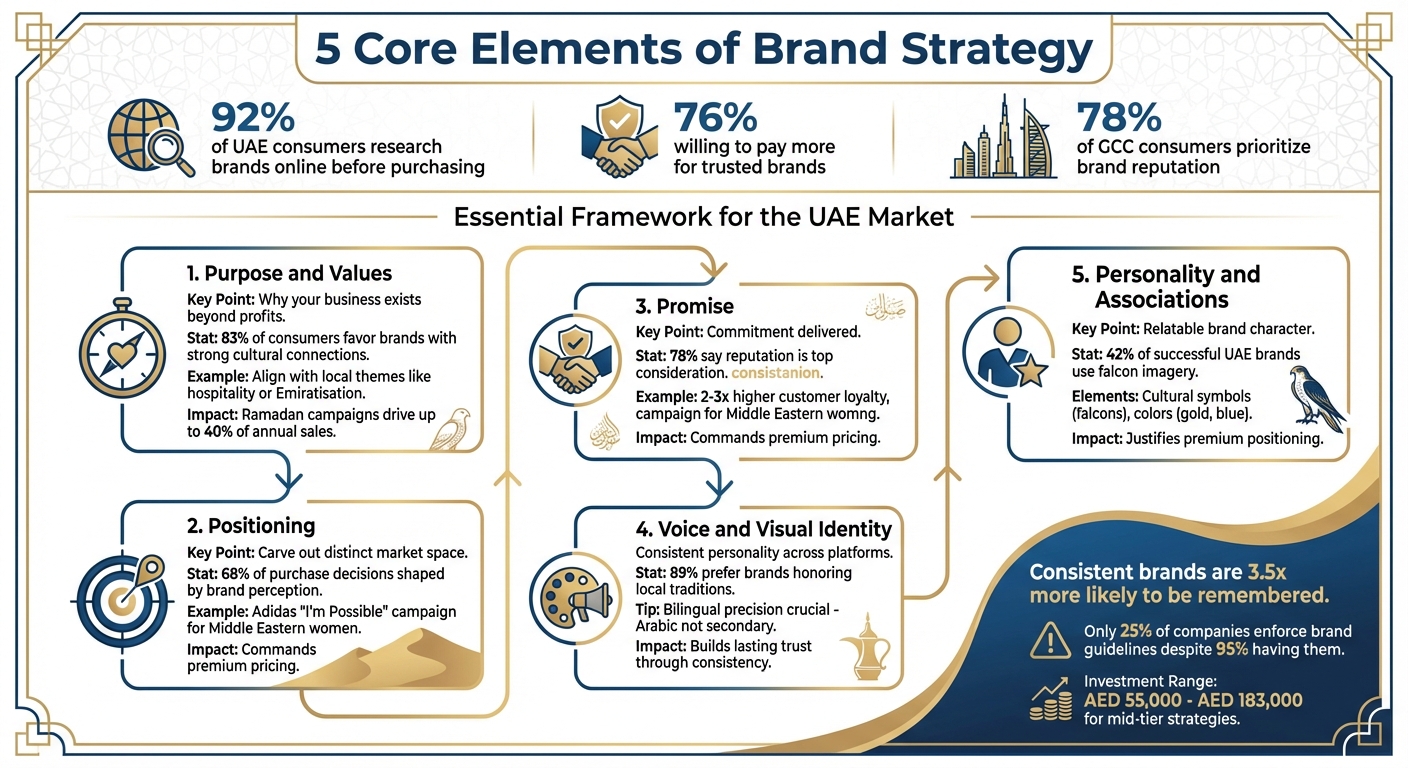
5 Core Elements of Brand Strategy in the UAE Market
1. Brand Purpose and Values
Your brand purpose answers a key question: Why does your business exist beyond just making money? In the UAE, a country where 83% of consumers favour brands with strong cultural connections, this “why” helps create authentic bonds across a diverse population of over 200 nationalities, while also respecting the essence of Emirati identity.
Take Careem as an example. By positioning itself as “the region’s own” ride-hailing service, it tapped into a purpose that resonated deeply with the local culture. This approach not only built trust but also helped the brand stand out in an intensely competitive market.
Your brand values, on the other hand, shape everything from customer interactions to the colours in your logo. In the UAE, a market that thrives on relationships, values like “Karam” (hospitality) – treating customers as family – or backing Emiratization efforts reflect alignment with national goals. These values reinforce your purpose, ensuring your brand feels relevant and genuine. For instance, Dubai Customs integrates its values of Leadership, Innovation, and Happiness into its services and daily operations.
Values also play a critical role in your brand’s visual identity and toolkit. Striking the right balance between tradition and modernity is essential. A financial services company might choose blue to convey trust and stability, while a luxury brand might lean on gold to evoke prestige and cultural sophistication. These decisions aren’t arbitrary – they’re strategic, especially since 89% of UAE consumers prefer brands that honour local traditions. This means your values should shine equally in both your Arabic and English branding, rather than being treated as secondary.
In a reputation-driven market like the UAE, a clear purpose and strong values inspire trust, especially during culturally significant times like Ramadan and Eid. For many businesses, campaigns during these periods can contribute to as much as 40% of their annual sales.
sbb-itb-6cae99a
2. Brand Positioning
Brand positioning is all about carving out a distinct space for your brand in the market and in the minds of your customers. It’s not just about being different – it’s about being meaningfully different in ways that truly connect with your audience. In the UAE, where 68% of purchase decisions are shaped by brand perception, positioning becomes a critical factor. It can determine whether your brand commands higher prices or fades into the background.
To succeed, your brand’s positioning needs to address gaps left by competitors while aligning with both Emirati traditions and the diverse expat community. A great example is Adidas. Instead of sticking to a global formula, they tapped into a local insight: a YouGov statistic revealed that 88% of Middle Eastern women felt sports were not for them. Adidas responded with their “I’m Possible” campaign, featuring real women from Dubai. This move positioned the brand as inclusive and culturally aware, rather than just another global sportswear company. Such clear positioning shapes every element of your brand messaging.
Your positioning also influences how your brand is perceived – whether it leans toward tradition or modernity. For instance, a financial services company might emphasise “trust and stability”, using colours like blue to evoke reliability. On the other hand, a tech startup might highlight “innovation and progress” to align with the UAE’s forward-thinking ambitions. Consistency is key here – 76% of UAE consumers are willing to pay more for well-branded products, but only when every interaction with the brand, from a bilingual logo to customer service, reinforces the same message.
“In the UAE, your brand isn’t what you say it is – it’s what the market believes it to be.”
- SK – Insights and Beyond
Another critical decision is whether to position your brand as local or international. While sectors like luxury and tech thrive on a global reputation, industries like F&B and services often see better results with a regional focus. Overlooking Arabic or local cultural elements can signal a lack of understanding of the market. A strong positioning strategy should naturally amplify your brand’s purpose, promise, and personality while remaining relevant to the local audience.
At Brand Husl, we specialise in helping brands navigate these challenges. By creating strategies that honour Emirati heritage while embracing the region’s modern vision, we ensure your brand stands out and stays relevant in this dynamic market.
3. Brand Promise
Your brand promise is the commitment that shapes every interaction with your customers. When you deliver on it, you earn loyalty; when you don’t, you risk losing trust. In the UAE, where 78% of GCC consumers say brand reputation is their top consideration when making a purchase, your promise isn’t just a statement – it’s the bedrock of trust.
In this region, trust is deeply tied to cultural alignment. A consistent digital presence that reflects your promise in both English and Arabic is critical. Many brands stumble here. If your promise feels secondary in Arabic, you’re unintentionally telling a significant portion of your audience that they matter less – a costly mistake in a market where cultural understanding is paramount.
“Frankly, a brand is a promise. And promises are meant to be kept.”
- SK – Insights and Beyond
Building trust in the UAE requires more than just clever marketing. It demands alignment with cultural values like hospitality and national goals, such as “We the UAE Vision 2031.” For example, if you promise exceptional service, this must be reflected everywhere – from your in-store staff to online customer support. Every touchpoint matters.
The best promises are specific, believable, and actionable. If you claim “fastest delivery”, your logistics must back it up, every single time. Brands that consistently keep their promises in the MENA region enjoy 2–3 times higher customer loyalty and can charge 20–30% more for their products or services. A promise kept isn’t just a nice-to-have – it sets your brand apart as the preferred choice, reinforcing your purpose and strengthening your position in the market.
4. Brand Voice and Visual Identity
Your brand voice and visual identity are the essence of your business’s personality. In the UAE, where first impressions matter deeply, a strong digital identity can set the tone for how your brand is perceived. While your purpose and promise shape your foundation, your visual and verbal identity bring that foundation to life, creating a lasting connection with your audience. For this to happen, your identity must consistently reflect your brand’s promise and positioning, fostering trust over time.
Visual identity goes far beyond just a logo. It includes your colour palette, typography, imagery style, and how these elements come together across every platform – from your website to your business cards. In the UAE, 83% of consumers favour brands that resonate with local culture, making it essential for your visual elements to appeal to both local and global audiences. For instance, gold and sand tones can evoke luxury and heritage, while blue conveys trust. Green, often symbolising prosperity, should be used thoughtfully to avoid overuse.
When it comes to bilingual typography, precision is key. Arabic text typically needs to be set 1–2 pixels larger than its English counterpart for balanced readability. Pair typefaces that complement each other visually, such as Dubai Font with Montserrat or Noto Sans Arabic with Inter. Avoid relying on automated right-to-left tools for Arabic layouts, as they can lead to errors. Always have a native Arabic designer review your materials – overlooking this step can make Arabic-speaking customers feel like an afterthought.
Your brand voice is just as important as your visuals. It’s the consistent personality your brand conveys, whether it’s professional and formal or approachable and warm. While your tone might adapt to different situations – celebratory for achievements, empathetic for challenges – your voice should remain steady. In the UAE, a formal and respectful tone works well in B2B contexts, whereas a more personal and friendly approach can resonate in B2C. Additionally, 89% of UAE consumers value brands that honour local traditions and Islamic values. Aligning your messaging with cultural milestones like Ramadan and Eid is not just respectful but also impactful, as these periods can drive up to 40% of annual sales.
Every interaction with your brand, whether digital or physical, should reflect a unified visual and verbal identity. In the UAE, where physical elements like signage and office spaces still hold significant weight in building trust, your offline presence must align seamlessly with your online identity. A single inconsistency – be it a mismatched colour, an outdated logo, or an off-brand tone – can undermine the trust you’ve worked hard to cultivate.
At Brand Husl, we integrate these principles into every aspect of a brand’s identity. By ensuring that your visual and verbal elements work together harmoniously, we help create a consistent brand personality that resonates deeply and builds meaningful connections.
5. Brand Personality and Associations
Your brand personality is essentially the character your business embodies – whether that’s bold and cutting-edge, warm and welcoming, or elegant and refined. In the UAE’s diverse market, where 78% of GCC consumers consider brand reputation their top purchasing factor, crafting a relatable and genuine personality is a must, not a choice.
The UAE presents a unique challenge: balancing its rich heritage with modern innovation. Your brand needs to resonate with over 200 nationalities while staying true to Emirati values. Take Emirates NBD as an example – they merge traditional Emirati principles with advanced digital banking solutions, creating a personality that appeals to both local and global audiences. This mix of tradition and progressiveness fosters strong connections, which we’ll dive into further.
Symbols rooted in culture play a massive role in building brand associations. For instance, falcon imagery is featured in 42% of successful UAE brands, symbolising heritage, strength, and prestige. Similarly, your colour choices matter: gold reflects luxury and tradition, blue conveys trust and reliability, and black exudes sophistication and authority. These visual cues go beyond aesthetics – they embody your brand’s essence and communicate effectively in a bilingual market.
“In the UAE, your brand isn’t what you say it is – it’s what the market believes it to be. What will they believe about you?” – Priscilla, Carril Agency
Consistency is key to sustaining these associations. With 92% of MENA consumers researching brands online before buying, your digital presence is often the first impression. A single inconsistency – like a poorly translated Arabic message or mismatched branding on your website – can weaken the personality you’ve built. And while 76% of UAE consumers are willing to pay premium prices for strong brands, they expect your execution to match the quality you promise.
Need help aligning your brand with local expectations? Contact Brand Husl for expert advice on navigating the UAE’s cultural landscape.
Conclusion
Building a successful brand strategy isn’t just a checklist – it’s about bringing everything together seamlessly. Your brand purpose should drive your positioning, which then shapes your promise, voice, visual identity, and personality. When these elements align, you create something that stands out: a brand that connects with people, earns trust, and justifies higher pricing. Without this unity, the entire foundation of your brand can falter.
Research shows that consistent brands are 3.5 times more likely to stick in consumers’ minds. They can also charge 20-30% more than generic competitors. In the UAE, where 68% of buying decisions hinge on brand perception, this level of integration is a necessity, not a luxury. However, despite 95% of companies having brand guidelines, only 25% enforce them, leading to inconsistencies that weaken trust and confuse customers. These numbers highlight the importance of ensuring you build a strong brand identity where every element works harmoniously.
“A brand without strategy is just decoration. A brand with strategy is a competitive advantage.” – BrandingStudio.ai
Operating in the UAE brings unique challenges. With over 200 nationalities, a blend of Emirati values, bilingual communications, and cultural sensitivities, even small missteps can have big consequences. A single misaligned Arabic translation or culturally inappropriate design can undo months of work. Mid-tier agency strategies in the UAE cost between AED 55,000 and AED 183,000, typically requiring 3–6 months to complete. Yet the investment pays off when 76% of UAE consumers willingly pay more for brands they trust.
This is where professional expertise becomes invaluable. Brand Husl offers tailored solutions to navigate these complexities, providing brand audits, strategy development, and implementation across every touchpoint – from digital platforms to physical packaging. Their deep understanding of the UAE market ensures your brand not only looks polished but also resonates with local audiences. For businesses launching new ventures or refining their identity, expert guidance turns your brand’s core elements into a cohesive and competitive force.
FAQs
How do I define my brand purpose for the UAE market?
When shaping your brand purpose for the UAE market, it’s essential to align with the region’s rich heritage and consumer preferences. Incorporate local traditions into your branding – elements like Arabic calligraphy, gold accents, and iconic motifs such as palm trees or falcons resonate deeply with the culture.
Bilingual communication is a must. Make sure your messaging is available in both Arabic and English to connect with a diverse audience. Additionally, reflecting Islamic values in your approach can help establish trust and respect within the community.
Given the UAE’s reputation for luxury and diversity, your brand should respect traditional values while delivering a sense of sophistication. By tailoring your purpose to the UAE’s distinct identity, you can create a connection that feels both genuine and relevant.
How can I position my brand against local and global players in the UAE?
In the UAE’s bustling and competitive market, crafting a brand strategy that resonates locally is key. To connect with the audience effectively, prioritise bilingual communication in both Arabic and English, reflecting the region’s linguistic diversity. Incorporate Islamic values thoughtfully, as they play a significant role in shaping consumer preferences, alongside a focus on luxury and premium quality, which align with the aspirations of many in the UAE.
To stand out, highlight what makes your brand special. Whether it’s local authenticity or a commitment to exceptional quality, ensure your message is clear and appealing. Consistency is equally important – your brand experience should feel seamless across all touchpoints, from digital platforms to physical stores. Everything should align with your brand’s purpose, vision, and values.
For businesses looking to refine their approach, working with experts like Brand Husl can provide the tailored insights and strategies needed to thrive in the UAE market.
How do I keep my Arabic and English branding consistent across all touchpoints?
Creating a bilingual brand identity that works seamlessly in both Arabic and English requires careful planning and attention to detail. It’s not just about translating words; it’s about respecting cultural nuances while maintaining visual harmony across both languages.
Start by defining your brand purpose, values, and positioning clearly in both Arabic and English. Make sure these align with the local culture and sensitivities, ensuring that your brand resonates with audiences in the UAE.
When it comes to visuals, focus on elements that can bridge the gap between the two languages:
- Colour palettes: Choose complementary colours that appeal to both Arabic and English-speaking audiences, while reflecting your brand’s personality.
- Typography: Select fonts that work well in both Arabic and English. Arabic script and Latin characters often have different design needs, so look for typefaces that visually complement each other.
- Imagery: Use visuals that are culturally appropriate and relatable for the region, ensuring they connect with both language groups.
Lastly, ensure your designs are functional for both RTL (right-to-left) and LTR (left-to-right) formats. This is especially important for websites, apps, and printed materials to ensure a smooth user experience across platforms. By balancing these elements, you can create a brand identity that feels unified and inclusive.
Related Blog Posts

BRAND HUSL
We’re a collective of brand strategists, designers, and unapologetic truth-tellers who’ve spent over two decades turning chaos into clarity for businesses across the globe. From global names to fearless startups, we’ve built brands that stick, scale, and sell—without the fluff. Everything we create is rooted in strategy, storytelling, and ROI, because good branding isn’t just pretty—it’s powerful.