

Brand strategy is the blueprint for consistency that defines how your business is perceived. It goes beyond logos and design to include your purpose, voice, messaging, and market positioning. In the UAE, where markets like Dubai and Abu Dhabi are bustling with competition, a solid brand strategy is essential for standing out. Research shows over 80% of consumers require trust in a brand before purchasing, making a clear and consistent strategy crucial for success.
Key elements of a brand strategy:
- Purpose: Why your business exists beyond profit.
- Vision & Mission: Long-term goals and steps to achieve them.
- Target Audience: Who your customers are and what drives them.
- Positioning: What sets you apart from competitors.
- Values: Principles guiding decisions and actions.
- Messaging: Your brand’s voice, tone, and communication style.
Brand Husl helps UAE businesses transform these elements into impactful identities. From conducting research to creating visual and verbal branding, they ensure consistency across all touchpoints. Their work blends modern practices with local insights, as seen in projects like the Al Falah community and Dubai Financial Services Authority (DFSA) rebranding.
Why it matters: Consistent branding can boost revenue by 10–20%, while clear purpose and trust can increase customer loyalty. Brand Husl’s expertise ensures your business connects with the UAE’s diverse audience while maintaining professionalism across platforms. You can even use a brand consistency checker to evaluate your current standing.
What Is Brand Strategy?
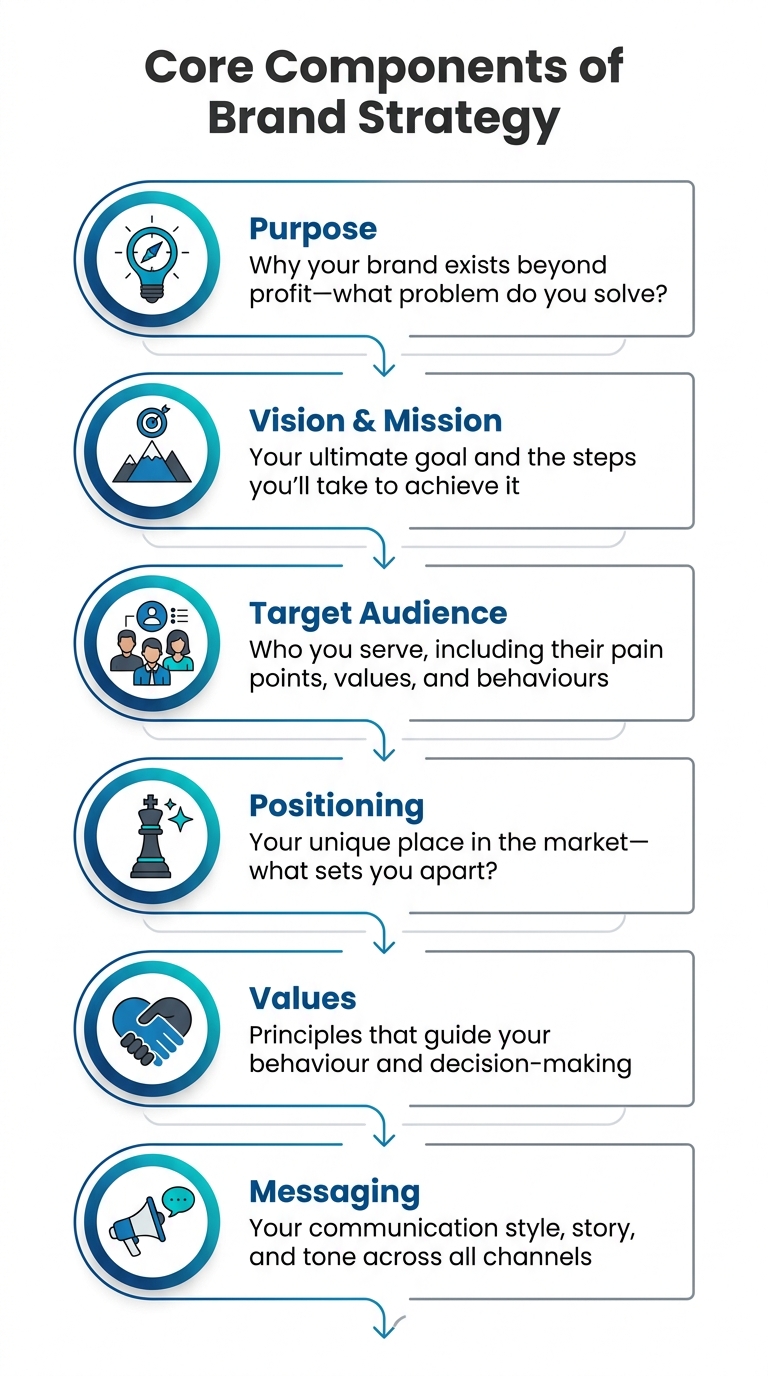
6 Core Components of Brand Strategy Framework
Brand strategy is your business’s long-term game plan – it defines your purpose, guides your operations, and pinpoints your audience. Think of it as the playbook that lays out your values and goals before you even think about logos or colours.
This strategy is the backbone of every decision your business makes. It’s what helps you carve out a space in a crowded market and gives customers a reason to choose you over the competition. Without it, even the flashiest branding efforts risk falling flat.
“A brand strategy connects the heartbeat of your business to the needs of your audience to ultimately reach your business goals.” – Haley Batucan, Brand Strategist and Designer, Selah Creative Co.
A well-crafted strategy doesn’t just look good on paper – it delivers financial benefits. It can justify premium pricing by creating perceived value, lower customer acquisition costs by enhancing brand recognition, and help businesses navigate tough market conditions. For instance, research shows that consistent branding across all platforms can boost revenue by 10% to 20%, a game-changer for businesses aiming to scale. This is the kind of impact Brand Husl focuses on when developing strategies that yield measurable outcomes.
Core Components of Brand Strategy
To create an effective brand strategy, you need to focus on several interconnected elements that work together seamlessly. Let’s break them down:
- Purpose: Why does your business exist beyond making money? What problem are you solving for your customers?
- Vision: What does success look like for your business in the long run?
- Mission: What specific steps will you take to achieve that vision?
- Target Audience: Who are your customers, and what drives them? Go beyond demographics – understand their challenges, values, and behaviours.
- Positioning: How does your business stand out from the competition? What makes you distinct in the marketplace?
- Values: These are the guiding principles that shape your decisions and actions, from customer interactions to partnerships.
- Messaging: This includes your brand’s voice, tone, and the way you communicate your story across all platforms.
Here’s a quick overview of these components:
| Component | Definition |
|---|---|
| Purpose | Why your brand exists beyond profit – what problem do you solve? |
| Vision & Mission | Your ultimate goal and the steps you’ll take to achieve it |
| Target Audience | Who you serve, including their pain points, values, and behaviours |
| Positioning | Your unique place in the market – what sets you apart? |
| Values | Principles that guide your behaviour and decision-making |
| Messaging | Your communication style, story, and tone across all channels |
Mastering these elements ensures your strategy is solid, laying the groundwork for the next phase – bringing it to life visually.
Strategy vs. Identity: Understanding the Difference
Your brand strategy outlines the internal framework, while your brand identity is how you express it to the world. Once your strategy is clear, it’s time to translate it into visual and verbal elements.
“Brand identity captures the meaning intent of the firm.” – Jill Avery, Professor, Harvard Business School
In simple terms, your strategy defines what you stand for and who you’re talking to. Your identity, on the other hand, determines how you look and sound while delivering that message. Here’s a great example: In 2022, United Airlines launched the “Good Leads The Way” campaign as part of a broader brand identity refresh. By 2024, the airline saw premium revenue grow by 10% and corporate revenue rise by 7% year-over-year.
The lesson here? A strong identity must be rooted in a solid strategy. Without that foundation, your visual and verbal branding can feel scattered. But when strategy and identity work hand-in-hand, they create a consistent message across every touchpoint – whether it’s your website, packaging, or face-to-face interactions.
sbb-itb-6cae99a
How to Develop a Brand Strategy
Creating a brand strategy takes careful research and a clear understanding of your goals. For businesses in the UAE, this means balancing your internal vision with the unique dynamics of a market where 80% to 90% of the population consists of expatriates, while the Emirati community holds strong cultural and economic influence.
Start by defining your brand’s purpose and mission. In competitive hubs like Dubai and Abu Dhabi, a well-defined purpose helps you stand out. From there, pinpoint your target audience. Go beyond basic demographics – dig into their behaviours, challenges, and values. For example, are you appealing to health-conscious individuals in the growing wellness industry, or tech-savvy professionals in the UAE’s thriving startup ecosystem?
Next, turn your attention to the competition. Understanding your competitors is essential, especially in sectors like tourism and hospitality, where the UAE attracts millions of visitors each year. Conduct market research to identify what others are doing and uncover opportunities they may have missed. Tools like brand perception analysis and competitive benchmarking can help you carve out a distinct position in the market.
With your research in hand, it’s time to build a strong brand identity. These pillars – such as Purpose, Perception, Personality, Positioning, and Promotion – form the backbone of your brand identity. Test these elements through surveys, A/B testing, and social media analytics, then fine-tune them based on the feedback you gather. Once your pillars are solid, establish brand guidelines to ensure consistency. These guidelines should cover everything from your tone of voice (whether professional, casual, or technical) to your visual identity (logos, colours, and fonts) and messaging across platforms like websites, emails, and even packaging.
For businesses in the UAE, building trust is non-negotiable. Consider registering with a Free Trade Zone like UAQ FTZ to enjoy benefits like 100% ownership and tax exemptions, which can enhance your credibility. When showcasing your work, focus on quality over quantity. Highlighting four to five standout projects with detailed case studies will leave a stronger impression than a long list of average efforts. Keep in mind that the UAE is a relationship-driven market where trust and long-term connections carry more weight than quick, transactional exchanges.
Step 1: Discovery and Research
Every great brand strategy begins with solid discovery and research – it’s what eliminates the guesswork. Before shaping your brand’s purpose or designing its visual identity, you need to dig deep into your market, understand your competitors, and uncover what truly matters to your customers.
Start by setting clear research goals. What are you trying to uncover? For instance, are you figuring out why customers prefer one hospitality brand over another in Dubai’s bustling market? Or are you exploring why tech professionals in Abu Dhabi gravitate toward specific fintech platforms? Without clear objectives, you might end up with data that looks impressive but doesn’t actually help. Interestingly, firms that conduct regular, structured research – at least quarterly – often see higher growth compared to those that don’t. This kind of research becomes the backbone of every branding decision you’ll make.
Competitive analysis is a goldmine for UAE businesses. For example, a study showed that positioning based on thorough research could increase website conversions by 400% and drive a 50% jump in organic search traffic (Source: Hinge Marketing, 2024).
To gather meaningful insights, use a mix of research tools. Interviews and focus groups reveal the emotional reasons behind customer decisions, which is especially important in the UAE, where relationships and trust play a huge role. Surveys, on the other hand, provide hard data about customer preferences and behaviours. CRM tools like Salesforce can help you track detailed customer profiles, while social listening tools let you monitor brand sentiment across platforms. Here’s an eye-opener: 79% of consumers are more likely to buy from brands that share their values. So, it’s not just about knowing what your customers want – it’s about understanding why they want it. These insights lay the groundwork for defining your brand’s core identity.
Step 2: Define Your Brand Foundations
After gathering insights from your research, the next step is to establish the core pillars of your brand: purpose, vision, mission, and values. Think of these as the DNA of your business – guiding every decision, strategy, and message. These elements form the framework that ensures consistency and alignment across all aspects of your brand.
Your brand purpose answers the question: “Why does our business exist beyond making a profit?” It’s about identifying the unique role your company plays in the world. For businesses in the UAE, this means balancing tradition with forward-thinking innovation – honouring the region’s rich heritage while embracing modern progress. Here’s a striking figure: consumers are 400–600% more likely to buy from businesses with a clear sense of purpose. Additionally, 83% of CEOs have either established or are actively working on defining their brand purpose, with 73% stating it heavily influences their strategic decisions.
Your vision outlines where you want to go in the long run, while your mission describes the steps you’ll take to get there. Values, on the other hand, guide how your business interacts with employees, customers, and the community. In the UAE, values like trust, respect, and patience are essential, reflecting the relationship-focused nature of business in the region. A “people-first” approach resonates deeply, mirroring the hospitality ingrained in local culture.
To refine these foundations, ask questions like, “What impact does our work have on the community?” and “What sets us apart?” Once defined, integrate your purpose into every aspect of your operations – corporate culture, employee training, and customer interactions. For example, when establishing values, consider your target audience. Emirati nationals, Western expats, and South Asian communities each bring unique cultural expectations, so tailor your approach accordingly. Timing is also crucial – avoid launching major campaigns during Ramadan, and instead, align with themes of spirituality and togetherness, using culturally significant colours like green, white, and gold.
Regularly review your business model and marketing materials to ensure they continue to reflect your core purpose. A mismatch between your brand foundations and audience expectations can damage trust. Keep in mind that 63% of consumers are willing to pay more for brands they trust, and 62% consider a brand’s ethics when making purchasing decisions.
Once these foundations are in place, you’re ready to build a strong and cohesive brand identity in the next phase.
Step 3: Turn Strategy Into Brand Identity
Once you’ve nailed down your core brand foundations, it’s time to turn that strategy into a clear and recognisable identity. This step is about transforming abstract ideas into visual and verbal elements that people can connect with. In essence, you’re giving your brand a face, a voice, and a personality that customers can instantly identify and remember. This includes everything from logos and colours to typography and tone of voice.
Let’s start with the visual identity. Your logo, colour palette, and font choices are more than just design elements – they’re the first impression your brand makes. And first impressions matter. In fact, 94% of first impressions are influenced by design, and you only have around seven seconds to capture attention. Every design choice should reflect your brand’s mission and values. For instance, if trust and dependability are at the heart of your brand, you might lean towards blue tones (associated with trust) and classic serif fonts that exude professionalism. On the other hand, if sustainability is your focus, green hues and organic shapes can visually reinforce that commitment. This isn’t just guesswork – colour psychology helps align what people see with what you want them to feel.
Typography is another key element of your visual identity. Choose two or three fonts that reflect your brand’s personality and work well across different platforms and sizes. For example, a luxury brand might go for refined serif fonts, while a tech startup might pick clean, modern sans-serif options. To get everyone on the same page, consider creating mood boards using tools like Pinterest or Behance. These boards help align your team on the overall aesthetic direction before finalising designs. Remember, your verbal identity should complement these visual elements to create a cohesive brand experience.
Speaking of verbal identity, it’s just as crucial as the visuals. Your tone of voice defines how your brand communicates at every touchpoint, from social media captions to customer service emails. In a market like the UAE, it’s essential to use language that resonates with local cultural nuances while staying true to your brand’s essence. Avoid overwhelming your team with a long list of traits like “bold, friendly, trusted, insightful.” Instead, focus on two or three clear principles that guide your brand’s voice. For example, “We are reliable and trustworthy, but never boring” provides clarity without overcomplicating things.
Finally, consistency is key. A cohesive brand identity across all platforms – your website, social media, packaging, and even signage – can boost revenue by 10% to 20%. To maintain this consistency, develop a detailed style guide. This document should outline your visual standards, tone of voice, and buyer personas, ensuring everyone stays aligned as your brand grows. A strong style guide prevents mixed messages and keeps your brand identity clear and unified.
How Brand Husl Supports Your Brand Strategy
Crafting a brand strategy is one thing – bringing it to life is another challenge altogether. That’s where Brand Husl steps in. With a deep understanding of the UAE market and expertise across various sectors, they create brands that resonate locally while embracing modern design principles. Their work blends cultural inspiration with forward-thinking innovation, ensuring your brand feels rooted in tradition yet prepared for the future.
Take the Al Falah project as an example. In October 2013, Brand Husl developed a technical master plan and executive summary for the Al Falah community development in Abu Dhabi. Drawing inspiration from Al Sadu, an Arabian weaving tradition, they created a design that celebrated local heritage. Arian Hashemi, Founder of Brand Husl, explained:
“The inspiration came from the indigenous weavings of Arabia called Al Sadu… We interpreted the patterns to create a publication that visually bridged the gap between the heritage of Al Sadu and the public realm.”
This project was presented to the Royal Family of Abu Dhabi and went on to win a Silver Lynx Award in the Publications category at the Dubai Lynx awards in February 2013. It’s a powerful example of how Brand Husl transforms strategies into impactful, award-winning outcomes.
Here’s a closer look at how Brand Husl executes its strategic brand development process.
Brand Identity Development
Brand Husl creates comprehensive brand systems that bring clarity and consistency to every touchpoint. Their process begins with brand audits and strategy development, followed by identity design and implementation. Whether it’s signage, packaging, promotional materials, or digital platforms, they ensure every element reflects the brand’s core identity.
For example, their work with the Dubai Financial Services Authority (DFSA) involved updating the brand identity to align with its modern role while maintaining its authority within the Dubai International Financial Centre. By building on a strong identity framework, Brand Husl ensures your brand stays cohesive and recognisable.
Branding Solutions Inspired by Local Heritage
One of the standout aspects of Brand Husl’s work is their ability to merge traditional Arabian heritage with modern design. Their philosophy, “looking forward by looking back”, allows them to create designs that feel both fresh and culturally grounded.
A great example is their rebranding of ADCOOP (Abu Dhabi Co-operative Society). Under the theme “Legacy Meets Innovation”, Brand Husl modernised the brand’s identity while preserving its community roots. As Hashemi explains:
“Design can do that. It can rewrite the story.”
This approach is especially impactful for UAE businesses with long-standing histories, enabling them to honour their heritage while preparing for future growth.
Digital and Print Integration
Brand Husl ensures that your brand’s identity is consistent across every platform, whether it’s a mobile screen, a printed brochure, or a physical storefront. By creating detailed Look & Feel guidelines, they guarantee uniformity in colour codes (CMYK for print, HEX/RGB for digital), typography, and tone of voice. This attention to detail is crucial, especially when 76% of consumers check a brand’s online presence before engaging further.
Their full-service approach – spanning strategy, design, and implementation – ensures a seamless transition from concept to execution. With Brand Husl, every element of your brand is aligned, making sure nothing gets lost in the process.
Maintaining Brand Consistency Across Touchpoints
Having a strong brand identity is just the first step; ensuring that identity remains consistent across every platform and interaction is what keeps your brand impactful. Research shows that 90% of potential customers expect a consistent brand experience across all touchpoints [1]. If your website conveys one message but your social media or physical stores tell a different story, trust can quickly erode. Consistency isn’t just about aesthetics – it’s a smart business move that can boost revenue by 33% [1]. These principles serve as the foundation for embedding your brand strategy into every customer experience.
Using Brand Guidelines
Brand guidelines are essentially your brand’s playbook. They cover everything from logo placement and spacing to colour codes (HEX for digital, CMYK for print) and typography rules. Without these guidelines, teams are left guessing, which leads to inconsistencies. A well-documented guide clarifies how your logo should appear on various backgrounds, specifies the fonts for headings and body text, and establishes your brand’s tone in written communications.
For example, Brand Husl provides Look & Feel guidelines that consolidate all brand assets in one easy-to-access location. This ensures that whether it’s your marketing team in Dubai, your sales team in Abu Dhabi, or external collaborators, everyone works from the same blueprint. Having approved logo files, colour palettes, and messaging frameworks readily available eliminates room for error. As Jon Holbrook, Product Marketing Manager at Mailchimp, puts it:
“When you communicate your brand message consistently, your marketing is more persuasive and credible, which drives business results.”
When your internal teams are aligned, your brand can adapt and evolve while staying true to its core identity.
Scaling Your Brand Over Time
As your business grows, your brand needs to keep up – but it must do so without losing its recognisability. For instance, sticking to a signature brand colour can increase brand recognition by 80% [1]. Whether you’re updating messaging or introducing new products, maintaining your core visual identity is key. Flexible brand guidelines allow you to innovate while preserving your foundation. Regularly revisiting and refining these guidelines ensures your brand stays consistent, even as you expand into new markets or launch fresh offerings.
Conclusion
In the UAE’s competitive marketplace, having a strong brand strategy is not just an option – it’s the cornerstone of sustained success. With 99% of the population active on social media, businesses in the region need much more than just a logo. They require a well-rounded approach that aligns international standards with local cultural values. As the saying goes: “In the UAE, your brand is your reputation.” – myNZTE.
Brand Husl rises to this challenge by combining modern branding and typography techniques with a deep understanding of Emirati heritage. The UAE’s diverse and multicultural environment calls for brands that seamlessly blend global trends with local traditions. This involves thoughtful cultural adaptation that respects local values while maintaining professional excellence.
Their services encompass strategy, design, and integrated execution across digital and print platforms. With their in-depth local knowledge, Brand Husl ensures that brands not only appear polished but also connect meaningfully with the UAE audience. By incorporating Arabic elements to honour cultural roots or aligning with the nation’s focus on trust and long-term relationships, they create brands that genuinely resonate within the market.
[1] RAG Doc 1
FAQs
How do I know if my business needs a brand strategy?
If your business finds it challenging to clearly express its identity, engage with its audience, or differentiate itself in a crowded market, it might be time to rethink your brand strategy. A well-defined approach lays out your brand’s purpose, values, and messaging, ensuring everything stays consistent across all platforms and interactions. This becomes even more critical when stepping into new markets or scaling up, as it plays a key role in building recognition, fostering loyalty, and driving long-term growth.
What’s the difference between brand strategy and brand identity?
A brand strategy is a long-term roadmap that outlines how a business positions itself in the market. It focuses on aspects like communication, connecting with the audience, and achieving specific goals. Think of it as an internal compass that guides decision-making across the organisation.
On the other hand, brand identity is what the world sees. It’s the external face of the brand, encompassing visual elements like logos, colours, and design. These components work together to reflect the brand’s personality and values to its audience.
How long does a brand strategy and identity project take in the UAE?
A brand strategy and identity project in the UAE typically spans 4 to 6 months. This timeframe covers essential steps like research, strategy development, identity design, and the creation of brand guidelines along with launch assets.
To see measurable growth in brand awareness, you might need to invest an additional 6 to 12 months, as building traction takes consistent effort and time.
Related Blog Posts

BRAND HUSL
We’re a collective of brand strategists, designers, and unapologetic truth-tellers who’ve spent over two decades turning chaos into clarity for businesses across the globe. From global names to fearless startups, we’ve built brands that stick, scale, and sell—without the fluff. Everything we create is rooted in strategy, storytelling, and ROI, because good branding isn’t just pretty—it’s powerful.