

A consistent brand voice across all touchpoints is essential for building trust, driving revenue, and improving customer loyalty. In the UAE, where consumers interact in both Arabic and English across multiple channels, maintaining this consistency can significantly enhance customer experience and business performance. Here’s why it matters:
- Revenue Growth: Brands with consistent messaging can see up to a 23% increase in revenue, with 32% reporting a 20% rise.
- Trust and Loyalty: 81% of customers prioritize trust before purchasing, and 88% of loyal customers return for repeat purchases.
- Higher Conversions: Using three or more unified channels leads to a 287% higher conversion rate.
- Customer Journey: Shoppers in the UAE often engage with 3–5 channels before buying, making consistent messaging critical for seamless interactions.
Key Challenges:
- Teams working in silos often create inconsistent communication styles.
- Many companies fail to follow their own brand guidelines.
- Translating brand voice between English and Arabic requires careful adaptation to avoid alienating audiences.
Solutions:
- Appoint "Brand Voice Champions" to oversee consistency across departments.
- Use detailed style guides with bilingual guidelines and tone matrices for clarity.
- Leverage AI tools alongside human oversight to ensure messaging aligns with the brand’s personality.
Consistency in brand voice is not just about marketing – it’s about delivering a unified experience across every touchpoint, from social media to physical stores. This approach builds trust, enhances recognition, and ensures long-term business success.
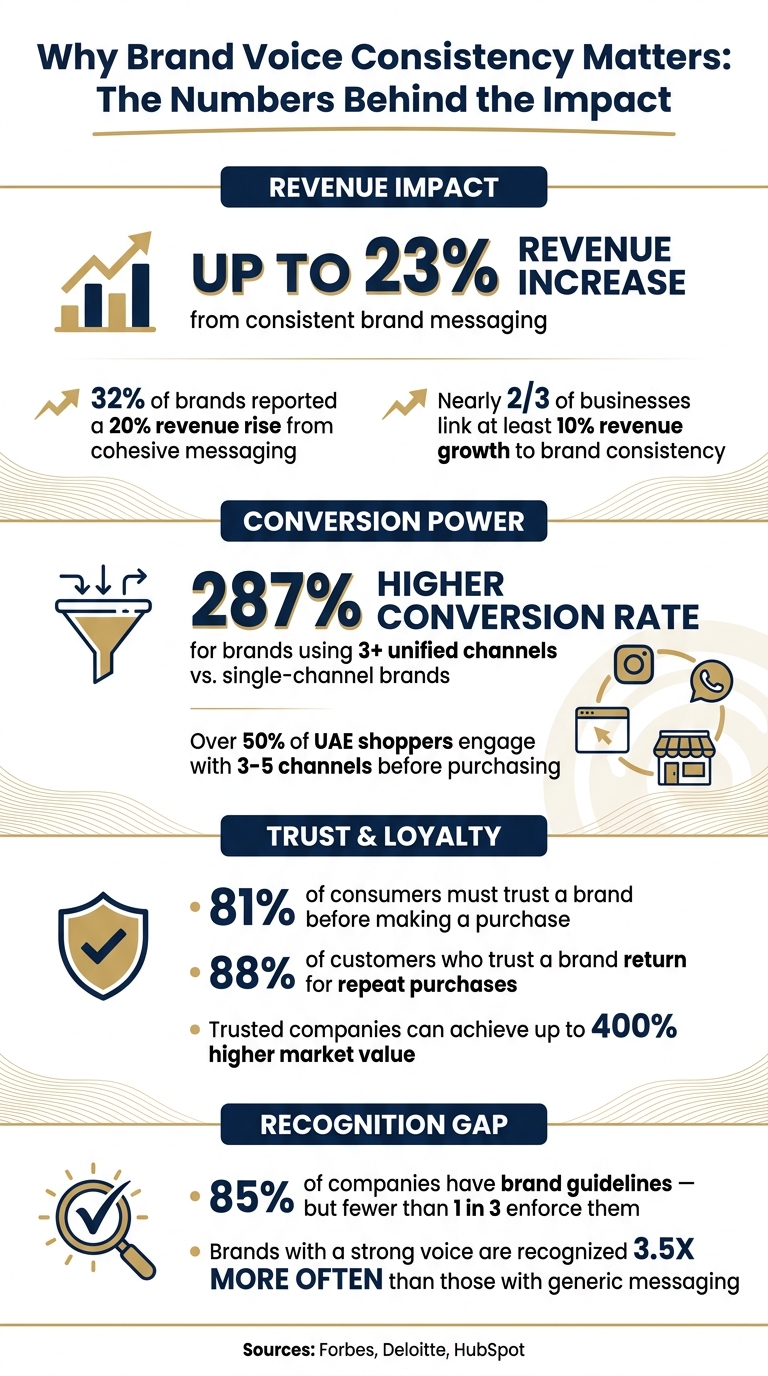
Brand Voice Consistency: Key Stats That Drive Revenue & Trust
How Brand Voice Shapes Cross-Channel Performance
Revenue and Conversion Impact
Sticking to a consistent brand voice can lead to impressive revenue growth. Studies reveal that maintaining uniform branding across platforms can boost revenue by up to 23%, with nearly two-thirds of businesses linking at least a 10% rise in revenue to consistency. Even more striking, 32% of brands reported a 20% revenue increase as a direct result of cohesive messaging, according to Forbes.
Conversion rates tell a similar story. Brands that use three or more marketing channels with a unified voice see a whopping 287% higher conversion rate compared to those sticking to a single channel. Think of every touchpoint – whether it’s a WhatsApp follow-up, an Instagram ad, or an in-store conversation – as a building block. When the messaging aligns across all these interactions, the value multiplies. These statistics highlight the financial rewards of building trust and recognition through consistent communication.
Trust, Recognition, and Loyalty
Trust is non-negotiable in the UAE market. A striking 81% of consumers say they need to trust a brand before making a purchase. Once that trust is earned, the benefits are clear: 88% of customers who trust a brand will return to buy again, according to Deloitte.
In a bilingual market like the UAE, consistency between English and Arabic messaging is especially critical. A brand that sounds polished and professional in English but awkward or mismatched in Arabic risks alienating its audience. This disconnect can signal a lack of attention to the local market, driving customers toward brands that feel more cohesive and reliable. This requires a structured approach to build a strong brand identity in the UAE that resonates across cultures.
"Inconsistency sends mixed signals, and mixed signals kill trust." – Jon Boles, Founder & CEO, AVINTIV
The rewards of trust go beyond loyalty. Trusted companies consistently outperform their competitors, with studies showing they can achieve up to 400% higher market value. This underscores how much brand perception can influence long-term success.
Omnichannel Effects and Touchpoint Interaction
A unified brand voice doesn’t just drive revenue and trust – it also enhances every customer interaction across multiple channels. In the UAE, customer journeys are rarely linear. A shopper might first encounter a brand on Instagram, research it online, visit a physical store, and then complete the purchase through an e-commerce app. Each of these touchpoints is both an opportunity to engage and a potential point of failure.
"A strong, consistent brand voice isn’t just a nice-to-have – it’s the key to building deep customer connections and powering an effective omnichannel messaging strategy." – Fluentco
Over 50% of shoppers engage with three to five channels before making a purchase. This makes brand recall and recognition the glue that holds the entire journey together. When messaging stays consistent across all these touchpoints, it not only improves the customer experience but also boosts the chances of conversion at the final step.
sbb-itb-6cae99a
Common Barriers to Maintaining a Consistent Brand Voice
Even with the clear benefits of a strong brand voice, many companies struggle to maintain consistency. Surprisingly, while 85% of companies have brand guidelines in place, fewer than one-third actually stick to them. This gap between planning and execution often leads to a diluted brand identity.
Segmented Teams and Fragmented Processes
When marketing, sales, and customer service teams operate independently, their communication styles can vary widely. For example, marketing might use polished language in social media ads, sales could lean towards formal tones in emails, and customer service might adopt a casual approach in live chats. These differences often arise because each team prioritises speed and their own goals over a unified voice.
To address this, companies can introduce more structure. Appointing Brand Voice Champions – team members responsible for ensuring consistent voice application within their departments – can help align messaging. Additionally, establishing a cross-functional brand council to regularly review content and flag inconsistencies ensures everyone stays on the same page. Research shows that companies with a strong, clear brand voice are recognised by customers 3.5 times more often than those with generic messaging.
Missing Documentation and Guidelines
Vague descriptors like "friendly" or "modern" are not enough to guide teams. Clear examples and detailed instructions are essential. Laura M. Browning, Editor of the Masters in Marketing newsletter at HubSpot, highlights the importance of specificity:
"If the brand voice is ‘friendly, helpful, and kind,’ I’ll start with ‘friendly’ and just make a list. Does it mean more exclamation points? Does it mean using ‘hey’ instead of ‘hi’ or ‘hello’?"
For brands in the UAE, this becomes even more complex. Operating in a bilingual English-Arabic environment requires not just translation but a thoughtful adaptation of the brand’s personality to both languages. A tone matrix – outlining how the voice should adapt across scenarios like promotional campaigns or customer complaints – can provide clarity. This ensures every team member knows how to communicate effectively, whether in English or Arabic. Proper documentation also complements technological tools, creating a structured brand blueprint for consistent messaging.
Using Technology and AI to Support Consistency
AI tools have revolutionised content creation, but they also come with risks. Without clear guidelines, AI-generated content can feel generic, undermining the brand’s unique identity. The key is not to avoid AI but to manage it wisely.
Tools like Writer can enforce terminology rules, while Grammarly helps identify tone mismatches. However, technology alone isn’t enough. As content strategist Nathan Thompson explains:
"We load those tweaks in and we load that guide in and those best practices, and we make it part of our workflow, and then we build a little editor that says, Hey, is this LLM friendly or not? If it’s not, it helps rewrite it human in the loop, reviews it to make sure it’s still readable and digestible."
This "human-in-the-loop" approach is particularly important in the UAE, where cultural considerations – such as religious sensitivities, idiomatic expressions, and the balance between formal and informal Arabic – require human oversight. Technology can assist, but human judgement ensures the content remains authentic and appropriate.
Maintaining Brand Voice Across Different Channels
Defining your brand voice is one thing; ensuring it stays consistent across every customer interaction is a whole different challenge. Research shows that using three or more channels can lead to a staggering 287% higher conversion rate [1]. Whether it’s online, through social media, or in physical spaces, maintaining a unified tone strengthens your brand’s impact.
Digital Channels: Websites, Apps, and Email
With the UAE boasting one of the highest mobile penetration rates globally, it’s vital that your brand voice feels the same across mobile apps, desktop websites, and email newsletters. Imagine receiving a friendly email from a brand, only to find a starkly different tone on their product page – it’s jarring and damages trust.
To avoid this, keep your terminology, tone, and level of formality consistent across all digital platforms. Whether it’s an SEO-optimised page, a WhatsApp message, or an app notification, every interaction should feel like it’s coming from the same brand. This digital consistency also lays the groundwork for seamless social media and online marketplace communication.
Social Media and Online Marketplaces
Social media is often where cracks in brand voice become most obvious. Different teams managing organic posts, paid ads, and customer service replies can lead to tonal inconsistencies. For example, if your Instagram Stories are playful and witty but your comment replies are overly formal, it sends mixed messages to your audience.
As Bilal Hallab, Digital Enthusiast and Strategist, explains:
"The concept of brand authenticity is deeply tied to cultural and societal norms, especially in places like UAE and Saudi Arabia."
This is especially true on platforms like TikTok and Instagram, where users are not only active but also highly aware of cultural nuances. Jumping on fleeting social media trends without tailoring them to your brand voice can make your content seem disconnected. A simple reference guide – covering tone keywords, preferred phrases, and even emoji usage – can help align everyone, from ad creators to customer service teams, ensuring a unified approach. But while digital consistency is key, your physical presence must also reflect the same voice.
Physical Channels and Customer Service
Whether someone interacts with your brand at a Dubai mall exhibition or in a retail store in Abu Dhabi, the experience should match what they see online. From signage and event scripts to packaging and staff interactions, every detail communicates your brand voice – even though these aspects are often overlooked in brand guidelines.
Ramona Sukhraj, Writer, highlights this perfectly:
"When your brand voice is consistent, this trust grows as people know what you’re about and what you stand for, so they can feel more comfortable and confident in following or buying from you."
For UAE businesses operating across both English and Arabic mediums – whether it’s at GITEX or community malls – training staff to embody your brand voice is essential. A tone matrix tailored to different scenarios can help customer service representatives deliver clear and aligned communication, building trust and loyalty with your audience.
How to Build and Maintain a Consistent Brand Voice
Core Systems and Governance
Creating a consistent brand voice begins with a solid foundation. Start with a content audit – review samples from all your channels and evaluate how well they align. This step helps identify inconsistencies in tone and reveals which teams may need clearer direction.
Next, establish 3–5 core voice pillars using a "We Are / We Never" framework. For example, "We are confident but approachable; we never use alienating jargon." These pillars should guide the creation of a centralised style guide. This guide should cover preferred vocabulary, grammar rules, and clear examples of what to do and avoid.
For organisations in the UAE and GCC that operate in both Arabic and English, the style guide must include bilingual guidelines. These should go beyond literal translations, offering direction on how the brand’s personality should adapt in each language. A tone matrix can be very helpful here, showing how your brand voice shifts across different platforms and situations:
| Channel | Primary Tone | Key Focus |
|---|---|---|
| Website | Informative & Clear | Accuracy, SEO, and brand personality |
| Social Media | Casual & Engaging | Community building and short messages |
| Personal & Varied | Personalisation and context-specific messaging | |
| Customer Support | Empathetic & Helpful | Clarity and reassurance during friction points |
| Sales Assets | Confident & Professional | Jargon-free value propositions |
Governance is just as important as good documentation. Designate a Voice Champion – an individual or small team responsible for maintaining standards, conducting quarterly reviews, and updating the guidelines as your brand evolves. A cross-functional team, including members from marketing, sales, and customer service, ensures that the brand voice remains unified across all departments, not just those directly responsible for content creation. These systems allow for accurate measurement and continuous improvement of your brand voice.
Measuring Voice Consistency and Acting on Feedback
Defining your brand voice is one thing – ensuring it resonates is another. A practical way to test this is through blind recognition testing. Remove logos and visuals from your content and ask customers or staff if they can identify it as yours. Brands with a strong, recognisable voice are identified 3.5 times more often than those with generic messaging.
In addition to recognition, track engagement metrics like time spent on a page or conversion rates for content that adheres to your voice guidelines versus content that doesn’t. Incorporate social listening to see what adjectives people use to describe your brand. If your goal is to sound "warm and expert", but customers describe you as "formal and distant", it’s time to address that gap.
"Brand voice isn’t about sounding clever. It’s about sounding like yourself, consistently, in every context." – Aether Brand Communications Lead
You can also use perception surveys to gather direct feedback. Asking customers, "What three words would you use to describe our brand?" provides clear insights into how your voice is being perceived. Document recurring editorial errors and use them to refine your training materials. This systematic approach ensures your brand voice remains effective and adaptable.
Working with Specialist Branding Partners
Maintaining a consistent brand voice across multiple channels and languages is no small task. Partnering with branding specialists can help ensure your voice remains cohesive at every touchpoint.
Brand Husl collaborates with businesses to conduct in-depth brand audits, create detailed voice and identity guidelines, and implement them across all platforms – from websites and packaging to signage and events. For UAE businesses working in both Arabic and English, they provide bilingual guidelines that preserve the brand’s personality in each language. Instead of treating brand voice as a one-time creative exercise, Brand Husl integrates it into a practical system that teams can use daily.
"When marketing, sales, and customer success align around a single voice, buyers experience a cohesive journey that builds trust and accelerates decisions." – Nathan Thompson, Content Strategist
The outcome? A brand voice that doesn’t just live in guidelines but is consistently reflected wherever your customers interact with you.
Conclusion: Brand Voice as a Long-Term Business Asset
Brand voice isn’t just a creative exercise – it’s a long-term asset that fuels revenue, builds trust, and ensures smooth customer interactions. For businesses in the UAE, this means crafting communications in both Arabic and English that resonate across every platform and audience touchpoint.
The challenges of maintaining consistency highlight the importance of governance. Studies show that a consistent brand voice positively impacts financial performance and customer loyalty. In the UAE, where businesses interact with customers across digital platforms, physical spaces, and service channels, a fragmented voice can weaken overall performance.
Interestingly, while 85% of companies have brand guidelines, fewer than one-third strictly enforce them. This enforcement is critical for creating a scalable and effective brand voice. For UAE businesses, which often cater to diverse audiences across multiple languages and platforms, maintaining these guidelines is even more crucial. A well-governed brand voice safeguards your reputation, simplifies operations, and ensures AI tools are used effectively. As Ramona Sukhraj of HubSpot explains:
"When your brand voice is consistent, this trust grows as people know what to expect from you. They know what you’re about and what you stand for, so they can feel more comfortable and confident in following or buying from you."
Brands that thrive in competitive markets are those that see their voice not as a marketing tool but as core business infrastructure. By building it thoughtfully, documenting it clearly, and maintaining it across every channel, you create the foundation for enduring customer trust and sustained market success.
FAQs
How do I define a clear brand voice?
To establish a clear brand voice, focus on crafting a consistent personality, tone, and style that align with your company’s values. This means carefully selecting the words, sentence structures, and emotional tones that will connect with your audience on a deeper level.
Start by developing detailed guidelines that outline your brand’s key traits, preferred language, and overall style. These guidelines should serve as a reference for all teams to ensure everyone stays aligned. When your brand voice remains consistent across all channels, it helps build recognition, trust, and confidence among your customers.
How can we maintain the same voice in English and Arabic?
To keep your brand voice consistent across both English and Arabic, it’s essential to craft detailed brand guidelines. These guidelines should clearly outline the tone, style, and messaging for each language while maintaining a unified identity. Collaborate with bilingual professionals who are well-versed in the cultural subtleties of both languages. Regularly reviewing and auditing your materials will help ensure everything stays aligned. This method keeps your brand cohesive and ensures it connects meaningfully with different audiences.
How do we measure if our voice is consistent?
To gauge how consistent your brand voice is, you’ll need to evaluate how well your communication aligns across different channels. Start by creating clear voice guidelines. These should outline your preferred tone, word choice, and overall messaging style.
Next, conduct regular audits. Review emails, social media posts, website content, and other customer-facing materials to ensure they reflect the same voice. Pay close attention to customer interactions – whether it’s through email responses, comments, or direct messages on social platforms. These touchpoints often reveal how well your voice resonates and stays consistent.
Introduce feedback mechanisms, such as surveys or user feedback forms, to understand how your audience perceives your tone. This, combined with regular audits, helps track how closely your communication sticks to your guidelines.
Consistency isn’t just about internal reviews – it’s about how your audience recognises and connects with your brand over time. A steady, uniform tone builds trust and fosters familiarity, making your brand more memorable and relatable.
Related Blog Posts

BRAND HUSL
We’re a collective of brand strategists, designers, and unapologetic truth-tellers who’ve spent over two decades turning chaos into clarity for businesses across the globe. From global names to fearless startups, we’ve built brands that stick, scale, and sell—without the fluff. Everything we create is rooted in strategy, storytelling, and ROI, because good branding isn’t just pretty—it’s powerful.