

Brand consistency is the key to building trust, recognition, and long-term growth in today’s digital world. It ensures your business looks and sounds the same across platforms like websites, Instagram, and even WhatsApp, making it instantly recognisable and dependable.
Here’s why it’s important:
- Trust: Consumers in the UAE engage with brands across 7.6 touchpoints before making a purchase. Consistency builds reliability, while inconsistency triggers doubt.
- Recognition: Familiar branding elements make your business easier to remember and can increase revenue by up to 33%.
- Engagement: People are drawn to what feels familiar. Consistent branding boosts clicks, shares, and likes, ultimately driving more sales.
- Efficiency: Inconsistent branding wastes resources, with businesses losing millions annually correcting errors.
In a market like the UAE, where 67% of consumers shop on smartphones and 69% discover products on social media, maintaining a unified presence isn’t optional – it’s necessary. Whether it’s your logo, colours, or tone of voice, maintaining brand consistency across all touchpoints can mean the difference between standing out or blending into the crowd.
Takeaway: A consistent brand identity creates trust, recognition, and loyalty, directly impacting your bottom line. You can even use a brand consistency checker to see how your current assets measure up.
 How Consistency Builds Trust and Recognition
 How Consistency Builds Trust and Recognition
Research-Backed Impact on Trust
Building trust isn’t a one-time effort; it’s the result of showing up consistently across all platforms. When your brand maintains a steady appearance and tone, it communicates reliability, which fosters a sense of safety for your audience.
According to the Edelman Trust Barometer, brand trust ranks as the second most important factor influencing purchasing decisions, right after price. This is particularly relevant in the UAE, where consumers typically engage with brands across 7.6 touchpoints before making a purchase. Each interaction is a chance to strengthen – or weaken – trust.
Here’s how the brain reacts to consistent branding: it promotes cognitive fluency, which is the ease with which information is processed. Familiar branding elements make it easier for the brain to process and interpret, reinforcing a sense of truthfulness and dependability. On the flip side, inconsistency triggers cognitive dissonance, creating subtle doubts. Even if your audience doesn’t consciously notice the disconnect between your LinkedIn posts and Instagram stories, their brain does – and it chips away at trust.
Repeated exposure to a consistent brand identity not only enhances cognitive fluency but also fosters trust over time. The Nielsen Norman Group highlights that users form trust judgments within milliseconds of encountering a brand online, and consistency across platforms plays a major role in these snap decisions.
When trust is solidified, it naturally leads to stronger brand recognition.
Increased Brand Recognition
Consistency doesn’t just build trust – it makes your brand instantly recognisable. And recognition? That often translates directly into higher revenue. Research indicates that brands maintaining consistent identities across all channels can see revenue growth of up to 23%, with some studies reporting increases as high as 33%. Even a modest focus on consistency can boost revenue by 10–20%.
When your brand’s visual and verbal identity stays uniform – whether it’s on Facebook, your website, or in an email newsletter – it becomes easier for people to identify and remember you. This familiarity reduces the mental effort required to evaluate your brand, making it appear more credible and polished. In the UAE, where both Arabic and English are widely used, it’s crucial to maintain this consistency across languages to connect with both Emiratis and expats effectively.
Statistics back this up: 60% of consumers expect a seamless experience across all digital platforms, and 45% are more likely to trust a brand that delivers on this expectation. Meeting these expectations doesn’t just enhance recognition – it lays the groundwork for loyalty. And loyal customers are invaluable, with 88% of those who trust a brand likely to make repeat purchases.
sbb-itb-6cae99a
The Impact of Consistency on Engagement and Revenue Growth
Higher Engagement Rates
Consistency in branding does more than just build trust – it actively boosts engagement. When you use a brand blueprint for consistency, it reduces the mental effort required for your audience to identify your business and understand your offerings. This clarity leads to more clicks, shares, likes, and comments.
Psychologically, people are drawn to what feels familiar. The Mere Exposure Effect explains this: the more people encounter consistent brand elements – like your logo, colours, or tone – the more they prefer and trust your brand. This familiarity encourages them to engage with your posts, visit your website, and interact with your business. For instance, 79% of brand purchases are influenced by content shared by users online. Increased engagement like this directly contributes to revenue growth, as we’ll discuss next.
Revenue Growth Metrics
Consistent branding can boost revenue by 10–33%, thanks to its ability to foster trust and strengthen brand recognition. These numbers highlight why maintaining consistency is so crucial, especially in the competitive UAE market.
Studies show that 81% of consumers need to trust a brand before making a purchase, and 57% of loyal customers spend more with brands that maintain consistency. Given that existing customers contribute roughly 65% of total business revenue, it’s clear that trust – built through consistent branding – plays a vital role in driving growth. On the flip side, inconsistent branding can be costly: 52% of senior professionals at mid-to-large businesses report that it leads to losses exceeding AED 22 million annually. With purchasing decisions spanning an average of 7.6 touchpoints, every inconsistent interaction risks losing a potential sale.
Key Elements of Visual and Verbal Consistency
Both how your brand looks and how it sounds play a major role in building trust and engagement. Together, they create a seamless and recognisable experience that strengthens your connection with your audience. Whether someone is scrolling through Instagram, exploring your website, or reading your emails, maintaining consistency in visual and verbal elements ensures your brand feels familiar and dependable.
Unified Visual Identity
Your visual identity is often the first impression people have of your brand. This includes your logo, colour palette, and typography. To keep things consistent, define guidelines like where your logo appears, specific hex codes for colours, and a clear hierarchy for fonts.
It doesn’t stop there. Imagery style and layout patterns are equally important. Use photos with a similar tone or filter, and ensure spacing and alignment are uniform across all platforms. Why does this matter? Because it’s not just about aesthetics – 95% of purchasing decisions are subconscious, influenced by the emotional connection people feel with consistent branding.
But visuals alone aren’t enough; auditing your brand identity ensures your verbal communication is just as effective for creating a cohesive identity.
Consistent Messaging and Tone
While visuals draw attention, your tone of voice and messaging build your brand’s personality. A consistent verbal identity ensures your brand sounds the same across all platforms – whether it’s a social media post, website copy, or a customer service reply. This includes sticking to your taglines, storytelling style, and key messaging themes that reflect your values.
“Consistency is not about rigid repetition but about delivering a cohesive, authentic experience that feels unmistakably yours.” – Tanit de Pouplana, Content & Marketing Strategist, Cyberclick
To achieve this balance, decide which elements are “locked” – like your core values and primary tone – and which can be “flexible” to adapt to different platforms or audiences. This way, your brand stays true to itself while remaining relevant in diverse digital spaces.
How to Achieve Brand Consistency
Did you know that while 85% of companies have brand guidelines, fewer than 33% actually stick to them? The gap between having a plan and executing it often boils down to three actionable steps: creating clear guidelines, conducting regular audits, and collaborating with experts who understand your market. Let’s break these down.
Developing Brand Guidelines
Brand guidelines are like a compass – they keep all teams aligned. Start by reviewing every digital touchpoint, from your website to social media profiles, to spot any inconsistencies. Once you’ve identified problem areas, define your brand’s foundation: its core purpose, values, positioning, and promise. These elements will serve as your guiding principles for every decision moving forward.
Next, establish clear visual standards. Include specific instructions for logo usage, colour palettes (with hex codes for digital applications), typography hierarchies, and imagery styles. Don’t forget accessibility – standards like WCAG colour contrast are a must. On the verbal side, outline your tone of voice, messaging frameworks, and a glossary of approved terms. These steps ensure every interaction with your brand builds trust and familiarity.
Make these guidelines easy to access. Move away from outdated PDFs and adopt interactive brand portals or Digital Asset Management (DAM) systems. These tools act as a living, centralised source of truth. To make life easier for your team, create ready-to-use templates for social media, emails, and reports. Setting a firm deadline for transitioning to these systems encourages team adoption and keeps everyone on the same page.
Conducting Regular Brand Audits
Brand drift doesn’t happen overnight – it’s often the result of decentralised teams, regional offices, or external agencies unintentionally straying from the standards. Regular audits can help you catch these issues early.
Start by creating a matrix that documents your brand’s appearance across all channels. Include elements like logo usage, colour palettes, headline messaging, imagery styles, and tone. AI tools can be a huge help here, automatically scanning digital properties to flag deviations in typography, colours, spacing, and messaging. This saves time compared to manual reviews.
In addition to visual audits, conduct stakeholder interviews and monitor social media to understand how consumers perceive your brand.
“The ultimate goal of brand consistency is to align the two [brand identity and brand image], so your intended identity matches your audience’s perception of it.”
- Matthew Savener, Digital Media Veteran
Keep an eye on operational metrics like how long content reviews take and how often guidelines are overlooked. These insights show where your efforts are paying off and highlight areas that need more attention. Regular audits help prevent brand drift, protecting both consumer trust and revenue.
Working with Branding Experts
Sometimes, achieving brand consistency requires outside help. Branding experts bring a deep understanding of global standards while also tailoring approaches to local markets like the UAE, where cultural considerations are key. They help bridge the gap between how you define your brand and how your audience perceives it.
Take Brand Husl as an example. They don’t just create brand guidelines – they ensure they’re implemented across all touchpoints. Their services include conducting audits to identify inconsistencies, developing strategies aligned with your business goals, and rolling out changes across digital platforms, packaging, signage, and more. For businesses in the UAE, their local expertise ensures your brand resonates with the market while maintaining a global standard.
Experts also help manage organisational complexity. They can establish governance structures that define which brand elements are “locked” (like your logo and core values) and which are “flexible” for local adaptation. This is especially useful in markets like the UAE, where imagery and messaging often need to reflect cultural sensitivities while staying true to your brand’s core identity. Considering that 81% of consumers say they need to trust a brand before making a purchase, finding this balance is crucial for growth.
Consistent vs. Inconsistent Branding: A Comparison
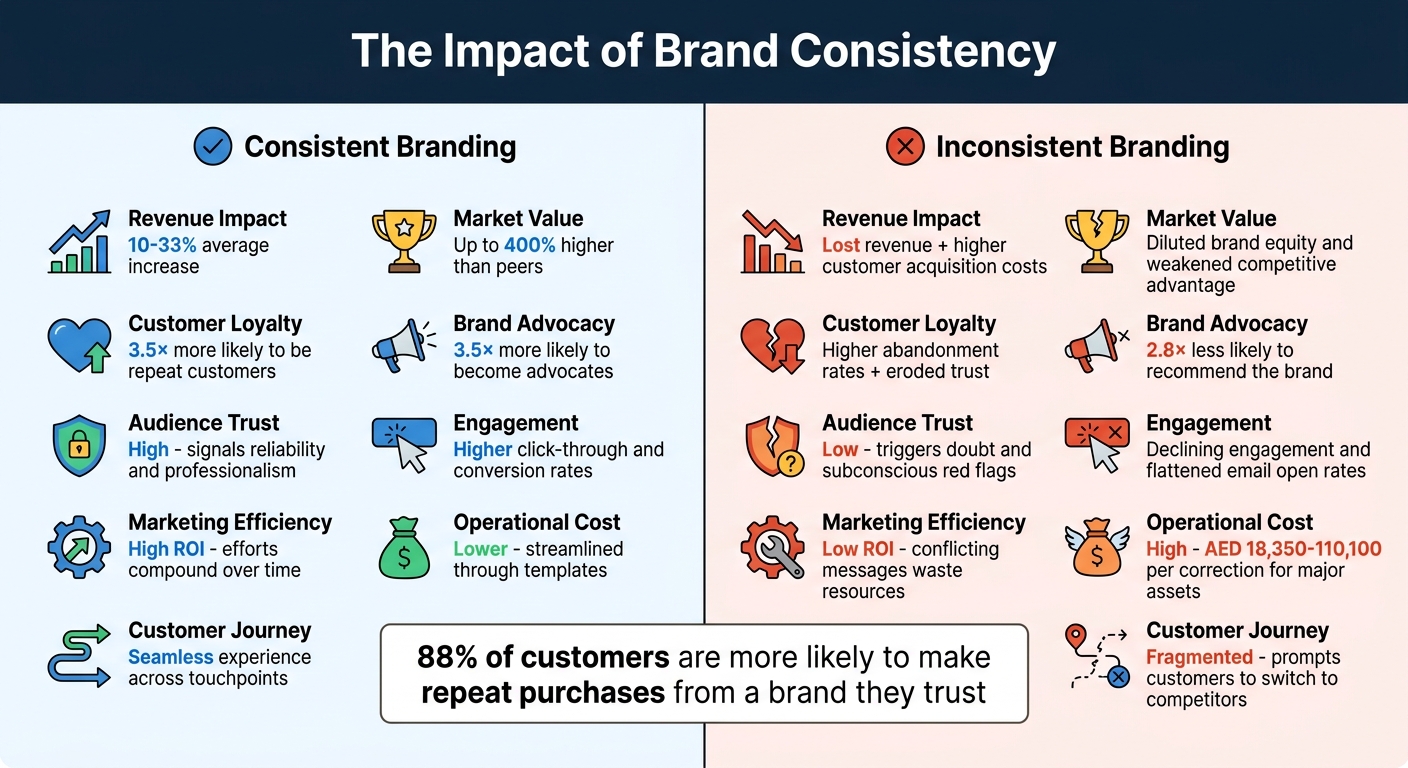
Consistent vs Inconsistent Branding: Impact on Revenue, Trust and Customer Loyalty
When it comes to branding, consistency isn’t just a nice-to-have – it’s a powerful driver of trust, engagement, and revenue. A unified brand across all digital platforms builds a seamless experience for your audience, while inconsistency disrupts the customer journey, creating barriers at every touchpoint.
Here’s a compelling statistic: consistent brands can achieve up to 400% greater market value, and businesses that present their brand consistently see revenue increases ranging from 10% to 33%. On the other hand, inconsistent branding leads to friction, which can derail the entire conversion process.
“Brand consistency is a proven growth multiplier.”
- Jon Boles, Founder & CEO, AVINTIV
The psychological impact of consistency is equally striking. 88% of customers are more likely to make repeat purchases from a brand they trust, and 87% are willing to pay more for such brands. In contrast, inconsistency forces customers to repeatedly “reprocess” your brand, which can erode trust and hinder conversions. This goes beyond visuals and color palettes – it’s about creating a brand that’s instantly recognisable and dependable.
Comparison Table: Consistency vs. Inconsistency
| Metric/Area | Consistent Branding | Inconsistent Branding |
|---|---|---|
| Revenue Impact | 10–33% average increase | Lost revenue; higher customer acquisition costs |
| Market Value | Up to 400% higher than peers | Diluted brand equity and weakened competitive advantage |
| Customer Loyalty | 3.5× more likely to be repeat customers | Higher abandonment rates; eroded trust |
| Brand Advocacy | 3.5× more likely to become advocates | 2.8× less likely to recommend the brand |
| Audience Trust | High; signals reliability and professionalism | Low; triggers doubt and subconscious “red flags” |
| Engagement | Higher click-through and conversion rates due to familiarity | Declining engagement and flattened email open rates |
| Marketing Efficiency | High ROI; efforts compound over time | Low ROI; conflicting messages waste resources |
| Operational Cost | Lower; streamlined through templates | High; AED 18,350–AED 110,100 per correction for major assets |
| Customer Journey | Seamless experience across touchpoints | Fragmented; prompts customers to switch to competitors |
Operationally, inconsistent branding is a drain on resources. Teams often waste time reworking assets or fixing tone mismatches, adding unnecessary costs. For instance, correcting major branding errors can cost anywhere from AED 18,350 to AED 110,100. In regulated industries, the risks are even higher, with potential fines reaching millions for non-compliance.
The bottom line? Consistent branding isn’t just about looking polished – it’s about building trust, improving efficiency, and creating a cohesive experience that keeps customers coming back.
Conclusion
Research highlights that brand consistency is more than a nice-to-have – it’s the bedrock of trust, recognition, and long-term growth in the ever-evolving digital world. By maintaining a unified visual and verbal identity across every interaction, you’re not just creating aesthetic alignment; you’re making your brand easier to recognise and trust. This clarity can directly impact your bottom line, with studies showing revenue can grow by up to 33%.
To achieve this level of consistency, businesses need well-defined brand guidelines, a centralised system for managing assets, and regular evaluations to avoid brand drift. These steps ensure every customer interaction strengthens their trust in your brand.
In competitive markets like the UAE, where consumers engage with brands across an average of 7.6 touchpoints before deciding to buy, maintaining a cohesive identity becomes even more crucial. A lack of consistency doesn’t just confuse potential customers – it can also inflate acquisition costs and waste marketing budgets.
Given the complexity of managing consistency across multiple platforms and channels, bringing in experts can make all the difference. Branding professionals like Brand Husl offer the strategic insight, tools, and execution needed to keep your brand aligned and drive tangible results.
Your brand is one of your most critical assets. Protect it with unwavering consistency to ensure its value continues to grow.
FAQs
What are the must-have brand elements to keep consistent everywhere?
To create a unified and recognisable brand across digital platforms, it’s essential to keep core elements consistent. This includes your visual identity – such as your logo, colour scheme, fonts, and images – and your tone and voice in messaging. Consistency in these areas strengthens trust and encourages engagement by providing a seamless brand experience.
How can I quickly audit my brand across all digital channels?
To give your brand a quick check-up, take a close look at your website, social media profiles, email campaigns, and any third-party platforms where your brand appears. Make sure your logo, colour schemes, tone of voice, and messaging are consistent everywhere. Tools like analytics platforms can help you track engagement and spot any inconsistencies. Regularly reviewing these elements ensures your content stays aligned with your brand guidelines and helps maintain a unified, trustworthy presence across all channels.
How do I stay consistent in both Arabic and English without losing my tone?
To maintain consistency in both Arabic and English, it’s crucial to create detailed brand guidelines that address tone, language, and cultural subtleties in the UAE. Develop bilingual style guides that harmonise your brand’s voice while respecting local expressions and sensitivities.
Make it a priority to regularly audit your content to identify areas for improvement. Use a centralised system to manage assets, ensuring your messaging and visuals remain consistent across all platforms. This approach helps preserve your brand’s identity while staying true to the region’s cultural context.
Related Blog Posts

BRAND HUSL
We’re a collective of brand strategists, designers, and unapologetic truth-tellers who’ve spent over two decades turning chaos into clarity for businesses across the globe. From global names to fearless startups, we’ve built brands that stick, scale, and sell—without the fluff. Everything we create is rooted in strategy, storytelling, and ROI, because good branding isn’t just pretty—it’s powerful.