

To create a strong brand across different media, you need to focus on three main areas:
- Consistency: Your visual identity (logos, colors, typography) and messaging should remain uniform across all platforms – whether it’s social media, print, or in-person events. This builds trust and recognition.
- Tailored Execution: Each medium has specific requirements. For digital media, prioritize scalable designs and responsive formats. For print, ensure high-quality resolution and precise color matching. For events, maintain clarity and proportionality in large-scale designs while engaging audiences emotionally.
- Measurement and Improvement: Use metrics like Net Promoter Score (NPS), Customer Lifetime Value (CLV), and social media engagement to evaluate branding effectiveness. Regular audits and tools like Digital Asset Management (DAM) systems can help maintain alignment and identify areas for refinement.
In the UAE, where diverse audiences interact in both Arabic and English, it’s crucial to ensure your brand resonates emotionally in both languages. This requires transcreation rather than direct translation to maintain the message’s essence. By combining brand toolkit, localized flexibility, and regular performance tracking, your brand can thrive across all platforms.
Visual Identity Elements for Cross-Media Branding
Your brand’s visual identity is like its signature – instantly recognisable across every platform. Whether it’s displayed on a massive outdoor billboard or a tiny favicon, these elements need to work effortlessly in every format.
Logo Design and Scalability
A well-designed logo holds its strength and clarity at any size. Keeping it simple is key – clean lines and balanced proportions ensure it looks sharp whether it’s a tiny mobile icon or a large banner.
Put your logo to the test. Shrink it to favicon size (16×16 pixels) to check if it’s still clear. Evaluate how it looks on both light and dark backgrounds – this is especially important in the UAE, where your logo might appear on everything from bright trade show displays to dark social media ads. Your logo should also work in monochrome for uses like embossing on luxury packaging or engraving on corporate gifts.
“A versatile logo is a silent ambassador. It looks equally strong whether it’s the size of a postage stamp or a highway billboard.” – Gean Ribeiro, Designer, Buzzvel
Consider creating a logo family with different versions: a horizontal layout, a vertical stack, and a simplified icon for smaller spaces. Stick to a limited colour palette – two or three colours – to keep it versatile and cost-effective for printing across various media. And always design in vector formats so your logo scales perfectly, whether it’s on business cards or building wraps.
Once your logo is fine-tuned, pair it with a consistent colour palette and typography for a cohesive look.
Colour Palette and Typography
Maintaining colour consistency across media requires attention to detail. Choose colours that work well in both CMYK for print and RGB for digital. Use Pantone swatches to ensure accuracy. A structured palette typically includes:
- One primary brand colour for your core identity
- Two support colours for accents or calls-to-action
- Neutral tones for backgrounds and text
Typography is just as important. Stick to two fonts: one for headings to convey your brand’s personality and another for body text to ensure readability. Sans serif fonts are ideal for digital platforms due to their clean and modern appearance. For mobile, body text should be sized between 16–18 pixels for comfortable reading. Avoid overly thin or decorative fonts – they lose legibility when scaled down or printed on textured surfaces.
Accessibility is another critical factor, especially for diverse audiences in the UAE. Ensure your colour combinations meet contrast guidelines (at least 4.5:1 for normal text and 3:1 for large text) as per the Web Content Accessibility Guidelines.
By locking in your colours and fonts, you lay the groundwork for a unified visual style that extends across all brand touchpoints.
Imagery and Visual Adaptation
Your visual identity isn’t just about logos and colours – it’s also about the images, graphics, and designs you use. A consistent imagery style, with uniform lighting, composition, and colour grading, helps your audience instantly recognise your brand – even without a logo.
For print, use high-resolution images, and for digital, optimise visuals to load quickly without sacrificing quality. Custom templates can help maintain consistency across platforms. Different platforms allow you to show different sides of your brand while staying within your visual framework. For example:
- Use Instagram Stories for casual, behind-the-scenes content.
- Share professional case studies on LinkedIn.
- Add interactive elements to boost engagement.
Make it a habit to conduct regular visual audits across all platforms to catch outdated designs or inconsistencies. This ensures your brand identity stays cohesive and impactful, no matter where it appears. These visual elements are the backbone of clear and consistent brand communication across all media.
sbb-itb-6cae99a
Creating a Consistent Brand Voice and Messaging
Your brand’s voice is like its personality – it breathes life into your identity. Just as your visual elements make your brand recognisable, your voice shapes how people perceive and connect with you. Whether you’re posting on Instagram, replying to customer queries, or rolling out a major campaign, your voice needs to be clear and consistent. This is especially important in the UAE, where over 200 nationalities come together, creating a unique and diverse market.
Defining Your Brand Voice
Start by identifying your brand’s core personality traits. Are you playful, authoritative, empathetic, or forward-thinking? Whatever your tone, it should remain recognisable across all platforms. For example, your LinkedIn content might lean towards a professional tone, while Instagram Stories could be more relaxed – but the essence of your brand must remain intact.
In the UAE, where Arabic and English dominate the business scene, simple translation won’t cut it. You’ll need transcreation – a process that adapts your message to evoke the same feelings in a different language and culture. For instance, a tagline that’s witty in English might not translate well into Arabic and could even cause offence. Collaborating with native speakers and cultural experts ensures your message resonates locally while respecting humour, idioms, and sensitivities.
“True brand consistency across languages and cultures means ensuring that your brand’s core message, values, and emotional resonance remain intact and impactful, regardless of the language spoken or the cultural context.” – HelloWorld Label
To make this process seamless, develop detailed brand guidelines that clearly define your voice. Include sections specifically for regional adaptations. This approach – centralised control with decentralised execution – allows local teams to make culturally relevant adjustments while staying true to your brand’s identity.
Maintaining Messaging Consistency
Once your voice is defined, the challenge is ensuring it’s reflected in every interaction. Consistency means delivering a cohesive brand experience, whether someone encounters you on social media, in a print ad, or at an event. Research shows that brands maintaining high consistency across channels can see revenue growth of 10% or more. Yet, while 85% of companies have brand guidelines, fewer than 33% enforce them effectively.
To avoid mixed messages or outdated content, use tools like Digital Asset Management (DAM) systems and Content Management Systems (CMS). These platforms ensure all teams work with the same approved assets and messaging. Additionally, gather insights through social listening, surveys, and analytics to understand how your voice is being received. For instance, if your content gets plenty of views but low engagement, it might be time to adjust your messaging.
Adapt your tone to fit each platform while staying true to your brand’s core voice. A formal, data-driven tone might work well for LinkedIn, while a casual, conversational style could resonate better on TikTok. Train your team to apply your voice consistently across all touchpoints. After all, trust is key – 66% of consumers say they’ll only buy from brands they trust, and trust is built through authentic and consistent communication.
Maintaining Consistency with Brand Guidelines
Brand guidelines serve as the backbone of a consistent identity across all platforms. They compile your visual and messaging standards into a single reference, ensuring a unified approach. In the UAE’s dynamic, multicultural market – where businesses often operate in both Arabic and English – having clear and detailed guidelines is especially important.
Components of Effective Brand Guidelines
Your brand guidelines should address both visual and verbal elements. Starting with visual identity, ensure you include details like logo variations, clear space requirements, and minimum sizes to guarantee legibility across platforms. Define your colour palette with precise codes – such as HEX and RGB for digital use, and CMYK and Pantone for print – to maintain uniformity. Typography is another critical aspect; specify the headline and body fonts, size hierarchy (H1 to H6), and spacing rules to ensure text is both readable and on-brand.
| Component Category | Essential Elements | Media-Specific Considerations |
|---|---|---|
| Visual Identity | Logo variations, clear space, colour codes (HEX/CMYK), font hierarchy | Scalability and accurate colour profiles for print and digital |
| Verbal Identity | Brand voice, tone of voice, vocabulary, key taglines | Adapt tone for social media (casual) vs. corporate reports (formal) |
| Visual Style | Photography style, illustration style, iconography, patterns | Responsive design for digital; tailored image treatments for platforms |
| Application Rules | Templates for social, email, and print; co-branding rules | Layout grids for web; bleed/margin rules for print materials |
A cohesive visual style is just as essential. Define your photography guidelines, covering aspects like lighting, composition, and subject matter, to ensure all visuals align with your brand. Include clear “dos and don’ts” with examples, such as incorrect logo usage or clashing colour combinations. Did you know that colour alone can boost brand recognition by up to 80%? Consistency across all touchpoints can also enhance perceived brand value by 20–30%.
Once guidelines are established, the next challenge is applying them consistently.
Implementation and Periodic Audits
Guidelines only matter if they’re followed. Make them accessible by hosting them on cloud platforms like Frontify or Adobe CC Libraries, so every team member can refer to them instantly. Use Digital Asset Management systems and an approval workflow with designated brand guardians to ensure outdated assets aren’t used.
Appoint a brand guardian and train department-specific brand champions to maintain compliance. Standardised templates can speed up content creation by 60%, allowing your team to focus on strategy rather than reworking designs.
Regular audits are essential to catch inconsistencies and update outdated elements. For fast-paced digital environments, consider monthly quality checks to avoid “brand drift.” Use a scoring system (e.g., a 1–10 scale) to evaluate materials across all touchpoints, from email signatures to social media visuals, and prioritise fixes based on their visibility and impact. Without regular audits, customer acquisition costs can increase by as much as 40%.
“Brand guidelines aren’t restrictions – they’re enablers. They give your team the freedom to create consistently great work without constantly reinventing the wheel.” – Vik Chadha, Brand Strategy Expert at Magnt
Adapting Branding for Digital, Print, and Experiential Media
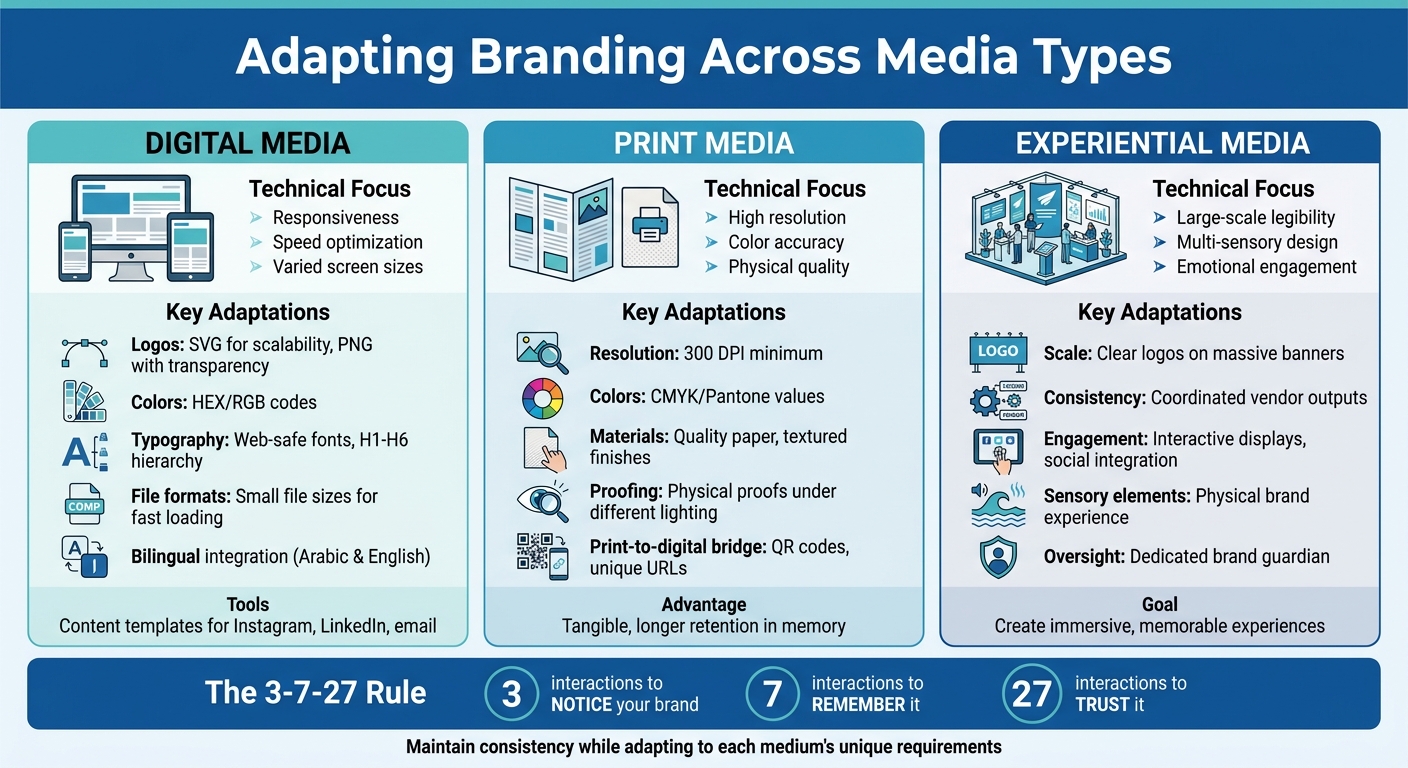
Cross-Media Branding Adaptation Guide: Digital, Print, and Experiential
You’ve got your brand guidelines sorted. Now comes the tricky part: making sure your brand shines across all types of media – whether it’s Instagram, a printed brochure, or a trade show in Dubai. No matter the platform, your brand should feel instantly familiar and cohesive.
Digital Media Adaptation
Digital platforms come with their own set of challenges, like responsiveness, speed, and varied screen sizes. To tackle this:
- Logos and Colours: Create scalable logo versions and test your colour palette (using HEX/RGB codes) across multiple devices to ensure consistency. For file formats, go for SVG for scalability and PNG with transparent backgrounds for social media, keeping file sizes small for faster loading.
- Typography: Use web-safe font alternatives if your primary fonts aren’t supported online. Set a clear hierarchy for headings (H1 to H6) that works seamlessly on both desktop and mobile.
- Content Templates: Build branded templates for Instagram carousels, LinkedIn posts, and email headers. This ensures your team can work efficiently while keeping the brand consistent.
- Bilingual Integration: In the UAE’s bilingual market, design for both Arabic and English. Make sure the visual identity remains consistent across both languages.
Print Media Considerations
Print is all about precision and quality. Unlike digital, there’s no room for error once it’s on paper. Here’s what to focus on:
- Resolution and Colours: Use 300 DPI resolution and switch to CMYK or Pantone colour values for accurate printing. Always review physical proofs under different lighting conditions before mass production.
- Paper and Finishes: Choose materials that reflect your brand. For instance, a luxury brand might opt for thick, textured paper with spot UV finishes, while a tech startup might lean toward clean, minimalist designs. In the UAE, quality materials are key – anything cheap can hurt your brand perception.
- Bridge Print and Digital: Include QR codes or unique URLs on printed materials to drive traffic to your digital platforms. This not only connects the two mediums but also helps you track ROI.
Print has a unique advantage: it’s tangible. Studies show that print ads often stick in people’s minds longer than digital ones because of the physical interaction.
Experiential Media and Event Branding
Experiential media takes branding to another level by creating immersive, physical experiences. Whether it’s GITEX in Dubai or a product launch in Abu Dhabi, your event branding should reflect the same identity as your digital and print materials – just on a larger scale.
- Large-Scale Design: Logos must remain clear and proportional, even on massive banners. Colours should be consistent across materials like vinyl, fabric, and paper, despite variations in how they render.
- Sensory Engagement: Events offer a chance to connect emotionally with your audience. Take inspiration from Red Bull’s extreme sports events, which reinforce their energetic image. Use interactive displays, social media integration, or feedback stations to deepen the experience.
- Consistency: Designate someone to oversee all event materials, ensuring consistency across vendors and preventing visual mismatches.
| Medium | Technical Focus | Adaptation Strategy |
|---|---|---|
| Digital | File optimisation, responsive design | Scalable logos, HEX/RGB colours, device testing |
| High resolution, accurate colours | 300 DPI, CMYK/Pantone, quality materials, physical proofs | |
| Experiential | Large-scale legibility, multi-sensory design | Consistent visuals, coordinated vendor outputs, interactive audience engagement |
The 3-7-27 rule is a great reminder: people need 3 interactions to notice your brand, 7 to remember it, and 27 to trust it enough to stick around. By adapting your branding for each medium while staying consistent, you’ll guide customers smoothly from awareness to loyalty.
Measuring and Improving Branding Performance Across Media
After aligning your brand across various platforms, the next logical step is to measure how these efforts translate into actual results. Tracking performance takes the guesswork out of branding and provides actionable insights. The key is identifying metrics that reflect your brand’s influence and effectiveness.
Key Performance Indicators for Branding
Start with metrics that directly affect your business outcomes. Net Promoter Score (NPS) is a simple yet effective way to measure customer loyalty. By asking customers how likely they are to recommend your brand on a scale of 0-10, you get a clear picture of your brand’s health. Similarly, Customer Lifetime Value (CLV) shows how well your branding efforts retain customers over the long term. Strong branding encourages repeat business, increasing overall customer spend.
For digital platforms, keep an eye on website traffic, goal completions in Google Analytics, and social media engagement (likes, shares, comments). These metrics reveal whether your messaging is resonating with your audience. To gauge brand recognition and recall, track ad impressions, clicks, and survey responses that shed light on how customers discover your brand. In a competitive market like the UAE, understanding these touchpoints is critical for optimising your budget.
Additionally, monitor Customer Acquisition Cost (CAC) and conversion rates. A well-established brand often lowers acquisition costs while improving conversion rates. Research indicates that consistent branding across platforms can increase revenue by 10% to 33%. Furthermore, 68% of businesses report that brand consistency directly contributes to revenue growth of 10% or more.
“Your marketing campaigns are often the most useful way to measure brand awareness and ongoing brand recognition.” – Huddle Creative
Tools and Analytics for Continuous Improvement
Once you’ve established your KPIs, use the right tools and regular audits to refine your branding strategy. Tools like Google Analytics or Hootsuite can automate KPI tracking and simplify performance monitoring. Integrating your CRM with analytics tools provides a complete view of the customer journey, from first interaction to final conversion. This end-to-end perspective highlights your branding strengths and areas needing improvement.
Conduct quarterly audits to assess your brand’s visual identity, messaging, and overall presence. Use a 1–10 scoring system to rate elements like messaging consistency and visual appeal. This data-driven approach ensures that your improvements are based on evidence, not instinct. If your foundational brand toolkit scores below 5, prioritise fixing it – everything else depends on a solid base.
For offline media such as print or experiential campaigns, rely on surveys, focus groups, and “how did you hear about us” questions to measure brand recognition. Test internal alignment by asking employees what your brand stands for. If responses vary widely, it’s a sign of internal misalignment that could eventually affect customers. Regular checks are crucial, as maintaining consistency can boost brand recognition by up to 80%. Make sure your analytics reflect the local market dynamics and customer behaviours specific to the UAE for the best results.
Conclusion
Building a strong brand across various media channels revolves around three key principles: maintaining consistency in your visual and verbal identity, tailoring your approach to suit each platform’s specific needs, and prioritising ongoing evaluation and improvement. Whether it’s a digital ad or a billboard, these elements should shine through.
For businesses in the UAE, the task becomes even more intricate due to the region’s incredible diversity. With over 200 nationalities and expatriates making up around 88% to 90% of the population, branding here requires more than just translating content. Instead, focus on transcreation – a process that ensures your message resonates emotionally in both Arabic and English, while respecting the area’s rich traditions. True consistency across cultures lies in preserving your brand’s core values and emotional appeal.
A practical way to manage this complexity is by adopting a centralised control with decentralised execution model. This means sticking to core brand guidelines while giving local teams the flexibility to adapt elements like visuals and event timing. Take into account factors like local workweeks, cultural holidays, and digital habits to ensure your branding feels relevant.
Technology plays a crucial role in supporting this approach. Using tools like Digital Asset Management systems helps ensure everyone has access to approved brand materials, while Content Management Systems with localisation capabilities make delivering multilingual content more efficient. Regular audits can help spot inconsistencies early, and feedback from social listening and surveys keeps you in sync with the UAE’s fast-evolving digital landscape.
Branding is never static – it’s an ongoing journey. By implementing strategies like scalable designs and precise performance tracking, you can build a brand that not only adapts but thrives in the UAE’s dynamic and diverse market.
FAQs
How do I keep my brand consistent without sounding repetitive?
To keep your brand consistent without sounding repetitive, stick to a cohesive visual identity, tone, and messaging across all platforms. Establish clear brand guidelines to ensure your style, voice, and overall behaviour remain standardised. At the same time, keep your content fresh by experimenting with different formats, themes, or storytelling techniques. By maintaining your core brand elements while introducing variety, you strengthen your identity and keep your audience intrigued.
What’s the best way to adapt branding for Arabic and English in the UAE?
Adapting branding for both Arabic and English in the UAE involves careful attention to the distinct characteristics of each language. Arabic’s right-to-left script, its flowing, connected letters, and the absence of uppercase and lowercase distinctions require a tailored design approach.
When creating logos, it’s important that they function seamlessly in both languages. This can be achieved using dual-language lockups or layouts that align with cultural preferences. To maintain a cohesive look, designs should feel natural in each language, ensuring the visual flow and balance are preserved across all platforms.
Which 3 metrics should I track first to measure branding impact?
To understand how well your branding efforts are working, keep an eye on these three important metrics:
- Recognisability and memorability: Check how quickly and easily people recognise your logo or other brand elements and how well they stick in their minds.
- Brand consistency: Make sure your visuals, messaging, and tone are aligned and consistent across all platforms and communication channels.
- Audience engagement: Look at likes, shares, comments, and other interactions to see how much your audience connects with and supports your brand.
These metrics give you a solid snapshot of how your branding is performing.
Related Blog Posts

BRAND HUSL
We’re a collective of brand strategists, designers, and unapologetic truth-tellers who’ve spent over two decades turning chaos into clarity for businesses across the globe. From global names to fearless startups, we’ve built brands that stick, scale, and sell—without the fluff. Everything we create is rooted in strategy, storytelling, and ROI, because good branding isn’t just pretty—it’s powerful.