

Every time a customer interacts with your business – whether through Instagram, WhatsApp, or at your store – it shapes how they see your brand. These points of contact, known as brand touchpoints, influence everything from first impressions to long-term loyalty. For businesses in the UAE, where 98.99% of people use social media and WhatsApp is a preferred communication tool, touchpoints take on unique importance. Here’s what you need to know:
- What are touchpoints? Every moment a customer interacts with your brand, from ads to post-purchase support.
- Why do they matter? Positive experiences build trust, while inconsistencies – like mismatched tones or lack of local payment options – can drive customers away.
- How to optimize them? Map out touchpoints across the customer journey (Awareness, Consideration, Purchase, Retention, Advocacy) to identify gaps and improve experiences.
Statistics show that businesses refining these interactions see 54% higher marketing ROI and 56% more revenue from cross-sells. In the UAE, aligning touchpoints with local preferences – like bilingual communication and seamless WhatsApp support – can make or break your customer relationships.
The key? Understand customer needs, align touchpoints with their expectations, and maintain consistency across all channels. A well-mapped journey ensures every interaction adds value, builds trust, and strengthens loyalty.
Identifying and Categorizing Brand Touchpoints
Every interaction between your brand and your customers matters. From your website to billing emails or even the inserts in your packaging, you need to identify and track every single connection point.
Types of Brand Touchpoints
Brand touchpoints can be grouped into three main categories:
- Digital: Think websites, social media profiles, email campaigns, mobile apps, and online ads.
- Physical: This includes stores, product packaging, event booths, and printed materials like brochures.
- Human: Personal interactions such as sales conversations, WhatsApp support chats, or account manager calls.
For instance, a customer might first notice your brand through an Instagram ad (digital), then visit your physical store in Abu Dhabi, and later send queries via WhatsApp (human). Each of these moments is an opportunity to shape their experience.
Complete Checklist for Finding Touchpoints
To uncover all your brand’s touchpoints, immerse yourself in the full customer journey. Search for your brand online, explore your website, and test your support channels. Using a brand audit checklist can help ensure you don’t miss any critical identity elements during this review. Collaborate with different teams:
- Marketing: Examine ads, social media content, and campaigns.
- Sales: Review interactions with prospects.
- Customer Service: Analyse support tickets and feedback.
- Product Teams: Investigate user interactions and feedback.
Blend insights from customer interviews and chat transcripts with data from analytics tools. Metrics like pageviews, email open rates, and social media engagement can reveal trends. Don’t overlook behind-the-scenes processes either. For example, a delay in shipping might not seem like a big deal internally but could frustrate your customers.
"Identifying and effectively mapping customer journey touchpoints are crucial steps in enhancing the customer experience and fostering brand loyalty." – Amanda Athuraliya, Content Editor, Creately
Once you’ve gathered this information, map out these touchpoints across the customer lifecycle to maintain brand consistency for a clearer strategy.
Touchpoints at Each Customer Lifecycle Stage
With your touchpoints identified, align them with the key stages of the customer lifecycle. This helps you meet customer expectations at every step.
- Before Purchase: At the awareness and consideration stages, focus on touchpoints like social media posts, Google searches, influencer content, blog articles, and events. The aim here is to educate and build trust.
- During Purchase: When customers are ready to buy, they interact with product pages, sales reps, the checkout process, or your physical store. These touchpoints should minimise obstacles and encourage action.
- After Purchase: Post-purchase touchpoints like billing confirmations, thank-you notes, package tracking, and onboarding emails play a key role in building loyalty. Customer support, loyalty programmes, and follow-up surveys also help turn one-time buyers into repeat customers.
For example, 85% of customers say loyalty programmes encourage them to keep shopping with a brand. That’s why it’s essential to prioritise improvements in high-impact areas, like streamlining your checkout process or adding Arabic-language support to your FAQ section. These small changes can make a big difference in customer satisfaction and loyalty.
sbb-itb-6cae99a
Mapping Touchpoints to the Customer Journey
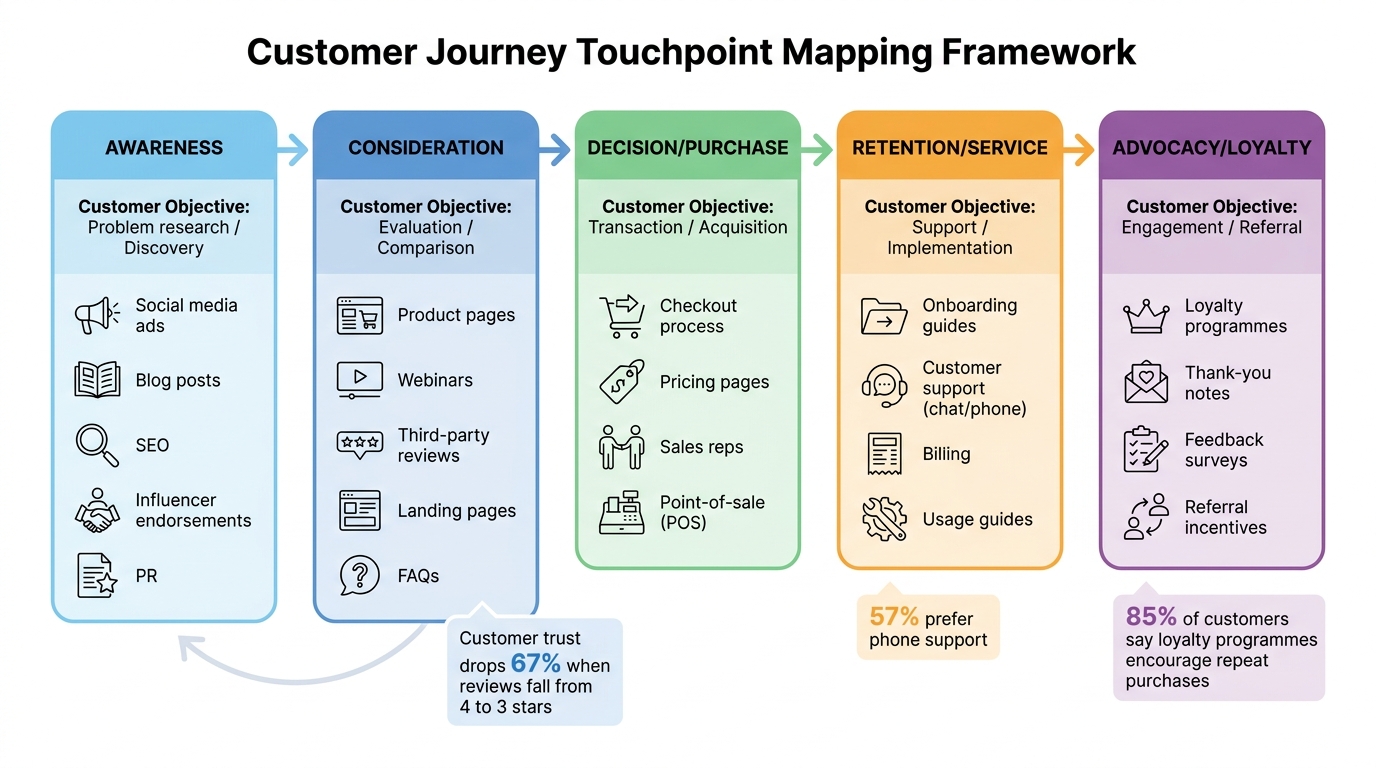
Customer Journey Touchpoint Mapping Framework – 5 Stages from Awareness to Advocacy
Once you’ve identified and organised your brand’s touchpoints, the next step is to position them along the customer journey. This process helps uncover any gaps and refine the overall experience. By doing so, you can pinpoint exactly where and how customers engage with your brand, making it easier to improve their journey.
Understanding the Customer Journey Framework
The customer journey typically unfolds across five key stages: Awareness, Consideration, Decision, Retention, and Advocacy. Each stage has a unique focus and demands specific touchpoints to guide customers effectively.
- Awareness: This is where customers first discover your brand. Touchpoints here include social media ads, blog posts, PR efforts, and influencer endorsements.
- Consideration: At this stage, customers evaluate their options. They interact with product pages, webinars, FAQs, or third-party reviews.
- Decision: This is the purchase moment, involving interactions like the checkout process, pricing pages, or sales conversations.
- Retention: After the purchase, the focus shifts to keeping customers engaged through onboarding guides, customer support, and billing assistance.
- Advocacy: Satisfied customers become brand advocates through loyalty programmes, referral incentives, and feedback surveys.
Here’s a breakdown of how touchpoints align with each journey stage:
| Journey Stage | Customer Objective | Common Touchpoints |
|---|---|---|
| Awareness | Problem research / Discovery | Social media ads, blog posts, SEO, influencer endorsements, PR |
| Consideration | Evaluation / Comparison | Product pages, webinars, third-party reviews, landing pages, FAQs |
| Decision/Purchase | Transaction / Acquisition | Checkout process, pricing pages, sales reps, point-of-sale (POS) |
| Retention/Service | Support / Implementation | Onboarding guides, customer support (chat/phone), billing, usage guides |
| Advocacy/Loyalty | Engagement / Referral | Loyalty programmes, thank-you notes, feedback surveys, referral incentives |
By understanding this framework, you can ensure your brand delivers the right message at the right time, tailored to each stage of the journey.
Matching Touchpoints with Customer Needs
To make touchpoints truly effective, you need to align them with your customers’ actual needs – not just your internal goals. This requires digging into customer feedback through interviews, surveys, and support logs to uncover their motivations and pain points at each stage.
For instance, during the Consideration phase, customers often look for detailed, bilingual content to make informed decisions. Meanwhile, in the Retention stage, many (57%) prefer call support over email, emphasising the need to meet expectations through the right channels. Aligning touchpoints with these preferences ensures you’re addressing what customers value most.
Touchpoints should also align with three key behavioural drivers: Attention, Relevance, and Trust. For example:
- A flashy ad may grab attention, but if it doesn’t address customer pain points, it won’t resonate.
- Trust is critical – data shows that customer trust drops by 67% when reviews fall from four stars to three, underscoring the importance of testimonials and transparent communication.
Creating Visual Touchpoint Maps
Visual maps can turn all this data into a clear, actionable overview. Start by listing touchpoints in chronological order and mapping them alongside customer emotions. Use colour-coding to highlight:
- Positive moments (green)
- Friction points (red)
- Decision-making areas (yellow)
"A journey map challenges your assumptions about when the journey truly begins and ends, thus identifying as many opportunities for innovation as possible." – Srikant Datar, Dean, Harvard Business School
These maps can uncover patterns that spreadsheets might miss. For example, you might notice frustration during checkout due to a lengthy form or delight from a personalised thank-you note.
Keep in mind, today’s customer journeys are rarely linear. Customers often loop back from Consideration to Awareness as they gather more information. Your map should reflect this reality, showing how touchpoints interconnect and influence each other, instead of treating them as isolated events.
Optimising Brand Touchpoints for Consistency
Once you’ve mapped out all your brand’s touchpoints, the next step is ensuring they align under a single, cohesive identity. Why? Because inconsistency confuses customers and can erode their trust. A seamless, unified experience not only builds credibility but also drives results. Research backs this up: brands that deliver outstanding customer experiences can see up to five times more sales. Consistency, then, isn’t just about aesthetics – it’s a business priority.
Maintaining Brand Consistency Across Touchpoints
Your brand should feel the same no matter where or how a customer interacts with it – whether that’s on Instagram, in a retail store, or through your product packaging. Achieving this requires comprehensive brand guidelines. These guidelines should cover both visual elements (like logo placement, colours, typography, and imagery) and verbal elements (such as tone of voice, messaging, and branded phrases). Think of these guidelines as your compass, ensuring a social media post reflects the same personality as your in-store signage or email communications.
Adapting your brand for physical and digital spaces can be tricky, but the goal remains the same: consistency. For physical environments like stores or events, sensory engagement and well-trained staff are key. Employees, in particular, act as living representations of your brand. Their behaviour and interactions should reflect your values. On the digital side, UX/UI design and personalised content are vital. Even something as routine as the checkout process should embody your brand, as first impressions matter even at this stage.
Balancing both physical and digital worlds becomes even more challenging when they intersect. An omnichannel strategy is essential here. Whether customers are browsing online and picking up in-store or starting a support query via chat and continuing by phone, a centralised data system is crucial. Tools like Salesforce or HubSpot allow you to create a unified view of customer interactions, ensuring smooth transitions and eliminating redundant touchpoints. This centralisation helps every team member deliver consistent and informed service.
Removing Friction and Improving Transitions
Friction in the customer journey happens when unnecessary effort is required. Think about a lengthy checkout process, confusing navigation, or having to repeat information across channels. These moments frustrate customers and hurt your brand’s reputation. To keep things running smoothly, it’s essential to streamline transitions between touchpoints.
Start by auditing your touchpoints to identify pain points. Use customer feedback, usability scores, and support logs to pinpoint where people are struggling or dropping off. Common issues include requiring an account before browsing, making customers re-enter information across platforms, or failing to provide self-service options. Solutions like Single Sign-On (SSO) for easy login or interactive Help Centres can significantly reduce effort.
The numbers show why this matters. While 57% of customers prefer phone support, many issues don’t need direct human involvement. AI chatbots and self-service portals can handle routine queries instantly, leaving your team free to focus on complex problems that require empathy and a personal touch. This approach ensures your brand remains consistent while using resources efficiently.
Using Brand Guidelines Effectively
Brand guidelines are only as useful as their implementation. All too often, companies create detailed documents that are ignored, leaving teams to interpret the brand on their own. For guidelines to work, they need to be clear, regularly updated, and applied consistently across all departments – from marketing to operations.
A "Hub-and-Spoke" model can be particularly effective for larger organisations managing multiple markets or channels. The central hub oversees core guidelines, ensuring essential elements like logo usage and brand values stay consistent. Meanwhile, individual teams or channel specialists (the spokes) adapt these guidelines for specific needs – whether that’s tailoring content for different regions, optimising for specific platforms, or fine-tuning messaging for particular audiences.
Guidelines should evolve over time. Regular updates based on trends, customer feedback, or strategic changes keep them relevant. When launching new touchpoints – whether it’s a mobile app, a trade show booth, or redesigned packaging – refer back to these guidelines to ensure everything aligns. This ensures every interaction reinforces your brand identity.
Implementing and Monitoring Touchpoint Strategies
Having a solid plan to put optimised touchpoints into action is just as crucial as designing them. Without proper implementation and regular monitoring, even the most well-thought-out strategies can fail. This phase focuses on detailed planning, ensuring consistency, and tracking performance from execution to analysis.
Creating an Implementation Plan
Start with a brand audit to evaluate your current touchpoints. Identify which ones are effective, which need improvement, and which should be phased out. This audit lays the groundwork for your strategy. From there, create a detailed task list that includes updates to design elements, marketing materials, digital assets, and internal training. Prioritise the touchpoints that have the biggest impact – those that influence purchase decisions, customer satisfaction, and loyalty the most.
Involve teams from marketing, sales, customer service, and product development to gather diverse insights. Roll out the strategy in phases to test and refine before scaling it across all channels. Use a brand implementation checklist to keep everything consistent during this rollout.
Measuring Touchpoint Performance
Once your touchpoints are live, tracking their performance is essential. Focus on different metrics depending on the customer journey stage:
- For awareness, monitor engaged visits and social media reach.
- During consideration, track trial signups and newsletter subscriptions.
- At the purchase stage, measure conversion rates and shopping cart abandonment.
- For post-purchase, focus on retention rates and the Net Promoter Score (NPS) to gauge customer loyalty.
"There are multiple different metrics and KPIs that we have at every stage of the customer journey. In the ‘Discover’ phase, we would look at [engaged] visits. In the ‘Try’ phase, we would look at trial signups… In the ‘Buy’ phase, it would be the conversion rate." – Maninder Sawhney, Vice President of Digital Media, Adobe
Centralise all your data using tools like Google Analytics, Salesforce, HubSpot, and social media dashboards. This unified view helps you identify patterns, pinpoint friction areas, and understand which touchpoints are driving real results. Pay close attention to response times and resolution rates on support channels like live chat, email, and social media to maintain consistent service quality.
Continuous Improvement Through Feedback
Tracking performance is only half the job – you need to act on the insights you gather. Collect feedback through various methods, including customer surveys, interviews, social media monitoring, and support logs. Post-purchase follow-up emails are particularly effective for gathering immediate customer sentiment while reinforcing your brand relationship. Don’t wait for complaints; use data and observation to identify hidden pain points that customers might not voice directly.
Hold regular "health monitor" sessions with your team to ensure that touchpoint adjustments are genuinely enhancing the customer experience. Use data to validate the scale of any issue before taking action, so you focus on solving major problems instead of minor inconveniences. Often, the touchpoint with the poorest experience sets the tone for overall satisfaction, so continuous fine-tuning is crucial to staying ahead in a competitive market.
Conclusion
Mapping and refining brand touchpoints is essential for building strong customer relationships and driving business growth. Every interaction – whether it’s a social media ad or a call to customer support – shapes how people view your brand’s values and dedication. When these touchpoints work together smoothly, they inspire trust, eliminate friction, and turn casual visitors into loyal customers.
The numbers speak for themselves: brands that deliver standout experiences across touchpoints can achieve up to five times more sales, while retaining a customer is far more cost-effective than acquiring a new one. Companies like TUI and Ticketek prove the power of this approach. For instance, between 2024 and 2025, TUI mapped five key customer journey phases and introduced 40 automated messages triggered by real-time behaviours. The results? A 118% rise in app bookings and a 205% increase in sales of ancillary products. Similarly, Ticketek personalised their weekly newsletter using journey mapping, boosting click-to-convert rates by 228% and driving a 49% increase in sales from opened emails. These examples highlight how strategic touchpoint mapping can transform insights into measurable business growth.
The secret to success lies in treating touchpoint maps as dynamic tools that evolve with customer behaviours and market trends. As highlighted throughout, keeping these maps updated with fresh data is essential to staying competitive in the UAE’s fast-paced market. Regular reviews, collaboration across teams, and ongoing feedback loops help ensure your brand remains consistent and engaging across every channel. Focus on the moments that truly matter – those "Aha!" points where customers connect with your brand’s core value – and refine them based on data-driven insights.
Start with a comprehensive audit, identify the most impactful touchpoints, and roll out changes in manageable stages. Use clear metrics at each stage of the journey – like engaged visits for awareness, trial signups for consideration, conversion rates for purchases, and Net Promoter Score for retention – to track your progress. Keep in mind that 94% of first impressions are design-related, and customer trust drops by 67% when reviews dip from four to three stars.
In a market like the UAE, where cultural subtleties and high expectations shape customer experiences, optimising your brand touchpoints is more crucial than ever. At Brand Husl, we’re committed to helping you craft strategies that resonate with your audience and cultivate lasting loyalty. By managing your touchpoints systematically, you can turn every interaction into a meaningful brand asset.
FAQs
How do I find all my brand touchpoints quickly?
To get a clear picture of your brand touchpoints, start by mapping out every way customers interact with your brand across all platforms. These could include social media, website visits, emails, customer service calls, or even in-store experiences. Begin by listing these interactions and evaluating how your brand shows up on each channel. Tools like customer journey mapping templates can make this process easier by helping you visualise and organise all touchpoints systematically, ensuring nothing slips through the cracks.
Which touchpoints should I fix first for the biggest impact?
Focusing on the touchpoints that shape customer decisions is crucial, particularly during the early stages like brand awareness and consideration. Equally important are key moments such as the purchase and post-purchase interactions.
To make the most impact, prioritise areas like:
- Website visits: Ensure your site is user-friendly, visually appealing, and provides clear, relevant information.
- In-store experiences: Create an inviting atmosphere with helpful staff and seamless service.
- Personalised communication: Use tailored emails, messages, or offers to connect with customers on a more individual level.
When these high-impact touchpoints are improved, they help establish trust and credibility, leading to better customer satisfaction, increased loyalty, and long-term business growth.
What’s the simplest way to keep my brand consistent across channels?
To keep your brand consistent across different channels, start by building a clear and well-defined brand identity that matches your overall strategy. Identify all the ways customers interact with your brand throughout their journey – these are your brand touchpoints. Then, ensure that your messaging, visuals, and tone are consistent across all platforms. Whether it’s online, in-store, or any other interaction, this consistency helps create a unified brand experience that reflects your values and personality.
Related Blog Posts

BRAND HUSL
We’re a collective of brand strategists, designers, and unapologetic truth-tellers who’ve spent over two decades turning chaos into clarity for businesses across the globe. From global names to fearless startups, we’ve built brands that stick, scale, and sell—without the fluff. Everything we create is rooted in strategy, storytelling, and ROI, because good branding isn’t just pretty—it’s powerful.