

When managing a brand, visual identity standards and brand guidelines are two critical tools, often confused but serving distinct purposes.
- Visual Identity Standards focus on the technical aspects of your brand’s appearance – logos, colours, typography, and imagery. They ensure your brand looks consistent across platforms and materials.
- Brand Guidelines go beyond visuals, covering your brand’s voice, messaging, and overall positioning. They answer broader questions like “Who are we?” and “How do we communicate?”
In the UAE’s multicultural market, consistency in branding across Arabic and English is essential. Visual identity standards maintain precision in design, while brand guidelines ensure alignment across all communications, helping your brand connect with diverse audiences.
Quick Comparison:
| Aspect | Visual Identity Standards | Brand Guidelines |
|---|---|---|
| Focus | Visual design elements (logos, colours, etc.) | Broader brand strategy, voice, and messaging |
| Audience | Designers, developers, creative teams | Marketing, sales, HR, executives |
| Purpose | Ensures visual consistency | Guides brand communication and positioning |
| Scope | Technical and design-specific | Comprehensive brand framework |
Both are essential for building a strong, consistent brand presence, especially in competitive markets like Dubai. Together, they ensure your brand is professional, recognisable, and aligned with its goals.
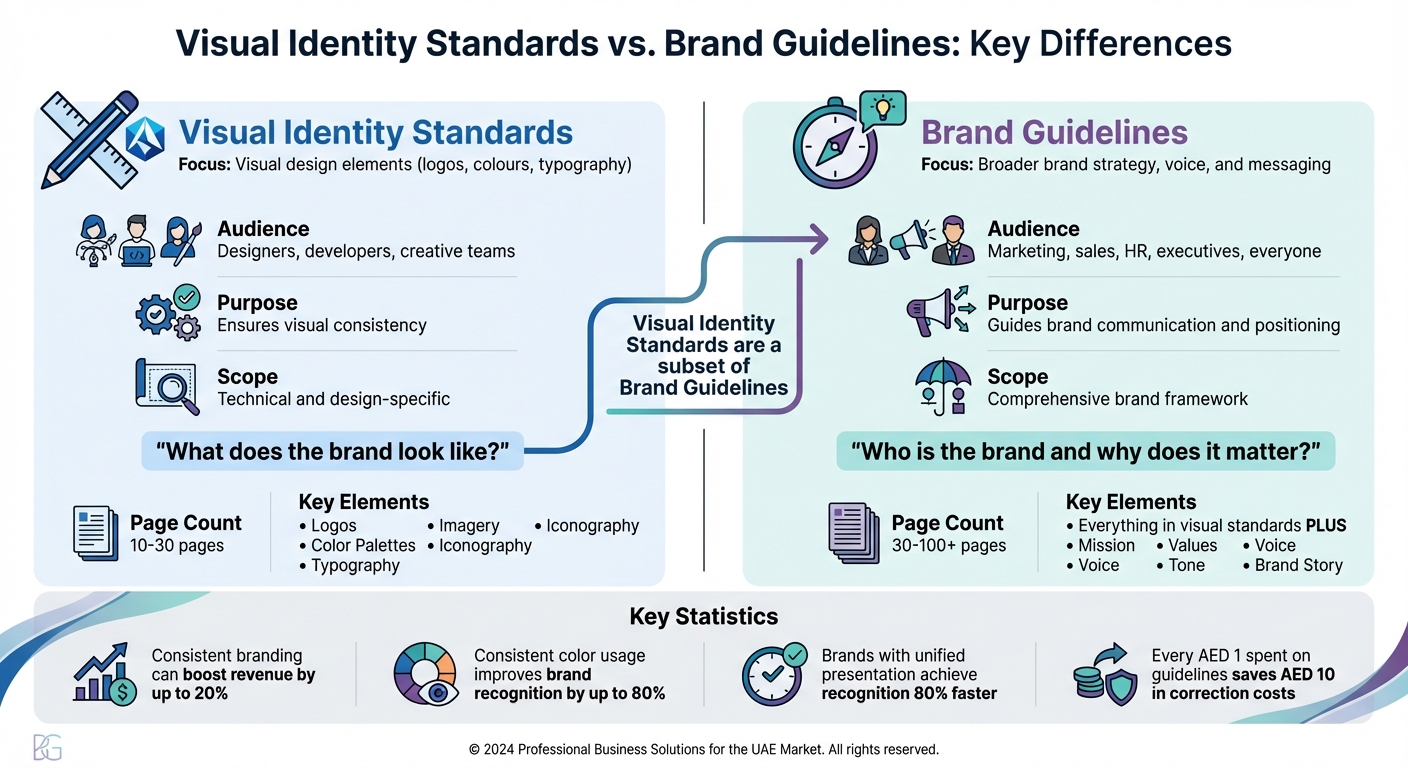
Visual Identity Standards vs Brand Guidelines: Key Differences Comparison
What Are Visual Identity Standards?
visual identity standards are the detailed guidelines that define how your brand should visually present itself across different platforms and mediums. They cover essentials like your logo, colour palette, typography, and imagery – everything that contributes to your brand’s visual presence. Think of them as a playbook that ensures your brand looks consistent, whether it’s on a billboard along Sheikh Zayed Road, a mobile app, or a business card.
These standards act as a go-to reference for everyone involved in creating materials for your brand. Whether it’s designers, printers, web developers, or marketing teams, they all rely on this guide to maintain consistency and avoid variations that could dilute your brand’s identity. In short, this document is the backbone of your brand’s visual consistency.
Take McDonald’s as an example. Back in 2020, they launched a campaign that didn’t even include their logo or name. Instead, they used their signature typography and colour palette, and yet, people instantly recognised the brand. This is the power of sticking to well-defined visual identity standards.
Key Elements of Visual Identity Standards
A complete set of visual identity standards typically includes five main components. Here’s a closer look:
- Logo specifications: These outline everything from primary and secondary logo versions to monochrome options, minimum sizes for legibility, clear space requirements, and even examples of incorrect usage (like stretching the logo or placing it on cluttered backgrounds).
- Colour palettes: Exact colour codes – Pantone for print, HEX for web, RGB for screens, and CMYK for offset printing – ensure your brand colours are consistent, whether they appear on a Dubai Metro ad or an Instagram post.
- Typography guidelines: Approved fonts, weights, and hierarchies (for headings, body text, captions, etc.) ensure a unified and professional tone across all written content.
- Imagery and photography standards: These define the mood and style of your brand’s visuals, including rules for lighting, composition, subject matter, filters, and resolution.
- Iconography and graphics: A library of approved icons, illustrations, patterns, and their usage rules ensures a consistent visual language for supplementary graphics.
| Visual Element | Specifications | Purpose |
|---|---|---|
| Logo | Variations, clear space, minimum size, misuse rules | Ensures the logo remains recognisable and undistorted |
| Colour Palette | Primary/secondary colours, HEX/RGB/CMYK codes | Builds emotional association and can boost brand recognition by up to 80% |
| Typography | Font families, weights, hierarchy (H1, H2, body) | Creates legibility and a cohesive visual tone |
| Imagery | Photography style, lighting, subject matter | Reflects brand aesthetics and can increase engagement by up to 94% |
| Iconography and Graphics | Approved icons, illustrations, patterns | Maintains a consistent visual style across all materials |
These elements go beyond just defining the visual components – they also play a critical role in how your brand operates.
Purpose of Visual Identity Standards
Imagine a designer in Abu Dhabi and another in Sharjah working on separate projects for your brand. Without clear guidelines, their work might look completely different, confusing your audience. But with visual identity standards in place, their materials will look cohesive, as though they came from the same team. Studies show that consistent colour usage can improve brand recognition by up to 80%, while clear visual standards can enhance customer perception by 60%.
In the UAE’s diverse, multicultural setting, these guidelines are even more essential. They ensure consistency across both Arabic and English materials, helping brands communicate effectively with a wide audience. A centralised digital portal for storing updated visual assets ensures everyone is working with the latest resources. Including examples of incorrect usage – like stretched logos or unapproved colours – helps avoid common mistakes. Additionally, specifying colour contrast ratios ensures accessibility for all customers, regardless of visual ability.
This level of precision in visual branding sets the stage for integrating broader brand guidelines seamlessly.
sbb-itb-6cae99a
What Are Brand Guidelines?
Brand guidelines are essentially the blueprint for how a brand presents itself to the world. They go beyond just visuals, covering tone, messaging, strategic positioning, and rules for usage. Think of them as a manual that explains not only what your brand looks like but also why it exists, how it communicates, and what it represents.
These guidelines act as a central reference point for anyone interacting with your brand – from internal teams like marketing and sales to external collaborators like agencies or franchise partners. Studies show that consistent branding can boost revenue by up to 20%, while brands with a unified presentation achieve brand recognition 80% faster.
In the UAE’s dynamic and multicultural business landscape, having comprehensive guidelines is crucial. They help ensure consistency across Arabic and English communications, align digital and physical branding, and tie every effort back to long-term business goals rather than short-term campaigns. Let’s dive into the key elements that make up these guidelines.
Components of Brand Guidelines
Brand guidelines are a mix of visual standards and strategic frameworks, combined with messaging and tone. At their core, they include the following:
- Strategic Foundation: Defines the brand’s mission, vision, values, and market positioning – the principles that shape every decision.
- Verbal Identity: Outlines the brand persona, tone of voice, messaging structure, taglines, and rules for communication in different contexts.
- Editorial Standards: Covers grammar, punctuation, formatting, and inclusive language, such as whether to use the Oxford comma or how to treat product names.
- Brand Architecture: Explains the relationship between sub-brands, parent brands, and product lines, which is crucial for businesses that are expanding.
- Digital Guidelines: Sets standards for consistency across websites, social media, email signatures, and app interfaces.
- Experience and Culture: Defines how customer interactions should feel and how internal teams should embody the brand values.
| Element Category | Components Beyond Visuals |
|---|---|
| Strategic | Mission, Vision, Values, Positioning, Target Audience |
| Verbal | Tone of Voice, Messaging Architecture, Taglines, Brand Persona |
| Editorial | Grammar, Punctuation, Formatting, Inclusive Language |
| Operational | Brand Architecture, Customer Experience Principles, Internal Culture |
| Digital | Social Media Templates, Email Standards, App/Web Guidelines |
Modern brand guidelines are evolving. Instead of static PDF documents, many companies now use dynamic, cloud-based systems that allow for real-time updates and easy access for global teams. With AI-powered tools, creating comprehensive guidelines is up to 90% faster, while ensuring consistent branding across all materials.
These elements go beyond just visuals, shaping how your brand looks, sounds, and feels. They create a cohesive experience that defines your brand’s identity while streamlining operations.
Why Brand Guidelines Matter
Without clear guidelines, brands risk inconsistency, especially when working with multiple agencies or teams across different regions. This lack of alignment can confuse your audience and increase customer acquisition costs by up to 40%. Clear guidelines prevent this by standardising processes, enabling teams to scale content creation 60% faster with pre-defined templates for presentations, social media posts, and emails.
“Brand guidelines aren’t restrictions – they’re enablers. They give your team the freedom to create consistently great work without constantly reinventing the wheel.” – John Smith, Brand Strategy Expert
These guidelines also empower teams to make creative decisions independently within a structured framework. For instance, a marketing coordinator in Abu Dhabi can confidently design campaign materials without needing constant approval for every detail, saving time and effort.
In the UAE, where 88% of consumers value authenticity when choosing brands to support, clear and comprehensive guidelines ensure that every interaction reflects your brand’s true personality and values. This alignment ensures that every piece of content – from a social media post to a trade show display – contributes to building trust and long-term brand equity.
Key Differences Between Visual Identity Standards and Brand Guidelines
Although often used interchangeably, visual identity standards and brand guidelines serve different roles in managing a brand. Visual identity standards act as a brand toolkit focused solely on the brand’s appearance. They answer questions like: “What does our brand look like?” Meanwhile, brand guidelines are more extensive, addressing broader questions such as: “Who are we, why do we matter, and how do we communicate?”
Think of visual identity standards as a single chapter within the larger “book” of brand guidelines. While visual identity standards cover design elements like logos and colour palettes, brand guidelines also integrate the brand’s mission, values, messaging framework, and strategic goals.
“A style guide is a subset of brand guidelines. Brand guidelines include everything in a style guide, plus strategy, voice, tone, and more.” – Vik Chadha, Founder & CEO, Magnt
This quote highlights the distinct roles these documents play, as outlined in the comparison table below.
The intended audience for each document also varies. Visual identity standards are designed for technical use by creative teams, such as designers and developers, who need details like HEX codes or spacing rules. In contrast, brand guidelines are meant for a broader audience, including marketing, sales, HR, and external collaborators.
Comparison Table
| Aspect | Visual Identity Standards | Brand Guidelines |
|---|---|---|
| Definition | Focused on visual design elements (logo, colours, typography, imagery) | Comprehensive document covering visual, verbal, and strategic elements |
| Included Elements | Logos, colour palettes, typography, iconography, layout grids | Everything in visual standards PLUS mission, values, voice, tone, and brand story |
| Purpose | To ensure visual consistency and provide quick reference for design execution | To provide complete brand education, onboarding, and strategic decision-making |
| Team Applicability | Primarily for designers, developers, and creative partners | For everyone: marketing, sales, HR, partners, and executives |
| Core Question | “What does the brand look like?” | “Who is the brand and why does it matter?” |
For businesses in the UAE, it’s wise to start with comprehensive brand guidelines. Once established, you can extract sections focused on visual elements for design-specific needs. This approach ensures clarity and consistency while aligning with the unique demands of your market.
How Visual Identity Standards and Brand Guidelines Work Together
Visual identity standards lay the groundwork for brand guidelines. They define the essential design elements – like logo specifications, colour palettes, typography rules, and layout structures. These details ensure a polished and professional appearance. Brand guidelines, on the other hand, take these core elements and expand them into a more comprehensive framework, covering aspects like your mission, values, voice, tone, and messaging approach.
The two work in harmony. Visual identity standards focus on creating instant recognition across all materials, while brand guidelines tackle the bigger picture – helping teams across marketing, sales, HR, and leadership make consistent, informed decisions. This balance ensures your brand achieves both a strong visual presence and strategic alignment across all communications.
Most organisations start with visual identity standards (usually 10–30 pages) and later develop full brand guidelines (30–100+ pages) as they grow. This evolution builds on the technical foundation, improving overall consistency. While visual standards answer “what” designers and developers need for day-to-day tasks, the broader guidelines address the “who” and “why” that drive long-term strategies.
Today, many companies use dynamic, centralised systems to manage these standards, cutting discrepancies by up to 60%. For larger organisations, it’s common to create a condensed “quick reference” guide for fast-paced projects while keeping the full brand guidelines available for onboarding and strategic planning.
Visual identity standards ensure accuracy and consistency in execution, while brand guidelines provide the flexibility to adapt and grow strategically. Together, they ensure your brand’s personality shines through at every touchpoint – from your website and social media to customer service and internal communications.
When to Use Visual Identity Standards vs. Brand Guidelines
The choice between visual identity standards and brand guidelines depends on your specific needs – whether you’re focusing on technical execution or strategic alignment.
Visual identity standards are perfect for technical tasks that require quick access to design specifications. Think HEX codes, font sizes, or logo spacing. These are your go-to documents when working with website developers, creating marketing materials, or briefing external agencies for specific projects. In fact, research shows that 60% of design teams struggle with ambiguity in specifications, making these standards indispensable for clear and effective implementation.
On the other hand, brand guidelines are critical for maintaining strategic consistency, especially for scaling teams. They’re invaluable when onboarding new team members across departments like marketing, sales, or customer service. Why? Because understanding your brand’s reasoning and purpose is just as important as executing its design. Businesses that present their brand consistently across all platforms can see up to a 23% increase in revenue. In dynamic markets like Dubai, where bilingual communication and cultural sensitivities are key, detailed brand guidelines are even more essential.
Practical Applications
Knowing when to use each type of document can keep your branding efforts both efficient and aligned with your overall strategy.
- Use visual identity standards when speed and precision are paramount. Tasks like building your first website, launching an advertising campaign, or collaborating with freelancers on a single project benefit greatly from these straightforward, technical documents. For example, a concise 15-page guide can provide all the essential specs needed for creating a product page or designing social media graphics – no extra context required.
- Use brand guidelines for broader, more strategic initiatives. This includes rebranding efforts, market expansion, or managing multiple sub-brands. Whether you’re crafting brand messaging, developing social media content, or making decisions about target audiences, these guidelines are essential. They go beyond technical details to cover voice, tone, and positioning. Plus, they’re a smart investment: every AED 1 spent on comprehensive brand guidelines can save AED 10 or more in correction costs. For growing companies, consistent brand application can lead to 80% faster brand recognition and 60% quicker content creation.
How Brand Husl Supports Both Approaches
Brand Husl bridges the gap between visual identity standards and brand guidelines with a thoughtful, structured approach. Their five-step “Brand Husl Effect” – Discover, Develop, Design, Deploy, Deliver – ensures that visual elements are not only aesthetically pleasing but also grounded in market research and strategic insights.
Their identity design services focus on creating the core visual elements a brand needs, such as typography, colour palettes, and layout systems, all tailored for everyday use. But they don’t stop there. They also develop comprehensive Look & Feel Guidelines that combine visual and verbal branding elements. This ensures that teams understand not just the “how” of using the brand but also the “why” behind it.
What sets Brand Husl apart in the UAE is their deep understanding of the region’s unique market dynamics. They excel in creating bilingual guidelines that cater to the UAE’s multicultural environment, clearly defining rules for both Arabic and English typography and messaging. This attention to detail helps prevent inconsistencies and ensures a unified brand presence.
Their implementation services are tailored to the UAE’s specific needs, covering a wide range of touchpoints. These include:
- Experience design for physical spaces: Signage, wayfinding, interior branding, and exhibition stands.
- Packaging solutions: From design specifications to POS materials.
- Digital platform branding: Ensuring a cohesive online presence.
For the hospitality sector, they take it a step further with “Place-Based Branding”, incorporating local materials and working with artisans to create spaces that feel authentic and resonate with both residents and visitors.
“Brand Husl is not a group of designers putting colours together, they became a trusted partners we can always rely on!”
Conclusion
Visual identity standards and brand guidelines aren’t rivals – they’re complementary tools working together. Visual standards focus on the technical details that ensure logos, colours, and typography remain consistent across all platforms. On the other hand, brand guidelines provide the strategic framework, outlining your brand’s voice, values, and messaging. Together, they form the foundation for a cohesive brand experience.
For businesses in the UAE, this balance is even more important. With over 200 nationalities engaging daily, consistent branding communicates professionalism and reliability to investors and partners. In competitive environments like Dubai, this can make all the difference.
“In Dubai, branding isn’t just about looking good, it’s about being understood clearly and consistently across cultures.” – Meydan Free Zone
This unified approach becomes even more critical in culturally diverse markets. The UAE’s bilingual nature adds complexity, requiring visual standards to accommodate both right-to-left Arabic and left-to-right English. At the same time, brand guidelines must ensure that messaging is adapted thoughtfully to maintain its authenticity. Achieving this balance demands a deep understanding of both technical details and cultural subtleties.
Brand Husl excels at blending technical precision with strategic insight. Their approach ensures that your brand achieves visual and messaging consistency through detailed identity standards while staying true to its essence with well-defined Look & Feel Guidelines. Whether you’re starting a new business or refining an existing one, investing in both elements lays the groundwork for long-term success in the UAE’s ever-evolving market.
FAQs
Do I need both documents or just one?
You generally need both because they address distinct aspects of branding. Brand guidelines provide a broader framework, covering elements like tone of voice, messaging, and strategic direction to maintain consistency across all platforms. On the other hand, visual identity standards zoom in on design specifics, such as logos, colour schemes, and typography. When combined, they create a seamless and cohesive brand experience, which is especially crucial in a diverse market like the UAE.
Which should I create first for a new brand?
When launching a new brand, the first step is creating brand guidelines. These act as a blueprint for your brand’s visual identity, tone, messaging, and overall strategy, helping maintain consistency across all platforms and interactions.
Think of brand guidelines as the cornerstone of your identity. From there, you can develop more detailed documents, like style guides, which zoom in on the visual aspects – logos, colour palettes, and typography.
How do I keep Arabic and English branding consistent?
Creating a unified brand presence in the UAE requires careful attention to both linguistic and cultural details. To achieve this, comprehensive brand guidelines should be established, addressing key elements such as:
- Logo Usage: Ensure the logo works seamlessly in both Arabic and English, maintaining proportions, alignment, and visual balance.
- Typography: Choose typefaces that complement each other in both languages while reflecting the brand’s tone. Arabic fonts often differ in style and spacing compared to English, so selecting compatible options is crucial.
- Colour Palettes: Stick to colours that resonate with the local culture while aligning with your brand identity. Colours can carry different meanings across cultures, so research their significance in the UAE context.
- Imagery: Use visuals that appeal to the UAE’s multicultural audience, ensuring they are inclusive and culturally appropriate.
One effective approach is transcreation, which goes beyond direct translation by adapting messages to evoke the same emotions in both languages. This ensures your brand remains culturally relevant and emotionally engaging, no matter the language.
Consistency is key. By applying these principles across all touchpoints – whether in print, digital, or outdoor media – your brand will stay cohesive, recognisable, and respectful of the UAE’s rich diversity.
Related Blog Posts

BRAND HUSL
We’re a collective of brand strategists, designers, and unapologetic truth-tellers who’ve spent over two decades turning chaos into clarity for businesses across the globe. From global names to fearless startups, we’ve built brands that stick, scale, and sell—without the fluff. Everything we create is rooted in strategy, storytelling, and ROI, because good branding isn’t just pretty—it’s powerful.