

Your words define your brand. In 2026, with AI tools and quick digital interactions shaping first impressions, verbal identity has become critical. It’s how your brand communicates – through tone, language, and messaging – across every platform. And storytelling is the key to making your verbal identity memorable and impactful.
Here’s why it matters:
- Stories stick: People remember stories 22x more than plain facts.
- Trust builds loyalty: Consistent messaging can boost revenue by 33%.
- It connects emotionally: 90% of UAE consumers value authenticity, and storytelling bridges this gap.
The UAE’s unique market, with its blend of expatriates and Emirati traditions, demands a thoughtful approach to language. A brand voice that resonates across cultures, languages, and platforms isn’t a luxury – it’s essential. Storytelling transforms scattered words into a unified, trusted voice. This alignment is often achieved through a structured brand blueprint.
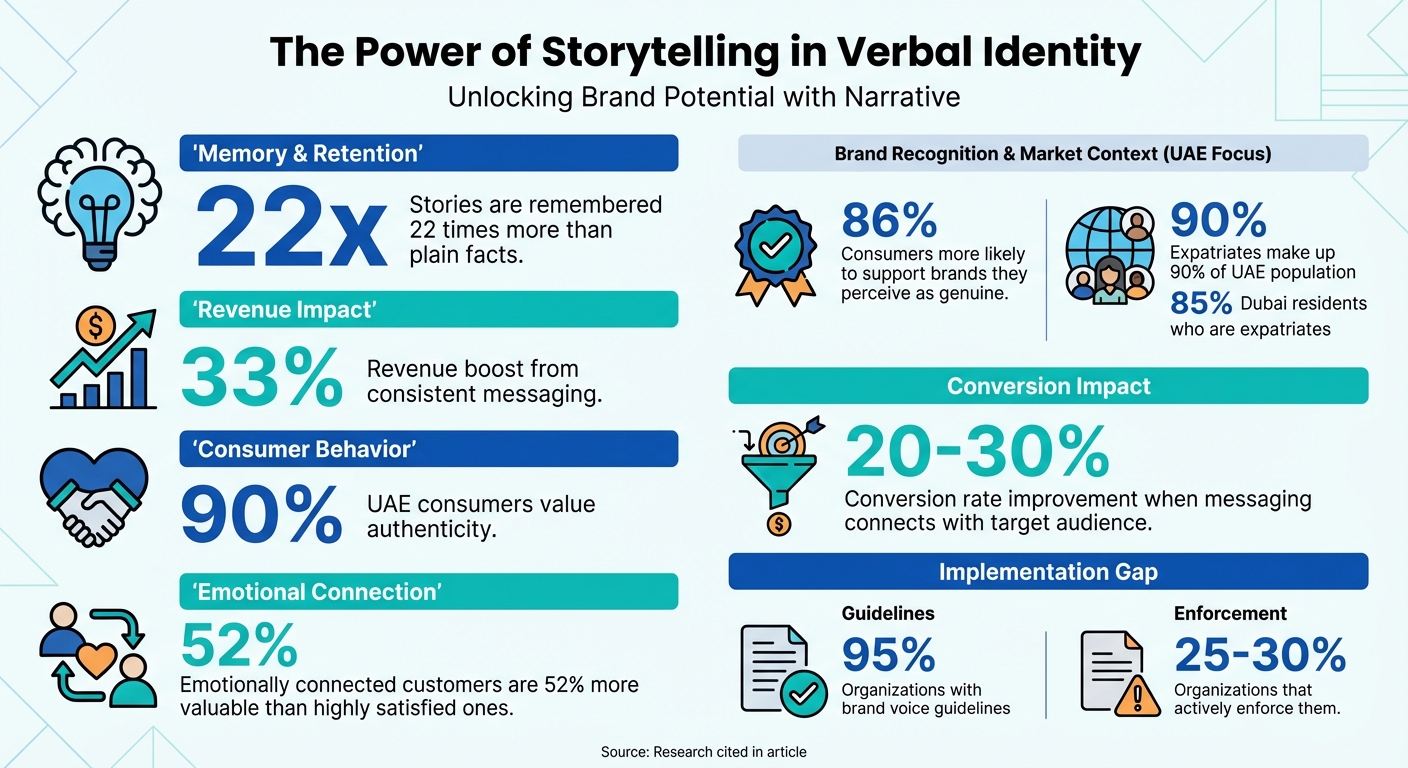
Key Statistics: How Storytelling Impacts Brand Verbal Identity
Common Problems in Building Consistent Verbal Identity
Even brands with strong visual identities can struggle when it comes to words. The challenge isn’t just about good writing – it’s about creating a consistent voice that resonates across every platform. Here are three common hurdles that can trip up efforts to build a cohesive verbal identity.
Inconsistent Messaging Across Channels
Imagine your brand sounding professional on LinkedIn but laid-back on Instagram. Or having customer support emails that read like legal contracts, while your website copy feels fun and conversational. These mixed signals confuse your audience and dilute your message. The root cause? Teams working in silos. Marketing might lean towards playful engagement, while Legal sticks to cautious, safety-first language. The result? A “patchwork of personalities” that lacks cohesion.
The absence of a brand toolkit often adds to the problem. Without it, team members and new hires interpret tone differently, leading to delays and inconsistencies. This becomes even trickier when handling multiple languages. A clever English slogan might lose its charm – or worse, its meaning – when translated into Arabic without the help of a native expert. These mismatches can weaken the emotional impact of your communication.
Weak Emotional Connection with Audiences
Focusing only on product features or drowning your audience in jargon can make even the best products forgettable. Why? Because it creates a barrier that stops your brand from forming genuine emotional connections.
This is especially true when cultural nuances are overlooked. For example, a tone that feels “confident” in English might come across as “aggressive” in Arabic, alienating your audience in the UAE. This disconnect is significant, especially when you consider that 86% of consumers say they’re more likely to support brands they perceive as genuine and relatable.
Missing Cultural and Regional Relevance
Cultural relevance is more than just a nice-to-have – it’s essential for connecting with diverse audiences. In the UAE, where expatriates make up 90% of the population but Emirati traditions remain deeply rooted, brands must strike a delicate balance. Ignoring these nuances can lead to messages that feel out of touch – or worse, offensive. For instance, a campaign that works in Western markets might clash with local religious or traditional values, damaging trust and reputation.
The mistake often lies in treating translation as a straightforward task, rather than a cultural adaptation. This is where transcreation – adapting messages to evoke the same emotions across cultures – comes into play. Unfortunately, it’s a step many brands skip. A successful verbal identity in the UAE must cater to different groups: Emirati nationals who value formality and heritage, Western expats who prefer straightforward communication, and Asian expats who focus on practicality. Without this cultural adaptation, a brand’s message risks losing its impact.
sbb-itb-6cae99a
How Storytelling Solves Verbal Identity Problems
Storytelling isn’t just about creativity; it’s a practical way to fix the gaps and inconsistencies that can weaken a brand’s verbal identity. When done right, it turns scattered messages into a cohesive narrative that connects with audiences across all platforms. Here’s how crafting a solid narrative, aligning your brand’s personality, and ensuring accessible content can tackle these challenges.
Building a Narrative Structure
Every story has a structure: context, conflict, and resolution. This same structure can serve as the backbone of your brand’s verbal identity. Start by setting the stage with market context, then highlight your customer’s challenge (the conflict). Position your brand as the guide offering solutions (the turning point), and finally, showcase the positive transformation (the resolution). By making the customer the hero of the story, you create a meaningful emotional connection. This structured storytelling approach is far more memorable than simply listing facts or features.
Matching Stories to Brand Personality
Consistency in tone doesn’t mean being monotonous. Your brand’s personality – shaped by its history, founders, and values – should stay constant, even as the tone shifts to suit different situations. For instance, Starbucks uses a spectrum of tones: from straightforward and informative for emails to expressive and editorial for campaigns. This balance ensures their voice is always recognisable. To achieve this for your brand, consider creating a tone map that adapts your messaging without losing the essence of your identity.
Making Content Accessible Through Stories
Stories adapt naturally to different formats and audiences, which is especially important in the UAE’s multilingual environment. Instead of direct translation, focus on transcreation – adjusting the story to evoke the same emotions in different languages. For example, Arabic storytelling often leans on poetic and symbolic elements, while English tends to favour clarity. Both can convey the same core message with thoughtful adaptation.
Additionally, with the rise of voice search and AI-driven tools like chatbots, your brand’s verbal identity must remain consistent across formats – whether it’s read, heard through a smart speaker, or experienced via a digital assistant. Stories provide the emotional thread that ties everything together. Using simple, clear language also ensures your content is accessible to people with diverse backgrounds and abilities. It’s worth noting that 52% of consumers expect brands to communicate at the right time, and storytelling helps you deliver the right message when it matters most.
How Brand Husl Develops Verbal Identity Through Storytelling

Full-Service Branding Solutions
Brand Husl has a structured five-step process – Discover, Develop, Design, Deploy, and Deliver – to craft a strong verbal identity.
- Discover: This phase involves understanding your target audience, analysing competitors, and identifying what makes your brand stand out.
- Develop: Insights gathered are shaped into a positioning strategy and a central idea that sets your brand apart in the minds of consumers.
In the Design phase, your verbal identity takes shape with tools like messaging frameworks, taglines, elevator pitches, and even brand naming. These elements ensure that every form of communication aligns with your brand. The Deploy stage focuses on maintaining consistency across all platforms, while Deliver ensures that your messaging remains unified and impactful over time.
This step-by-step approach addresses common challenges in verbal identity, ensuring your brand speaks with clarity, emotion, and relevance.
“We’re not just designers; we’re brand architects, storytellers, and problem solvers. Whether it’s branding, graphic design, social content, or motion, we craft work that doesn’t just look great – it performs.”
- Brand Husl
What sets Brand Husl apart is its unified team approach. The same group that defines your brand’s purpose and strategy also creates your website copy, develops social media content, and designs physical branding elements. This seamless integration ensures your brand narrative is cohesive and resonates on both local and global scales.
UAE Market Knowledge and Cultural Understanding
Brand Husl’s integrated process is enhanced by its deep understanding of the UAE market. With over 200 nationalities living in the UAE and both Arabic and English widely used in business, the agency tailors its branding strategies to this unique environment.
They focus on key elements like bilingual website development, integrating WhatsApp for commerce, and crafting messages that are culturally relevant. Their work with brands like ADCOOP, MAIR GROUP, and DIFC Courts highlights their ability to adapt to the UAE’s cultural and business landscape.
In sectors like luxury, hospitality, and real estate, Brand Husl balances tradition with modernity, ensuring that heritage and innovation coexist. They also audit visual elements for cultural sensitivity, making sure your brand story resonates authentically with diverse audiences. By combining strategic thinking with an understanding of the UAE’s cultural nuances, Brand Husl turns potential challenges into compelling brand narratives.
Measuring Storytelling’s Effect on Verbal Identity
Metrics to Monitor
To gauge how storytelling shapes your verbal identity, you’ll need to track both leading indicators (which predict future performance) and lagging indicators (which confirm results). Leading indicators include metrics like content compliance rates, vocabulary adherence, and readability consistency – these reveal whether your brand voice is aligning with your goals right now. On the other hand, lagging indicators, such as Net Promoter Score (NPS), branded search volume, and customer lifetime value (CLV), show whether your storytelling efforts are driving measurable business outcomes.
A great way to test the strength of your verbal identity is the Byline Test: remove your brand name and logo from your content. If people can still identify your brand through its voice, then your identity stands out. Additionally, tracking customer sentiment through feedback gives insight into whether your storytelling resonates emotionally. Why is this important? Research highlights that emotionally connected customers are over 52% more valuable to a brand compared to those who are merely “highly satisfied.”
For brands in the UAE, it’s also important to monitor engagement across bilingual content. Metrics like time-on-page can reveal whether story-driven content outperforms fact-heavy pages – longer engagement often signals a compelling narrative. With 70% of UAE shoppers favouring local products for their perceived authenticity, it’s crucial to assess how effectively your storytelling blends global appeal with local cultural nuances.
These metrics allow you to create a clear “before and after” picture of how storytelling impacts your brand’s verbal identity.
Before and After Comparison
Using these metrics, you can see how storytelling transforms verbal identity. Brands that consistently apply storytelling across all channels can achieve up to a 33% increase in revenue, while conversion rates improve by 20–30% when messaging directly connects with the target audience.
| Challenge | Storytelling Technique | Measurable Outcome |
|---|---|---|
| Inconsistent Messaging | Consistent style guides | Unified brand voice across all digital and physical touchpoints |
| Weak Emotional Connection | “Hero’s Journey” (customer as the hero) | Higher social media engagement (shares/saves) and stronger brand advocacy |
| Cultural Irrelevance | Bilingual voice adaptation & cultural metaphors | Greater trust and resonance with both Emirati and expat audiences |
| Low Brand Recall | Story-driven content (stories over facts) | 22x improvement in information retention and increased organic reach |
This shift addresses key challenges like inconsistent messaging, lack of emotional connection, and cultural disconnect.
To maintain these gains, conduct quarterly brand identity audits to spot gaps in storytelling execution and ensure teams follow brand guidelines. Interestingly, while 95% of organisations have brand voice guidelines, only 25–30% actively enforce them – highlighting the importance of regular measurement and enforcement.
Conclusion
Main Points to Remember
Storytelling has the power to unify scattered messaging into a cohesive brand voice. By crafting a clear narrative structure, brands can tackle common challenges like inconsistent messaging, weak emotional connections, and disconnects in diverse markets such as the UAE.
Research highlights the impact of storytelling: it enhances memory retention by 22 times and increases customer value by 52%. This makes it a powerful tool for creating content that consistently resonates with your audience.
In the UAE’s multicultural environment, storytelling serves as a bridge, connecting local heritage and values – like hospitality, family, and ambition – with the diverse population, including the 85% of Dubai residents who are expatriates. This approach goes beyond simple translation, adapting messages to emotionally resonate in both Arabic and English while respecting the region’s poetic traditions.
Brand Husl helps brands turn their verbal identity into a competitive edge. Whether it’s identifying storytelling gaps through brand audits or building messaging frameworks that work across platforms like digital media, packaging, and signage, they ensure a consistent and impactful brand voice.
Your verbal identity shapes how people perceive your brand in every interaction. When rooted in storytelling, it creates a voice that’s not only recognised and remembered but also trusted – turning one-time transactions into lasting relationships and customers into loyal advocates. By embracing this approach, you can strengthen your brand’s voice while building long-term trust with your audience.
FAQs
What is a verbal identity in branding?
A verbal identity in branding is all about how a brand speaks and communicates. It involves the strategic use of language, tone, and messaging to showcase the brand’s personality, values, and character. By creating a consistent voice, it helps the brand become more recognisable and builds a stronger emotional connection with its audience. Whether it’s through ads, social media, or customer interactions, verbal identity shapes how a brand communicates at every touchpoint.
How can storytelling keep my brand voice consistent across channels?
Storytelling helps maintain a consistent brand voice by weaving a unified narrative that mirrors your brand’s personality, tone, and core values. It ensures your messaging is aligned across various platforms, making your brand both recognisable and relatable.
In the UAE’s richly multicultural environment, storytelling plays an even more vital role. It helps navigate cultural nuances, allowing your brand to connect genuinely with diverse audiences while preserving a cohesive and unified voice across all communication channels.
How do I adapt stories for Arabic and English in the UAE?
To effectively craft stories for both Arabic and English audiences in the UAE, the key lies in transcreation – reshaping narratives to maintain their emotional depth and cultural resonance in each language. A word-for-word translation simply won’t cut it; it risks losing the intended meaning or, worse, causing unintended offence.
To truly connect, weave in elements of local traditions and values that reflect the UAE’s rich multicultural fabric. At the same time, ensure your brand’s tone and central message stay aligned across both languages. This approach helps create a unified and culturally aware identity that resonates with diverse audiences.
Related Blog Posts

BRAND HUSL
We’re a collective of brand strategists, designers, and unapologetic truth-tellers who’ve spent over two decades turning chaos into clarity for businesses across the globe. From global names to fearless startups, we’ve built brands that stick, scale, and sell—without the fluff. Everything we create is rooted in strategy, storytelling, and ROI, because good branding isn’t just pretty—it’s powerful.