

Your brand identity is more than just a logo – it’s how your business is perceived and trusted by customers. In the UAE, where businesses face a competitive and diverse market, keeping your brand current is essential. Here are 10 clear signs that it’s time to update your brand identity:
- Outdated Visuals: If your logo or design elements look old-fashioned or don’t work well on digital platforms, it’s time to modernize.
- Inconsistent Branding: Variations in your logo, colours, or tone across platforms confuse customers and weaken trust.
- Weak Messaging: If your brand story doesn’t connect with your audience or feels generic, it’s time to refocus.
- Shifting Audience: As your customers evolve, your brand must align with their expectations and values.
- Lack of Differentiation: If your branding looks or sounds too similar to competitors, you risk being overlooked.
- Outdated Market Position: If your brand no longer reflects current trends or consumer priorities, you’re losing relevance.
- Unrecognizable Across Channels: Customers should instantly identify your brand, whether on social media, your website, or print materials.
- Misaligned Values: If your brand values don’t reflect your company culture or customer expectations, it’s time for a reset.
- Outdated Website: A clunky, old website or poor mobile experience can harm your credibility.
- Audit Findings: If a brand audit reveals low recognition or negative customer perception, action is needed.
In the UAE, where 94% of businesses are SMEs, staying visually and strategically relevant is critical. A brand refresh or rebrand can improve recognition, trust, and revenue by up to 23%. Start by auditing your brand identity to identify gaps, then update visuals, messaging, and values to align with today’s market demands.
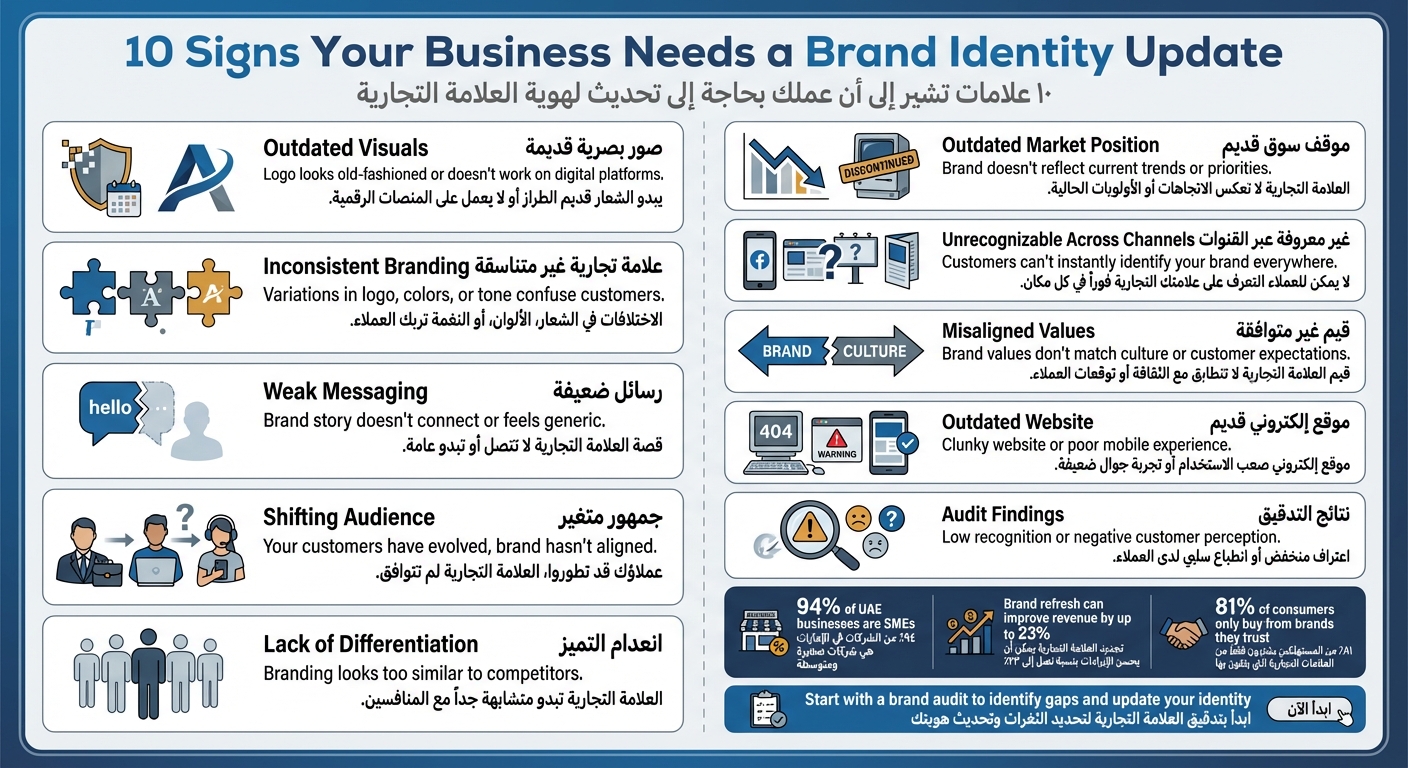
10 Signs Your Business Needs a Brand Identity Update
When Should You Rebrand Your Business? These 5 Signs Will Tell You!
sbb-itb-6cae99a
1. Your Visual Design Looks Old and Dated
Visual design is your brand’s handshake – it’s what customers notice first. In fact, 55% of first impressions are based on visuals. If your logo is packed with gradients, heavy drop shadows, or outdated elements, it screams that your business hasn’t kept up with modern trends. As Patty Tulloch, Co-Founder and Creative Director at DoubleShot Creative, aptly says:
"If your logo looks like it belongs in a time capsule next to an original iPhone, we need to talk".
Outdated design doesn’t just look bad – it can hurt your revenue. Brands with consistent visuals across platforms can see revenue increases of up to 23%. On the flip side, outdated branding erodes trust, which is crucial for 81% of consumers when deciding which brands to support. In the UAE, where expectations are high for brands to balance aspiration and authenticity, a dated design could cost you potential customers before they even hear your pitch.
Here’s a quick test: shrink your logo down to favicon size. Does it turn into an unrecognisable blob or lose important details? If yes, it’s time to rethink your design. Leading brands like Mastercard and Instagram have already transitioned from complex, skeuomorphic designs to sleek, flat aesthetics that work seamlessly in today’s digital world.
Typography and colour choices also play a big role in staying visually relevant. Fonts like Comic Sans or overly trendy typefaces can make your brand seem out of touch. Similarly, outdated or dull colour palettes can clash with modern displays, making your brand feel irrelevant. Consistency across platforms is key – if your website looks polished but your Instagram feels like it’s stuck in the past, it creates confusion and weakens your brand image.
Since 2020, 75% of companies have undergone a rebrand, showing that updating your visual identity is now the norm. Start by auditing your website, social media, and print materials for inconsistencies using a structured brand toolkit. Then, prioritise updating the elements that have the biggest impact on customer perception. Finally, ensure your refreshed visuals align with what your audience expects today.
2. Your Logo and Fonts Don’t Match Current Design Standards
Your logo and typography play a huge role in showing whether your brand is keeping up with modern design trends. Outdated elements like heavy gradients, bevels, or 3D effects in your logo can make your brand seem stuck in the past. The same goes for using fonts like Papyrus or other overused typefaces from the early 2000s – they instantly date your business and may give off an unprofessional vibe.
Today’s design standards favour simplicity and adaptability. A quick test? Try displaying your logo in one colour on a white background. If it loses its meaning or becomes unrecognisable, it’s likely too complicated for the digital-first world. Another test is scalability – shrink your logo to a tiny 16×16 pixel favicon. If the details blur or the text becomes unreadable, the design won’t perform well on mobile screens or social media profiles. These are often the first places potential customers encounter your brand, so a poorly functioning logo can hurt your brand’s impact and consistency.
File format matters, too. Using low-quality .jpg files instead of scalable vector formats (.ai, .eps, .svg) can result in blurry or pixelated logos on high-resolution displays. This isn’t just a cosmetic issue – 68% of companies say that consistent branding, including logos and fonts, has driven revenue growth of 10% to over 20%.
Take Burger King as an example. In January 2021, they ditched their outdated "blue swoosh" logo from 1999 in favour of a retro-inspired design. The refresh included a custom font called "Flame" and a colour palette that echoed their food. The result? Over one billion media impressions in just a few days and a noticeable boost in purchase intent. Similarly, Mailchimp revamped its branding by simplifying its "Freddie" mascot, adopting a bold new logo, and making bright yellow its signature colour. These changes helped the brand evolve into a full marketing platform while keeping its playful identity intact.
Here’s a simple exercise: line up your logo with those of your top three competitors. Does yours look outdated or less polished? If so, it could be costing you credibility. In the UAE’s highly competitive market, where sleek and professional visuals are a must, an outdated logo can drive customers toward brands that project a more modern and refined identity.
3. Your Brand Message Doesn’t Connect with Your Audience
A sleek logo and modern typography might grab attention, but your brand message is what keeps people engaged. It’s the story behind your business – who you are, what you do, and why it matters. If that story doesn’t resonate, the disconnect becomes obvious. When your key messages fail to spark interest or are too complicated for even your team to explain clearly, it’s a sign something’s off.
Here’s a quick test: ask three of your employees to describe your business in one sentence. If their answers are wildly different, your messaging lacks focus. Similarly, if your homepage headline sounds generic – like something any competitor could say – it’s not leaving an impression. In a fast-moving market like the UAE, where consumers value both professionalism and personality, unclear or overly formal messaging can drive people straight to a competitor who feels more relatable.
The stats don’t lie. 81% of consumers prefer buying from brands they trust, and trust begins with messaging that feels honest and relevant. Plus, 68% of customers say a brand’s story influences their buying decisions. When paired with modern visuals, a clear and engaging message ensures your brand not only looks polished but also connects with your audience. On the flip side, if your story feels inauthentic or disconnected, you risk losing potential revenue – consistent branding across platforms can boost revenue by as much as 23%, but only if your message lands.
"If your brand voice feels stiff, robotic, or like it was written by someone who’s never had a casual conversation, you’re creating walls instead of building bridges." – DoubleShot Creative
Take a moment to evaluate your current messaging. Does it reflect who you are, or does it sound like every other business in your industry? Are your values specific and meaningful, or just overused buzzwords like "innovation" and "synergy"? If your tagline feels vague or uninspired, it’s time to rethink it. In a diverse, tech-savvy market like the UAE, people expect brands to have a clear purpose and communicate in a way that feels authentic, not rehearsed.
4. Your Target Audience Has Changed or Grown
Audiences don’t stay the same forever – they evolve. Whether you’re transitioning from serving local SMEs to multinational corporations or launching new product lines, your brand identity needs to keep up. If your audience changes due to growth, expansion, or shifting behaviours, and your brand doesn’t adapt, you risk losing relevance.
Here’s a telling statistic: 40% of consumers in 2024 regularly try new brands. In a world where loyalty is fleeting, 80% of consumers now expect personalised experiences. Personalisation starts with knowing exactly who you’re speaking to. In the UAE’s diverse and dynamic market, where businesses often expand across the GCC or attract international clients, a one-size-fits-all brand identity simply won’t cut it. Just as outdated visuals can weaken your brand, failing to align with your audience’s expectations can erode both trust and revenue. To stay competitive in this market, your branding must reflect the needs and values of your evolving audience.
The numbers highlight the importance of understanding your audience. Start by reviewing your engagement data. Are your social media interactions declining or your website visits stagnating? These could be signs that your messaging no longer resonates. If your marketing is reaching the wrong people or failing to engage your ideal customers, it’s time to rethink your strategy. For instance, when Dunkin’ dropped "Donuts" from its name in 2018 to focus on beverages, it successfully reconnected with a broader, modern audience. The result? Increased sales the following year.
"Ultimately, our job is to compel people to want to have the products." – Ani Fonte, Senior VP of Business and Brand, Betty
Ignoring audience shifts comes with risks. For example, 62% of consumers expect brands to address social and environmental issues. If your brand remains neutral or outdated on the topics your audience cares about, competitors who adapt will leave you behind. Regularly audit your brand identity, update your audience personas, and use tools like social listening to stay connected to demographic changes. Another red flag? If your employees struggle to explain your mission to new customers, it’s a clear sign that your brand hasn’t kept up with market realities.
5. Your Brand Doesn’t Stand Out from Competitors
Having modern visuals and clear messaging is important, but it’s not enough to make your brand stand out in the competitive UAE market. If your logo, colours, and messaging look too similar to your competitors, potential customers might overlook you entirely. When your brand blends into the crowd, it risks becoming invisible.
A common mistake is relying on industry-standard colours and overused buzzwords. Think about it: tech companies often lean on blue, consultancies stick to corporate grey, and phrases like "innovation" and "excellence" are everywhere. While consistency is crucial – consistent brands are 3.5 times more visible than inconsistent ones – it won’t matter if your brand lacks distinction. If even your sales team struggles to explain what makes your brand different, it’s time to rethink your strategy. In a market where every detail matters, standing out is non-negotiable.
"If your brand blends in, people won’t notice you. Worse, they may just pick the competitor next to you." – Duck.Design
The cost of being forgettable is high. On the other hand, brands that connect with customers on a values level retain 89% of their customer base. True differentiation isn’t just about aesthetics – it’s about showing what your brand stands for. If your website looks like a copy of your competitors’ or if your name is easily confused with theirs, you could be losing revenue to brands that dare to take a bolder approach.
To address this, start with a competitive analysis. Look at your top five competitors and identify areas where your brand overlaps with theirs. Are you using the same colours, fonts, or messaging? If so, consider a bold change – maybe a completely different colour palette. Revise your messaging to remove generic claims and focus on specific, evidence-backed statements. Most importantly, refine your Unique Selling Proposition into one powerful sentence. Remember, 64% of consumers say shared values are the main reason they connect with a brand. Make sure your values stand out loud and clear.
6. Your Brand Position Doesn’t Match Current Market Trends
Markets evolve quickly, and what worked yesterday might not work today. If your brand position hasn’t kept pace with shifts in the industry, customer expectations, or broader societal movements, you may find yourself losing relevance. In the UAE’s dynamic business landscape, staying aligned with current trends isn’t just helpful – it’s critical for staying competitive.
Consider this: nearly 75% of shoppers switched brands in the past year. This highlights how easily consumers move on from brands that no longer resonate with them. You might notice signs like reduced social media engagement, declining sales in key areas, or having to discount products more heavily just to maintain sales. These are red flags that your brand needs to realign with what today’s consumers value. Perhaps your competitors are embracing new business approaches or adopting messaging that reflects sustainability and social responsibility while your brand remains stuck in a transactional mindset.
Take Campbell Soup Company as an example. In September 2024, under the leadership of CEO Mark Clouse, the company rebranded itself as "Campbell’s" to reflect its broader portfolio, which now includes snacks and other food products beyond its iconic soups. Clouse explained:
"This subtle yet important change retains the company’s iconic name recognition, reputation and equity built over 155 years while better reflecting the full breadth of the company’s portfolio."
To ensure your brand remains relevant, it’s essential to monitor key metrics like ad awareness, message recall, and purchase interest regularly. Keeping an eye on your competitors can also help you spot emerging trends and innovations. Most importantly, gather feedback directly from your audience through surveys and social media interactions. Today’s consumers expect more: 64% say shared values drive their loyalty to brands, and 62% want companies to take a stand on social and environmental issues. If your brand isn’t aligning with these priorities, you risk being left behind. Staying attuned to market trends and adapting your brand position is no longer optional – it’s a necessity for long-term success.
7. Customers Can’t Recognise Your Brand Across Different Channels
Having modern visuals is important, but it’s just as crucial to maintain consistency across all platforms. When your branding – both visual and verbal – varies from one channel to another, it can confuse your audience. Imagine having a sleek, updated website but pairing it with an Instagram account that looks outdated, or a formal tone on LinkedIn while posting casually on Facebook. These mismatched signals weaken brand recall and erode trust. And the financial impact? It’s real and measurable.
Consider this: brands that maintain consistency are 3.5 times more likely to be recognised by consumers compared to those that don’t. Even more striking, consistent branding across all channels can boost revenue by up to 23%. On the flip side, using different logo versions or keeping outdated email signatures while updating your website creates a disconnect. This often happens when brand guidelines are treated as informal knowledge – like one marketing expert at LimeLight Marketing jokingly remarked:
"Ask Sarah – she knows which blue we use"
Instead of being written down and accessible, these guidelines end up being passed around verbally. The result? Teams or agencies make independent branding decisions, leading to a fragmented presence that damages trust and ultimately hurts your bottom line. Keep in mind that 55% of first impressions hinge on visual consistency, and trust is everything – 81% of consumers stick to brands they recognise and feel familiar with.
To fix this, start by conducting a multi-channel audit. Take a close look at your website, social media profiles, email templates, and even printed materials to spot inconsistencies in visuals or messaging. Then, create a centralised, living brand style guide. This should include all the essentials – logos, fonts, colours, and tone of voice – so it’s easy for everyone, from employees to external partners, to stay aligned. Whether someone interacts with your brand on Instagram, visits your website, or reads an email, they should instantly recognise it as you.
8. Your Brand Values Don’t Match Your Company Culture or Customer Expectations
When your brand values are just empty buzzwords, it’s time to reassess. This disconnect becomes obvious in two key areas: internally, when your team struggles to define what your brand truly represents, and externally, when customers notice a gap between what you promise and what you deliver.
Here’s something to think about: 64% of consumers say shared values are the main reason they form a relationship with a brand. Even more striking, 82% of consumers worldwide prefer to buy from brands that align with their personal values. In a competitive market like the UAE, where trust and credibility hold significant weight, these stats underline the importance of aligning your brand values with both your company culture and customer expectations. Just like updating your visuals or messaging, ensuring your brand values are in sync is essential to staying relevant.
A glaring issue is what Patty Tulloch, Co-Founder & Creative Director at DoubleShot Creative, refers to as "Buzzword Bingo" values. She explains:
"If your brand values could apply to literally any company, they’re not doing their job."
Words like "Innovation", "Excellence", or "Synergy" might sound polished, but they often fail to reflect what makes your brand unique. Worse yet, when your actions contradict your stated values – like claiming to prioritise sustainability while relying on wasteful, non-recyclable packaging – you risk losing customer trust.
Another red flag? If your business cards or website no longer represent your company’s identity, it’s a sign your brand values are out of touch. Your values should actively influence how your business operates. With 75% of companies rebranding since 2020 to adapt to shifting consumer demands, outdated values can quickly become a liability. Misaligned values confuse both your team and your customers, making it clear that a brand refresh isn’t just optional – it’s necessary to maintain a cohesive and authentic identity.
9. Your Website and Digital Channels Look Outdated Next to Competitors
Your website is often the first impression potential customers have of your brand. As Patty Tulloch, Co-Founder & Creative Director at DoubleShot Creative, says:
"Your website is often the first impression potential customers have of your brand. If it looks like it was built when people still said ‘information superhighway,’ you’re losing credibility before anyone even reads your content."
If your site feels like a relic from another era, you risk losing credibility before visitors even engage with your content. An outdated design doesn’t just hurt your brand’s image – it can also make navigating your website on modern devices a frustrating experience.
In 2026, having a desktop-first website isn’t just outdated – it can directly hurt your conversions. Nick Biela from The Diamond Group explains:
"If your website was built for desktop first, it shows. And in 2026, that is not just a design problem. It is a conversion problem."
When visitors struggle to locate a contact button on mobile or deal with clunky navigation, they’ll likely turn to a competitor with a smoother, more responsive site. Even a small improvement in site speed – just 0.1 seconds – can boost retail conversions by 8% and travel conversions by 10%. A modern, user-friendly digital presence not only enhances functionality but also strengthens your brand’s overall identity by aligning with today’s customer expectations.
Consistency across platforms matters more than you think. If your visuals, logos, or branding look mismatched across channels, it confuses customers and undermines trust. Research highlights that consistent brands are 3.5 times more visible than inconsistent ones, and consistent branding across all channels can increase revenue by up to 23%. For instance, if your logo doesn’t scale properly to fit a 16×16 pixel favicon or you’re still relying on generic stock photos instead of authentic images of your team or work, it signals that your brand hasn’t kept up with modern standards. These small details can make a big difference in how your brand is perceived.
Beyond aesthetics, technical compliance is equally critical. Poor accessibility doesn’t just pose legal risks – it also sends a message that your brand is out of touch. Failing to meet WCAG Level AA standards, such as using inadequate colour contrast, signals to users that inclusivity and modernity aren’t priorities for your business. In the UAE, where 55% of a consumer’s first impression comes from visuals, neglecting these factors could drive potential customers straight to your competitors. A well-designed, accessible website is no longer optional – it’s essential.
10. Your Brand Audit Shows Problems with Recognition or Customer Perception
A brand audit is like holding up a mirror to see how your brand is actually perceived compared to how you think it is. If the results highlight weak brand recall, confusion with competitors, or negative sentiment, it’s a clear signal that your brand identity needs immediate attention.
When customers struggle to remember your name or confuse you with competitors, it’s not just a marketing issue – it’s a visibility problem in an already crowded market. Weak recall often stems from an indistinct brand identity. If your audit shows that potential clients can’t explain your value or frequently mistake you for someone else, your brand risks fading into the background.
This confusion on the outside often reflects deeper issues within the business. For instance, if employees hesitate to share your website or hand out business cards, it’s what Brian Lischer, Founder of Ignyte Brands, calls the “cringe test.”
"If you cringe a little when you reach for your business card… it’s probably time for a rebrand."
Internal disconnects can be just as damaging as external ones. If your team uses mismatched logos in presentations or avoids mentioning your company during networking events, it’s a sign your brand has lost credibility. This lack of alignment can hurt your ability to stand out or charge premium prices, as customers may see you as just another generic option.
A thorough brand audit can help pinpoint exactly where things are going wrong. Take Pabst Blue Ribbon, for example. In 2001, the beer brand was struggling, with sales dropping below one million barrels. After conducting a strategic audit, they repositioned themselves as a quality, American-made beer. By 2009, sales jumped by 25%, eventually hitting 92 million gallons sold in 2012. Similarly, Subway’s 2016 rebrand came after a 3.4% sales drop in 2015. Insights from their audit helped them create a "clear and confident" image, restoring consumer trust.
These examples show that acting decisively on audit findings can shift perceptions and spark growth. A brand audit isn’t just about identifying problems – it’s about uncovering opportunities to rebuild trust and stand out.
When to Refresh Your Brand Versus When to Rebrand Completely
Knowing how to know when your brand needs a makeover or a full rebrand can make a big difference in both time and cost. A brand refresh involves small updates – like tweaking your logo, adjusting colours, or modernising typography – while keeping your core identity intact. A full rebrand, on the other hand, is a complete overhaul, redefining your mission, values, and overall market positioning.
If your brand feels outdated but still aligns with your mission, a refresh might be all you need. Take Walmart as an example: they updated their colour palette and typography while keeping their iconic logo. Similarly, Mastercard embraced a cleaner, more digital-friendly design. These are cases where a refresh successfully modernised the brand without altering its essence.
However, there are times when a refresh simply isn’t enough. If your business identity has fundamentally shifted, it may be time for a full rebrand. Facebook’s transformation into Meta in October 2021 is a prime example. The company introduced a new name, an infinity-loop logo, and repositioned itself to reflect its focus on the metaverse. Dunkin’ also made a bold move between 2018 and 2019 by dropping "Donuts" from its name. This change signalled a shift from being doughnut-centric to becoming a beverage-led competitor in the coffee market, all while maintaining its iconic pink-and-orange colour scheme.
"A rebrand should point to where you’re going, not just where you’ve been." – Canny Creative
The scope and stakes vary greatly between these two approaches. A brand refresh typically costs around AED 183,500 and takes 4–6 months, whereas a full rebrand can exceed AED 1,835,000 and take up to a year. While a refresh helps preserve brand equity, a full rebrand may temporarily challenge customer recognition. Research shows that 75% of companies have updated their branding since 2020, and consistent branding across channels can boost revenue by as much as 23%. Deciding between a refresh and a full rebrand is a critical step in ensuring your brand remains relevant and competitive.
How to Implement Your Brand Identity Update
Start with a thorough brand audit. Evaluate your core purpose, vision, mission, and values to ensure they align with your current business direction. Review your visual identity – check if your logo functions well across both digital and print platforms, and assess whether your colour palette and typography still connect with your audience. Conduct targeted surveys to understand how your brand is perceived. In the UAE’s dynamic market, this groundwork is essential before diving into design updates. These insights will help you craft updates that align with your business goals.
After completing your audit, ensure your updates align with your business objectives and local cultural expectations. In the UAE’s multicultural environment, your brand should reflect both Emirati values and the diverse norms of the expat community. Pay special attention to Arabic typography and right-to-left (RTL) layouts for effective bilingual communication. Test new messaging and designs with various local groups to ensure they resonate. Keep in mind that 64% of consumers say shared values are the main reason they form connections with brands.
Develop a comprehensive brand style guide to maintain consistency across all platforms. This guide should outline the proper use of your logo, fonts, colours, and imagery to create a unified brand experience.
"A brand identity refresh is not just about a visual update – it’s a strategic process to realign your brand with the present and future." – Octopus Marketing Agency
Once your audit and strategy are in place, introduce changes gradually to ensure a smooth transition. Start by rolling out the new identity internally with training sessions to prepare your team as brand ambassadors. Then, update external channels like email, social media, advertisements, and PR simultaneously to create awareness and avoid confusion. In the UAE, a brand identity refresh typically takes 3 to 5 weeks, depending on the complexity of bilingual designs. Test major elements with select groups before launching the full update.
Conclusion
Your brand identity is always evolving. Markets shift, customer expectations change, and design trends come and go. If your visuals feel outdated, your messaging doesn’t connect, or your brand no longer grabs attention, it’s a clear sign that it’s time for a refresh. Overlooking these signals can hurt your reputation – outdated or inconsistent branding can weaken recognition and even impact revenue potential.
The good news? Keeping your brand in check doesn’t always mean a complete overhaul. In fact, consistent branding across all channels can boost revenue by up to 23%, and 81% of customers say they only buy from brands they trust. A well-thought-out refresh, tailored to your current goals, values, and audience expectations, can strengthen that trust and help your business stay competitive.
"Your brand is one of your most valuable business assets. Investing in its health and relevance isn’t vanity – it’s smart business strategy that directly impacts how customers see you, trust you, and ultimately choose you." – Patty Tulloch, Co-Founder & Creative Director, DoubleShot Creative
FAQs
How do I know if I need a refresh or a full rebrand?
A brand refresh works best when your core identity still aligns with your business but could use some updates – like tweaking visuals or refining your messaging to stay current. On the other hand, a full rebrand becomes essential when your brand no longer connects with your audience or reflects significant shifts in your business, such as expanding into new markets or adopting new values. If your brand feels old but still on track, go for a refresh; if it’s out of sync, it’s time to rebrand.
What should a brand audit include for a UAE business?
A brand audit for a UAE business involves examining several key areas to ensure alignment with local expectations and preferences. Start with the visual identity – this includes logos, colour schemes, and overall design, ensuring they resonate with the UAE audience. Next, evaluate messaging consistency across all platforms to maintain a unified voice. Additionally, review your market positioning to confirm it reflects local tastes and cultural values.
Another critical aspect is analysing competitor differentiation. Understand how your brand stands out in the crowded UAE market. Finally, assess your digital presence by monitoring metrics like website traffic and social media engagement. This helps ensure your brand remains relevant in the UAE’s fast-changing market. Paying close attention to these details and adapting to local nuances is key to staying competitive.
How can I update my brand without confusing existing customers?
To refresh your brand without leaving customers feeling lost, focus on clear communication and retain key elements they already associate with your business. Start by creating a detailed brand guideline that includes your visuals, tone of voice, and overall narrative to keep everything consistent. Be transparent about why you’re making these changes, highlighting how it reflects your dedication to quality and growth. Roll out updates gradually, either across different channels or in stages, so customers have time to adjust. This approach allows you to modernise your brand while maintaining the familiarity and trust you’ve built over time.
Related Blog Posts

BRAND HUSL
We’re a collective of brand strategists, designers, and unapologetic truth-tellers who’ve spent over two decades turning chaos into clarity for businesses across the globe. From global names to fearless startups, we’ve built brands that stick, scale, and sell—without the fluff. Everything we create is rooted in strategy, storytelling, and ROI, because good branding isn’t just pretty—it’s powerful.