

When your brand feels outdated, the choice between a brand refresh and a rebrand is key. A refresh updates your visuals and messaging while keeping your core identity intact with a structured brand toolkit – ideal for staying relevant in a fast-moving market like the UAE. A rebrand, however, is a complete overhaul of your identity, including your name, logo, and values, often necessary for major business shifts or entering new markets.
Key Points:
- Brand Refresh: Minor updates like logo tweaks, new colours, or refined messaging. Costs range from AED 80,500 to AED 367,500 and take 4–8 weeks.
- Rebrand: A full transformation, changing everything from visuals to your mission. Costs start at AED 400,000 and can take 6–18 months.
- Choose a refresh when your identity is solid but outdated. Opt for a rebrand if your business direction or audience has shifted significantly.
Quick Comparison:
| Aspect | Brand Refresh | Full Rebrand |
|---|---|---|
| Scope of Change | Visual updates (logo, colours) | Complete overhaul (name, values) |
| Timeline | 4–8 weeks | 6–18 months |
| Cost | AED 80,000–AED 367,500 | AED 400,000+ |
| Risk Level | Low | High |
| Triggers | Outdated design, minor shifts | Business pivots, new markets |
Evaluate your brand’s needs through a thorough audit to decide the right path forward.
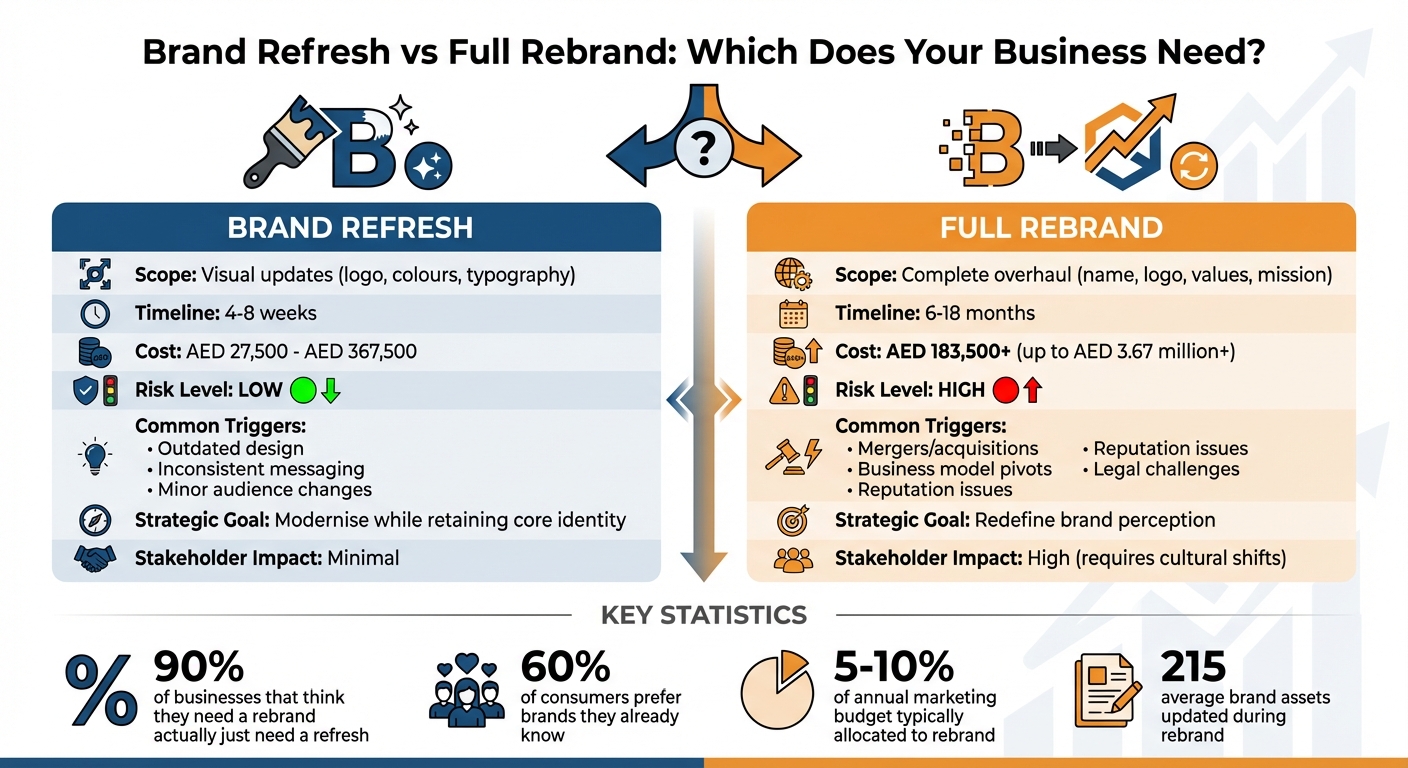
Brand Refresh vs Full Rebrand: Cost, Timeline and Risk Comparison
Rebrand vs Refresh: Which Strategy is Right for Your Business?
sbb-itb-6cae99a
What is a Brand Refresh?
A brand refresh is an update to your existing identity that keeps your core mission, values, and DNA intact while polishing your visual and verbal elements. It’s about refining, not reinventing. Think of it as giving your brand a fresh coat of paint while preserving its essence.
"A brand refresh is about staying relevant without losing yourself. It’s modernisation, not reinvention."
- Luke Burrell, Author
The main distinction here is preservation. While a rebrand involves completely starting over, a refresh focuses on refining visuals and messaging while leveraging the equity you’ve already built. This approach is lower risk, more cost-effective, and ensures your brand stays relevant in a fast-changing market like the UAE, where digital platforms are constantly evolving. From Instagram stories to payment apps, a refresh ensures your identity works across all touchpoints without alienating your existing audience.
Interestingly, about 90% of businesses that think they need a full rebrand actually just need a strategic refresh. A well-planned refresh can breathe new life into your brand, extending its relevance for years, without the disruption and expense of a complete overhaul. Here’s a closer look at what makes a brand refresh effective.
Main Elements of a Brand Refresh
A successful brand refresh focuses on visual and verbal updates while keeping your core strategy intact. On the visual side, this might include subtle adjustments to your logo for better clarity, introducing new secondary colours for versatility, or updating typography to improve readability on mobile devices. The aim is to modernise while maintaining consistency.
For example, Google updated its logo in 2015, switching to a cleaner, geometric sans-serif font and introducing a simplified "G" icon. Similarly, Starbucks refined its logo in 2011, removing the "Starbucks Coffee" text and leaving only the iconic siren, making it more adaptable for digital use.
Even smaller businesses can see big results with targeted updates. Take a local bakery that worked with Inkbot Design: they swapped out an overly decorative script font for a bold, clean sans-serif. This change made their name easier to read on delivery vans and packaging, leading to a 20% sales increase in six months.
"A brand refresh is a strategic operation, not a mere cosmetic update. If you skip the process, you’re just wasting money on expensive guesswork."
- Stuart L. Crawford, Creative Director, Inkbot Design
Verbal updates are equally important. These might involve fine-tuning your tone of voice, updating taglines, or aligning your mission statement with your current direction.
When You Need a Brand Refresh
A brand refresh is the right move when your core identity is solid, but the visual or verbal elements feel outdated or inconsistent. This could be due to design trends evolving, your brand not translating well to mobile platforms, or inconsistencies across different channels.
It’s also a practical choice for businesses with limited budgets or tight timelines. A professional refresh for an SME typically costs between AED 69,700 and AED 128,600 and takes around 1 to 2 months. It’s an efficient way to modernise without the disruption of a full-scale rebrand.
A refresh can also help if your target audience has shifted slightly – perhaps engaging more through digital channels – while your core customer base remains the same. For example, in early 2025, Walmart updated its visual identity by keeping its signature blue tones but modernising its font and graphics to appear more vibrant and contemporary.
Experts recommend conducting a brand audit every three years to ensure your identity aligns with your goals and stays competitive in the market.
What is Rebranding?
Rebranding is a complete transformation of your company’s identity. It goes beyond tweaking a logo or updating your tagline – it’s about redefining everything from your name and visual elements to your mission, values, and market positioning. Unlike a brand refresh, which keeps the essence of your brand intact, rebranding signals a total reinvention to align with new goals.
"A rebrand is the process of fundamentally changing an organisation’s corporate image."
- Stuart L. Crawford, Creative Director, Inkbot Design
Rebranding reshapes how a company is perceived. Take Justin.tv, for example. When it rebranded as Twitch in 2014, the company didn’t just change its name; it shifted its entire focus to video game streaming. This bold move led to Amazon acquiring Twitch later that year for $970 million. Similarly, Dunkin’ Donuts dropped "Donuts" from its name in 2018, adopting a brighter, modern logo to emphasise its identity as a coffee-first, convenience-driven brand.
Rebranding is no small feat. On average, companies revamp around 215 brand assets, dedicating 5–10% of their annual marketing budget to a process that usually takes 7 to 18 months. For mid-sized businesses, professional rebranding costs in 2026 start at AED 183,500 and can exceed AED 550,500.
"A refresh modernises how your brand is perceived; a rebrand changes what your brand stands for. The first is about relevance, the second is about reinvention."
- Theory House
Main Elements of Rebranding
Rebranding involves rebuilding every facet of your brand. Visually, this means creating a new logo, colour palette, typography, and design system. Verbally, it includes crafting a new name, tagline, brand story, and messaging framework. The strategic core also gets an overhaul, with updated mission, vision, and value statements, along with a revised positioning strategy.
Beyond these foundational changes, rebranding touches every aspect of your business. It affects your website, packaging, social media presence, and even internal culture. Legal steps, such as securing new trademarks or updating your registered company name, are also part of the process.
In 2026, brands are integrating modern elements into their rebranding efforts. Audio branding, such as sonic logos and audio signatures for voice search, is gaining popularity. Some companies are adopting blockchain-based verification to offer "Digital Product Passports", which validate claims about their values and practices. Meanwhile, bold, maximalist visuals are replacing minimalist designs to stand out in an increasingly AI-driven world.
When You Need Rebranding
Rebranding becomes essential when your current identity no longer aligns with your business direction. One common trigger is mergers, acquisitions, or spin-offs, where a unified new identity is crucial.
A strategic pivot can also necessitate a rebrand. For example, when G Fuel shifted from being a niche supplement to a leading energy drink for gamers, its new identity helped drive annual sales to $350 million. The original brand simply couldn’t support this new vision.
Other reasons to rebrand include targeting a new audience, addressing a reputation crisis, expanding into global markets where your current identity doesn’t resonate, or resolving legal disputes over trademarks.
"A rebrand isn’t a cosmetic fix; it’s a strategic necessity. It’s the only real path forward when a company’s mission, vision, and values have fundamentally changed."
- Theory House
Before diving into a rebrand, it’s crucial to conduct a thorough brand audit and market research. The gap between how your brand is currently perceived and where you want it to be must be substantial enough to justify the time, cost, and potential risks involved. A poorly executed rebrand can have disastrous consequences – Gap’s 2010 logo redesign faced such intense backlash that it was scrapped within a week.
Ultimately, the decision to rebrand should be based on whether your business needs a complete transformation or just a refreshed look.
Rebranding vs Brand Refresh: Main Differences
The main differences between a brand refresh and a rebrand come down to scope, risk, and intent. A brand refresh focuses on updating the visual identity – think of it as modernising your appearance while keeping the essence of your brand intact. A rebrand, on the other hand, involves a complete transformation, redefining not just how you look but also what your brand represents. Naturally, these differences impact both the cost and the time required to execute.
When it comes to financial investment and timelines, the contrast is clear. A brand refresh typically costs between AED 80,500 and AED 367,500 and is completed in 4–8 weeks. A full rebrand is a much larger undertaking, starting at AED 400,000 and stretching over 6 to 18 months. On average, businesses allocate 5–10% of their annual marketing budget to a rebrand, which can involve updating around 215 brand assets.
"A refresh modernises how your brand is perceived; a rebrand changes what your brand stands for. The first is about relevance, the second is about reinvention."
- Theory House
Risk Profiles: Refresh vs Rebrand
The level of risk is another critical distinction. A refresh builds on your existing brand equity, which can be a safer bet. In fact, 60% of consumers prefer to purchase from brands they already know, making a refresh a lower-risk strategy. Rebranding, however, is inherently riskier. It involves introducing a new identity to the market, which, if poorly executed, can alienate loyal customers. A cautionary tale is Tropicana’s AED 128.5 million rebrand, which led to a 20% drop in sales and AED 110 million in losses within months. The backlash forced the company to revert to its original branding.
Comparison Table
| Aspect | Brand Refresh | Full Rebrand |
|---|---|---|
| Scope of Change | Visual updates like logo, colours, typography; name remains the same | Complete overhaul of name, logo, positioning, values, and mission |
| Strategic Goal | Modernise and stay relevant while retaining core identity | Redefine brand perception due to a pivot, merger, or market shift |
| Timeline | 4–8 weeks | 6–18 months |
| Cost Range | AED 27,500–AED 367,500 | AED 183,500–AED 3.67 million+ |
| Risk Level | Low; builds on existing recognition | High; risk of alienating or confusing current customers |
| Stakeholder Impact | Minimal; involves internal alignment on visuals | High; requires significant cultural shifts and change management |
| Common Triggers | Outdated design, inconsistent messaging, minor audience changes | Mergers, business model pivots, reputation issues, legal challenges |
How to Decide: Brand Assessment Checklist
When deciding whether your brand needs a refresh or a complete rebrand, it’s essential to evaluate its current state and alignment with your goals. A complete rebrand often requires a much larger investment than a visual refresh, so asking the right questions is critical. Research indicates that 73% of companies face this dilemma as they approach 2026, and 77% of rebrands can negatively impact business performance if done for the wrong reasons.
Key Questions to Assess Your Brand
Start by examining whether your target audience has shifted. For instance, are you now catering to CFOs instead of IT managers? Also, consider whether competitors have started offering what once set your brand apart. If prospects frequently misunderstand your business or if your sales team struggles to explain your value without relying on a script, these could be signs of deeper issues that require a full rebrand. On the other hand, if your core positioning remains strong but your logo or website feels outdated or poorly suited for modern digital platforms, a visual refresh might be sufficient.
Using a Diagnostic Scoring System
A structured scoring system can simplify your decision. A 15-question diagnostic checklist can help you evaluate factors like audience alignment, value proposition, changes to your business model, and the relevance of your visual identity. If you answer "yes" to eight or more questions, it may indicate the need for a full rebrand. Fewer than five "yes" responses suggest that a visual refresh could be the better option. To get a well-rounded view, have multiple stakeholders complete the checklist independently. This can uncover internal misalignments in how your brand is perceived.
The Role of Brand Audits
A brand audit provides the data you need to make an informed choice. It evaluates both internal alignment and external market perception. Justin Lynch, a Brand Consultant at Avlier, advises conducting audits annually or whenever significant changes occur, such as shifts in your core offerings, market dynamics, or underperforming marketing efforts.
This diagnostic process not only helps clarify your brand’s needs but also lays the groundwork for a thorough audit.
Brand Husl‘s Brand Audit Services
Brand Husl simplifies the audit process by analysing visual identity, messaging, and market positioning across all customer touchpoints. Their approach combines strategic insights with practical design expertise to determine whether you need a targeted refresh or a complete overhaul. With Brand Husl, your investment is guided by data, ensuring your branding efforts achieve measurable outcomes.
Conclusion
To wrap up, let’s distill the key differences and factors to consider when choosing between a brand refresh and a full rebrand. The decision hinges on aligning your brand identity with your business objectives and the dynamics of your market. A brand refresh focuses on updating your visual identity while retaining the core equity you’ve built – perfect if your positioning is still solid but your visuals feel outdated. On the other hand, a full rebrand reshapes your brand at its core, which is essential when your business model has shifted, your audience has evolved, or your reputation needs a clean slate.
The contrast is straightforward: a refresh updates how your brand is perceived, while a rebrand redefines what your brand fundamentally stands for. Interestingly, companies that refresh their visual identity every four years see a 14% higher retention rate among younger customers. However, as we’ve seen in earlier examples, a poorly executed rebrand can carry serious risks.
Equipped with these insights, your next step should be a thorough brand audit. Tools like diagnostic frameworks, detailed evaluations, and stakeholder feedback – as outlined in our brand assessment checklist – can help you determine whether your brand needs a modern facelift or a complete transformation.
Brand Husl’s brand audit services, described earlier, offer a detailed evaluation of your visual identity, messaging, and market positioning. This ensures that whether you need a targeted update or a full-scale overhaul, your investment leads to tangible results.
FAQs
Will a refresh confuse my existing customers?
A brand refresh aims to update your brand’s look and feel while staying true to its core identity. This approach ensures your customers still recognise and trust your brand. Small tweaks, like improving visuals or refining messaging, can keep things fresh without alienating your audience. However, making big changes without clear communication can lead to confusion. To prevent this, it’s important to evaluate your brand’s current standing and test updates with your audience. This helps ensure the refreshed brand remains familiar and resonates with your customers.
What should a brand audit include before deciding?
A brand audit takes a close look at your brand’s purpose, story, visual identity, messaging, and market position. It’s about digging into both the internal aspects, like your core mission, and external factors, such as how customers perceive your brand. This often involves tools like customer feedback and market research.
Key areas to evaluate include:
- Brand assets: Are your logos, colours, and design elements consistent and effective?
- Customer perceptions: What do people think and feel about your brand?
- Competitive landscape: How does your brand stack up against others in your industry?
- Internal alignment: Is your team on the same page about what your brand stands for?
By identifying gaps and opportunities, a brand audit can help you decide if it’s time for a refresh or a complete rebrand.
How do I plan the rollout so nothing gets missed?
To make your rebranding or brand refresh as seamless as possible, start with a well-structured plan that includes clear timelines, key milestones, and active involvement from stakeholders. This ensures everyone is aligned and aware of their roles throughout the process.
Map out all communication channels you’ll use – such as internal memos, press releases, social media, and website updates – to maintain consistent messaging across the board. Consistency is key to reinforcing your refreshed brand identity.
Checklists are your best friend here. Use them to stay organised as you update your visual identity, marketing materials, and digital assets. Before going all in, consider testing the rollout on a smaller scale. This allows you to monitor how it’s received, identify any hiccups, and gather feedback you can act on early.
Related Blog Posts

BRAND HUSL
We’re a collective of brand strategists, designers, and unapologetic truth-tellers who’ve spent over two decades turning chaos into clarity for businesses across the globe. From global names to fearless startups, we’ve built brands that stick, scale, and sell—without the fluff. Everything we create is rooted in strategy, storytelling, and ROI, because good branding isn’t just pretty—it’s powerful.