

The UAE’s real estate market is booming, with January 2026 transaction values reaching AED 72.4 billion, a 63% increase from last year. But how do you market effectively to both tech-savvy millennials browsing Instagram and older Emiratis reading Al Khaleej? The answer lies in combining digital and print strategies.
- Digital marketing offers global reach, precise targeting, and cost efficiency. For example, email campaigns can deliver a 3,600% ROI, and platforms like Instagram or WhatsApp connect with millions instantly.
- Print marketing, while costlier, builds trust and credibility, especially for high-value transactions. A premium brochure or billboard on Sheikh Zayed Road leaves a lasting impression.
- Hybrid strategies amplify results by merging the strengths of both. For instance, QR codes on brochures bridge the gap between print and digital, offering instant access to virtual tours or WhatsApp chats.
Consistency across platforms is essential, as unified branding can boost revenue by 23%. Additionally, new UAE regulations require an Advertiser Permit and RERA/DLD approvals for all property promotions, making compliance a priority.
To stay competitive in this dynamic market, real estate brands must balance the speed of digital with the trustworthiness of print, ensuring their message resonates across all touchpoints.
1. Digital Marketing
Reach
Digital marketing breaks down geographical barriers, making property listings accessible 24/7 to over 4.5 billion internet users. Imagine this: a villa in Dubai Marina can be viewed simultaneously by an investor in London, a buyer in Mumbai, and a family relocating from Singapore – all without the need for a single printed brochure. This kind of instant, global accessibility is simply unmatched by traditional print methods.
The viral nature of digital content adds another layer of reach. When someone shares your property video on platforms like WhatsApp or Instagram, it can quickly spread to their entire network. A single post has the potential to reach thousands through likes, shares, and comments, creating a ripple effect that extends far beyond your initial audience. With approximately 97% of people now turning to search engines to find real estate services, having a strong digital presence is no longer optional – it’s essential.
Cost
One of the standout advantages of digital marketing is its cost efficiency. For instance, email campaigns deliver an average return of AED 132 for every AED 3.67 spent – an incredible 3,600% ROI. In contrast, direct mail campaigns typically achieve a far lower ROI of just 29%. Digital brochure platforms are also budget-friendly, with monthly fees ranging from AED 73 to AED 184 for unlimited listings. Compare this to the cost of printing and distributing 1,000 flyers, which can total around AED 3,300.
Another major benefit? Flexibility. If a campaign targeting international investors isn’t performing as expected, you can reallocate your budget to focus on local buyers within hours. This kind of real-time adjustment is impossible once you’ve committed to print materials.
Targeting Precision
Digital marketing platforms offer unparalleled precision when it comes to targeting. You can filter audiences based on factors like age, income, location, and online behaviour. For example, you can target 35-year-old professionals earning over AED 25,000 per month who’ve recently searched for "villas near Dubai International School." This ensures your marketing budget is spent on high-intent buyers rather than wasted on uninterested audiences. Campaigns that utilise three or more digital channels see engagement rates as high as 18.96%, compared to just 5.4% for single-channel efforts.
Search engine optimisation (SEO) is another powerful tool, allowing you to capture buyers at the exact moment they’re searching. If someone types "properties for sale in Dubai Marina", your listing can appear right when their interest is at its peak. Retargeting tools then keep your brand in front of these potential buyers, following them across social media and websites throughout their decision-making process. It’s no wonder that over 87% of real estate agents now rely on social media for lead generation – it’s an incredibly effective way to connect with motivated buyers. This level of precision and adaptability lays a strong foundation for digital strategies, complementing the traditional print methods explored in the next section.
sbb-itb-6cae99a
2. Print Marketing
While digital platforms offer a broad reach, print marketing excels at creating a strong, localised impact.
Reach
Print marketing is particularly effective for targeting specific neighbourhoods in cities like Dubai and Abu Dhabi. Tools such as yard signs, community flyers, and direct mail campaigns establish a physical presence that resonates with local audiences. For instance, a billboard on Sheikh Zayed Road or a high-quality brochure delivered to a mailbox can leave a lasting impression, strengthening brand recognition. This approach, often referred to as "geographic farming", helps build familiarity and trust within a targeted area over time.
Unlike digital ads that can disappear in an instant, print materials have staying power. A premium property catalogue might sit on a coffee table for weeks, while a well-designed business card can remain in someone’s wallet long after the initial interaction. Direct mail, in particular, stands out with an open rate of up to 90%, significantly higher than the 20% to 30% typical for email.
Cost
Print marketing does come with higher upfront expenses. Costs include professional design, high-quality materials like premium paper and ink, and specialised printing techniques. Distribution adds to the total, whether through postage, mailing services, or placement in local venues. For example, producing and distributing 1,000 flyers can cost approximately AED 3,300.
However, these costs often deliver stronger results, especially for high-value campaigns. While the per-unit price is higher, print marketing targeting luxury properties or high-net-worth individuals justifies the investment with better response rates. Direct mail campaigns achieve a 9% response rate for house lists and 4.9% for prospect lists, compared to the typical 1% response rate of email marketing. In real estate, specifically, targeted print campaigns yield a 3.7% response rate, making them a smart choice for transactions where quality matters more than volume.
Beyond the numbers, print marketing offers something digital often lacks: a tangible, immersive experience.
Engagement Type
Print materials engage more than just the eyes – they involve touch and even evoke emotion. The weight of premium paper, the feel of embossed lettering, and the visual appeal of professional photography combine to create a multisensory experience. These tactile elements can boost brand recall by 84%, with readers often engaging with print materials for up to 40 minutes, compared to the fleeting 10 to 15 seconds a digital ad might get.
This deeper engagement is especially valuable in the UAE’s luxury real estate market. High-end catalogues and custom packaging can convey an air of exclusivity, appealing to discerning buyers. Branded folders, for example, not only organise paperwork but also reinforce your professionalism and role as a trusted adviser. These physical items serve as lasting references that clients can revisit throughout their decision-making process.
By engaging multiple senses, print marketing builds a connection that’s hard to replicate digitally.
Trust Factor
Print marketing also carries a higher level of credibility. 82% of buyers trust print channels when making purchasing decisions, and 56% trust print advertisements more than online promotions. This trust is even more pronounced among older demographics (45+) and luxury consumers in the UAE, who often value traditional media for significant financial decisions.
"Users are profoundly influenced by a brand’s advertisement’s physical appearance to feel its legitimacy and dependability." – Maya Markovski, Architect and Founder, ArchitectureArtDesigns.com
The tactile nature of printed materials, combined with essential regulatory details like a RERA ID, reinforces trust, particularly for high-value transactions. A beautifully crafted brochure or a premium business card acts as a "tangible handshake", projecting reliability and professionalism. In the UAE market, where regulatory compliance is critical, including your RERA ID on all print materials strengthens this trust further.
Adding eco-friendly practices and interactive features, such as QR codes, can bridge the gap between print and digital. Buyers can scan a brochure to access virtual property tours or connect via WhatsApp, combining the credibility of print with the convenience of digital tools.
3. Combined Marketing Approaches
Bringing together the strengths of digital and print strategies creates a powerful marketing mix. By working together, these two mediums overcome each other’s limitations while amplifying their distinct advantages.
Reach
A combined strategy ensures your message reaches a broader audience. Digital channels, like social media and online ads, provide constant visibility, reaching thousands of potential customers across the UAE. On the other hand, print materials, such as direct mail or yard signs, make a strong impression in specific areas like neighbourhoods in Dubai or Abu Dhabi. Together, they ensure your brand is visible both online and offline, meeting people wherever they interact. Campaigns using three or more channels have been shown to achieve engagement rates of up to 18.96%, compared to just 5.4% for single-channel efforts[1].
Cost
While a hybrid approach may require a larger initial investment, it often delivers better results. Digital ads can efficiently boost overall awareness, while premium print materials focus on high-value prospects. Allocating your budget wisely between these channels ensures stronger engagement and higher conversion rates.
Engagement Type
The magic happens when print and digital efforts work together to reinforce your message across multiple touchpoints. For example, a potential buyer might notice a yard sign, see an Instagram ad, and later receive a direct mail flyer – all of which strengthen brand recall. This multi-channel exposure – spanning visual, tactile, and interactive elements – creates a lasting impression. Adding features like QR codes on printed materials makes it easy for prospects to access virtual tours or property details instantly. Interestingly, around 80% of consumers respond to print ads, and when paired with digital retargeting, the impact is magnified. This combination not only boosts engagement but also reinforces a consistent brand identity, which is crucial for building trust.
Trust Factor
Consistency is key. Using the same colour schemes, logos, and messaging across platforms – whether it’s a billboard, Instagram post, or brochure – projects reliability and professionalism. Print materials add a sense of permanence and credibility, while digital platforms offer instant interaction and social proof. As Real Producers Magazine puts it:
Print advertising builds credibility and brand recognition, while digital marketing drives instant engagement and action.
This balance is especially important in a market that values both traditional reliability and modern convenience.
Targeting Precision
A hybrid approach combines the precise targeting capabilities of digital marketing – based on demographics, income, and behaviour – with personalised print campaigns. For instance, brochures with unique URLs can track offline engagement, ensuring your print budget is spent on the most promising leads while your digital campaigns maintain wide visibility.
For real estate brands looking to create a unified and impactful presence, working with a creative agency like Brand Husl (https://brandhusl.com) can help integrate these strategies seamlessly, ensuring your message resonates across all touchpoints.
Advantages and Disadvantages
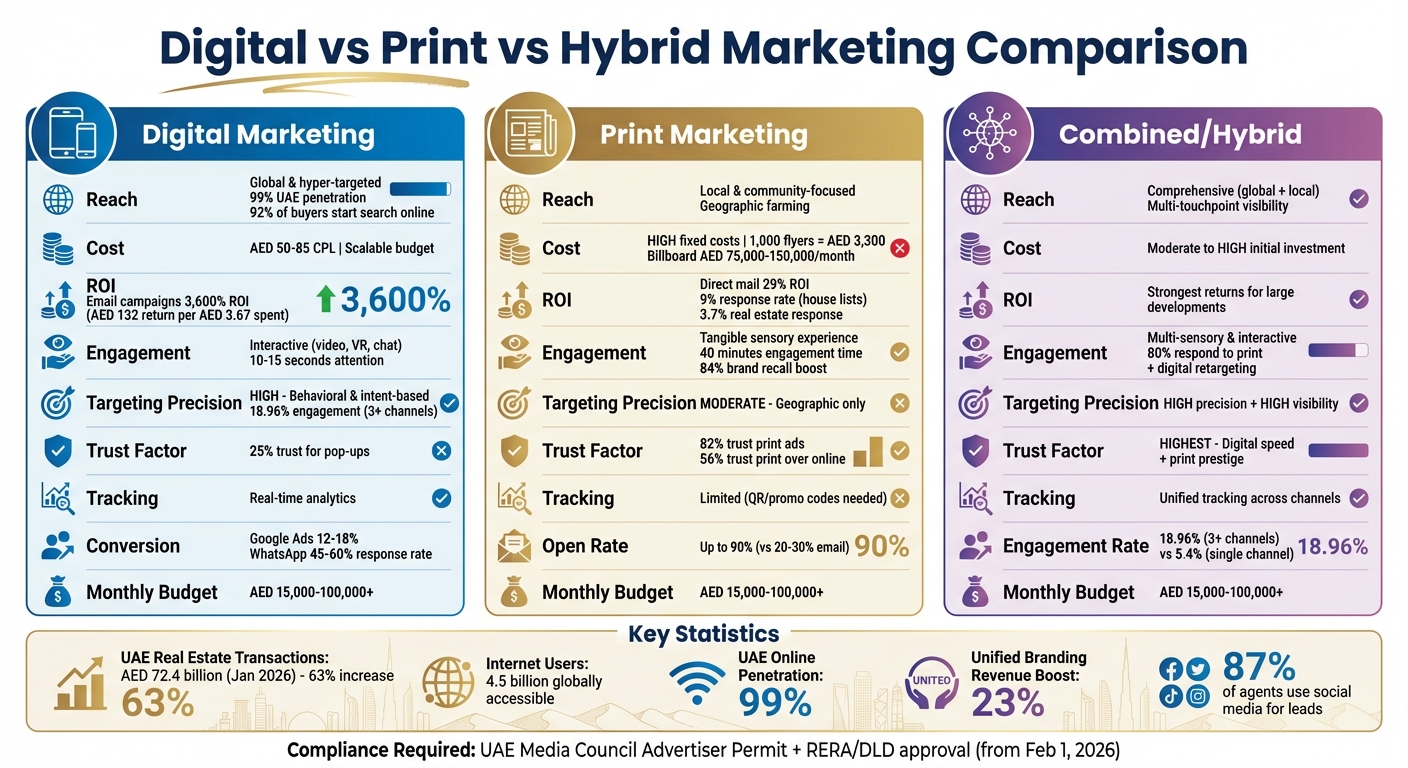
Digital vs Print vs Hybrid Marketing in UAE Real Estate: Complete Comparison
Finding the right balance between digital and print marketing is essential for real estate brands in the UAE. Each approach brings its own strengths and challenges, helping marketers allocate budgets wisely and connect with the right audience at the right time.
Digital marketing stands out for its wide reach and precise targeting. With 99% of the UAE’s population online and 92% of property buyers starting their search on the internet, digital platforms offer unmatched visibility. For instance, Google Ads in the UAE boasts conversion rates of 12% to 18%, with cost-per-lead (CPL) ranging from AED 50 to AED 85. Additionally, WhatsApp, a dominant communication tool in the region, achieves impressive response rates of 45–60%. However, digital marketing isn’t without its drawbacks. Ad fatigue and the overwhelming volume of online ads can dilute messages, especially when targeting older audiences who often prefer in-person interactions.
On the other hand, print marketing provides a sense of trust and credibility. Studies show that 82% of consumers rely on print ads when making purchasing decisions, and print materials are more likely to stick in people’s minds. For luxury properties, high-quality brochures and placements in premium magazines exude prestige that digital ads often lack. However, print comes with its own set of challenges. Costs can be steep – a prime billboard on Sheikh Zayed Road, for example, ranges from AED 75,000 to AED 150,000 per month. Its reach is geographically limited, and tracking ROI is difficult unless tools like QR codes or promo codes are used.
A combined approach merges the strengths of both channels, offering a more well-rounded strategy. By integrating digital precision with the credibility of print, brands can achieve broader reach, reinforce their messaging, and build trust through multiple touchpoints. While this hybrid model may require higher upfront investment, it often delivers stronger returns, especially for large-scale property developments. Developers in the UAE, for instance, allocate monthly advertising budgets ranging from AED 15,000 to over AED 100,000 for such campaigns.
| Metric | Digital Marketing | Print Marketing | Combined (Hybrid) |
|---|---|---|---|
| Reach | Global & hyper-targeted; 99% UAE penetration | Local & community-focused | Comprehensive (global + local) |
| Cost | Scalable; AED 50–85 CPL | High; fixed upfront costs | Moderate to high |
| Engagement | Interactive (video, VR, chat) | Tangible; sensory experience | Multi-sensory & interactive |
| Targeting Precision | High (behavioural, intent-based) | Moderate (geographic) | High precision + high visibility |
| Trust Factor | Lower (25% trust for pop-ups) | Higher (82% trust for print) | Highest (digital speed + print prestige) |
| Tracking | Real-time analytics | Limited (QR/promo codes) | Unified tracking |
Ultimately, the right choice will depend on your audience, goals, and budget. Digital marketing offers quick, measurable results, while print creates a lasting impression and builds trust. A hybrid strategy can help you tap into the best of both, ensuring your message resonates across the UAE’s diverse market.
Conclusion
In the UAE’s real estate market, combining digital and print strategies is essential to deliver consistent messaging across all platforms – from sleek Instagram posts to elegant property brochures. While digital channels offer incredible reach and targeting, print materials provide the credibility and prestige that luxury properties demand.
Consistency is key. Whether it’s a billboard on Sheikh Zayed Road or your website, ensure your logo, tagline, and tone remain uniform. This builds trust and strengthens your brand identity in the UAE, which is crucial in high-value property transactions.
Bridging the gap between print and digital is easier than ever with simple tools. Add QR codes to all printed materials – flyers, billboards, or newspaper ads – to direct potential clients to virtual tours, WhatsApp Business chats, or property-specific landing pages. Since leads are most valuable within the first ten minutes, integrating digital lead forms with automated WhatsApp responses ensures swift follow-ups. Plus, this approach helps you stay aligned with local regulations.
Speaking of regulations, compliance in the UAE is non-negotiable. From 1 February 2026, all property promotions will require a UAE Media Council Advertiser Permit alongside RERA/DLD approval. Plan your marketing budgets accordingly, as monthly expenses for major campaigns can range from AED 15,000 to over AED 100,000. Typical costs include SEO (AED 8,000–25,000), social media management (AED 7,000–20,000), and portal listings (AED 5,000–50,000+).
FAQs
How do I split budget between digital and print in the UAE?
To plan your marketing budget in the UAE, start by focusing on your objectives, target audience, and the nature of your industry. A common approach is dividing the budget into 60% for digital channels and 40% for print media, though this can differ based on your specific needs.
Given the UAE’s impressive 99% internet penetration, digital platforms are essential for reaching a global audience. On the other hand, print media remains effective for connecting locally, particularly when targeting premium developments or niche markets. Striking the right balance means using digital to expand your reach while leveraging print to foster trust and credibility within the local community.
Which print formats work best for luxury property marketing?
High-end brochures, architectural magazines, and bespoke postcards are perfect tools for marketing luxury properties. These formats offer a hands-on, trustworthy experience that connects with affluent buyers, leaving a lasting impression and elevating the appeal of your properties.
How can I track ROI from print ads using QR codes?
To measure the ROI of your print ads, include unique QR codes on your printed materials. These codes serve as a bridge between your offline content and online analytics, making it easy to track performance. When scanned, they direct users to specific landing pages, allowing you to monitor traffic, engagement, and conversions.
By using analytics platforms, you can dive into the data and assess how well your print campaign is performing. This method provides clear, measurable insights and ensures you can effectively connect your print efforts to digital results.
Related Blog Posts

BRAND HUSL
We’re a collective of brand strategists, designers, and unapologetic truth-tellers who’ve spent over two decades turning chaos into clarity for businesses across the globe. From global names to fearless startups, we’ve built brands that stick, scale, and sell—without the fluff. Everything we create is rooted in strategy, storytelling, and ROI, because good branding isn’t just pretty—it’s powerful.