

In the UAE’s competitive market, where 68% of purchase decisions are driven by brand perception and 76% of consumers are willing to pay more for strong brands, building a strong brand identity is essential. With over 200 nationalities and a unique mix of tradition and modernity, your brand must balance global appeal with respect for Emirati values. Here’s a quick summary of the seven steps to create a brand identity that thrives in the UAE:
- Align Your Mission and Vision: Craft statements that reflect your purpose and connect emotionally with the UAE’s diverse audience, in both Arabic and English.
- Conduct Market Research: Understand UAE consumer behaviour and analyse competitors to identify opportunities.
- Define Your Brand Personality: Establish traits that resonate with local values, balancing heritage and modernity.
- Develop Visual Identity: Choose culturally appropriate colours, symbols, and bilingual typography that represent your brand.
- Establish Brand Voice: Use a consistent tone in English and Arabic, tailoring messages to different cultural groups.
- Create Brand Guidelines: Document your visuals, voice, and values to ensure consistency across all platforms.
- Train and Distribute: Educate your team on using the guidelines effectively to maintain a unified brand presence.
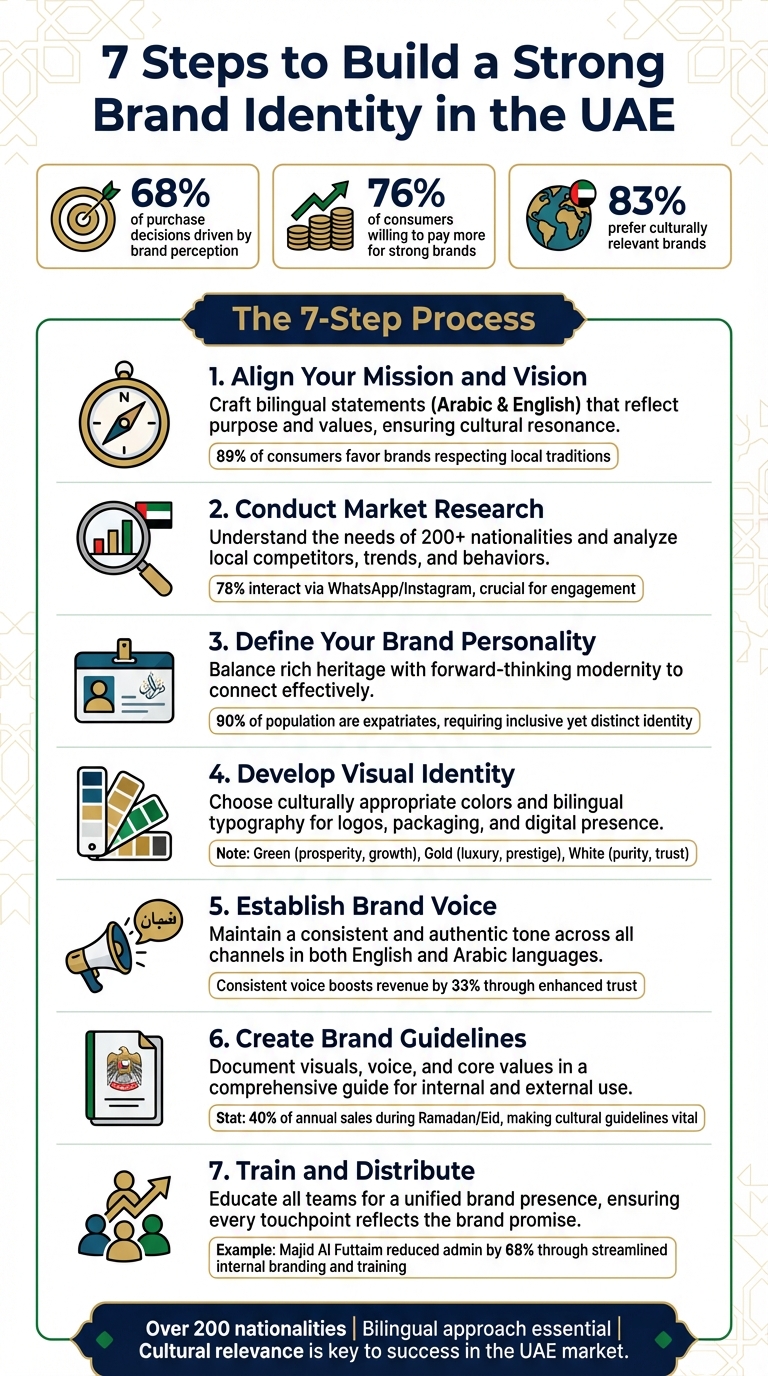
7 Steps to Build a Strong Brand Identity in the UAE
Step 1: Align Your Brand with Your Mission and Vision
Your mission and vision are the cornerstones of your branding strategy. The vision outlines your brand’s long-term aspirations, while the mission focuses on the steps you take today to achieve those goals. In the UAE, where 83% of consumers prefer brands that reflect cultural relevance, these statements need to connect emotionally with a diverse audience while respecting local traditions.
Think of your vision as your brand’s "north star" and your mission as the roadmap to get there. For instance, a hospitality brand in Dubai might have a vision like: "To become the region’s most trusted name in Arabian luxury experiences." Its mission could complement this with: "We deliver authentic Emirati hospitality through personalised service and cultural immersion." While distinct, these statements work together to shape the brand’s identity.
Writing a Mission and Vision Statement
Start by identifying your "why" – the deeper purpose behind your brand beyond just making a profit. Ask yourself: What problem are you solving? What values guide your decisions? Given that 89% of UAE consumers favour brands that respect local traditions, your mission and vision should strike a balance between global relevance and local sensitivity.
From the outset, craft these statements in both English and Arabic using Modern Standard Arabic for a formal tone. Collaborate with native speakers who understand cultural subtleties to ensure your message resonates equally in both languages. This approach ensures that the emotional depth of your statements is preserved, rather than simply translated.
"Vision is not a tagline – it is a strategic compass." – Octopus Marketing
Keep your vision concise – just one or two sentences – so it’s easy for employees and customers to remember. Incorporate values that reflect local cultural symbols, such as strength, hospitality, or pride. Many brands in the UAE also adapt their messaging during key occasions like Ramadan or UAE National Day to show genuine community engagement, which helps strengthen their connection with the market.
Making Sure Brand Positioning Reflects Core Values
Once your mission and vision are established, they should influence every aspect of your brand positioning. From the colours you choose to the way you interact with customers, every element must align with these core values. This consistency creates an "emotional anchor" that helps your marketing resonate more deeply. For example, if your mission highlights "Arabian hospitality", your brand should embody warmth, generosity, and personalised service at every customer touchpoint.
Your positioning should also balance tradition with modernity. Show innovation by offering cutting-edge services while respecting local customs. If sustainability is a key part of your mission, align your efforts with the UAE’s national sustainability goals to demonstrate your commitment to the country’s future.
Highlighting your regional roots or local ownership can also give you a competitive edge. Take Careem, for example – it thrived by showcasing its understanding of local needs and cultural alignment. Ask yourself: What makes your brand uniquely suited to serve this market? How do your values address the specific concerns of UAE consumers?
sbb-itb-6cae99a
Step 2: Conduct Market Research and Competitive Analysis
Before diving into logo designs or brainstorming taglines, it’s crucial to first understand your audience and the competition. In the UAE, where diverse cultures and rapid growth shape consumer behaviour, solid research is non-negotiable.
Understanding UAE Consumer Behaviour
The UAE is home to over 200 nationalities, creating a diverse market with distinct preferences. Emirati Nationals, who make up about 11% of the population, are known for their strong brand loyalty and significant spending power. Arab expatriates gravitate toward quality Arabic content and culturally aligned messages. Meanwhile, South Asians, the largest demographic group, tend to be price-conscious, with 42% still preferring cash-on-delivery options. Western expatriates, on the other hand, often seek premium products and globally familiar experiences.
To understand these dynamics, utilise local resources like the Dubai Statistics Centre (DSC) and Statistics Centre – Abu Dhabi (SCAD). Combine this data with insights from your CRM and website analytics to pinpoint your key customers and their preferred platforms. For instance, 78% of consumers in the UAE interact with businesses through WhatsApp or Instagram, with Instagram alone hosting 8.4 million daily users who spend an average of 52 minutes on the platform.
Family plays a central role in purchasing decisions, with multiple members often influencing the final choice. This means your campaigns should focus on family-oriented benefits rather than just individual appeal. Timing is also critical – adjust your messaging to align with local consumption patterns, such as the heightened evening activity during Ramadan.
A great example of leveraging these insights is Huda Beauty, a Dubai-based cosmetics brand. By collaborating with over 200 micro-influencers from various nationalities, they managed to reduce customer acquisition costs by 34% and boost lifetime value by 23%, compared to campaigns relying on a single mega-influencer.
Once you’ve gathered these consumer insights, it’s time to assess your competition.
Analysing Competitors in the UAE
With a clear picture of your audience, the next step is to evaluate competitors and identify untapped opportunities. Start by mapping out both direct competitors (those offering similar products) and indirect competitors (those providing alternative solutions). In the UAE, indirect competitors can capture significant market share, so it’s essential to consider them too. Analyse factors like pricing strategies, product offerings, brand image, and distribution channels.
Go beyond online research by incorporating methods like mystery shopping and in-person visits to validate your findings. Pay attention to bilingual messaging, as translation inconsistencies can reveal gaps in competitors’ strategies. Identifying underserved segments – whether Emiratis, South Asians, or Western expatriates – can help you carve out a niche.
Use tools like Google Maps reviews, local directories, and social listening platforms to gauge customer sentiment. These resources can help you uncover frustrations with existing market leaders. Look for gaps, or "whitespace", in the market. For instance, if most competitors focus on luxury, you might find an opportunity to emphasise practicality and family-friendly services.
"In the UAE, competition is visible, measurable, and accelerating. New brands enter every quarter, pricing models shift quickly, and customer expectations evolve faster than in most global markets."
– Accurate Middle East
Given the fast-paced nature of the UAE market, industries like retail, food and beverage, and healthcare benefit from quarterly competitor reviews instead of annual studies. Setting up automated dashboards to track real-time changes in pricing, product launches, and customer sentiment can help you stay ahead. These insights will guide your efforts to create a brand that truly resonates with UAE consumers.
Step 3: Define Your Brand Personality and Values
Once you’ve completed your market research and competitive analysis, the next step is to give your brand its unique character. Think of your brand personality as the human traits people associate with your business – whether that’s professional, playful, or modern. Interestingly, 83% of consumers prefer brands that resonate with their cultural identity. So, defining your personality isn’t just about standing out – it’s about creating a connection that feels authentic and memorable.
Choosing Brand Personality Traits
Focus on traits that balance heritage and modernity. While innovation is highly valued, the market also holds a deep respect for tradition. Brands that succeed often embody qualities like generosity, humility, and respect. Even luxury brands in the region avoid being overly flashy, opting instead for subtle sophistication.
Given that around 90% of the population consists of expatriates, your brand personality needs to appeal to a diverse audience spanning over 200 nationalities, while still honouring Emirati traditions. For Emirati nationals, a formal and respectful tone works best. Western expats tend to respond well to direct communication, while Asian audiences often prefer practical and straightforward messaging. Tailoring your tone and approach to different cultural groups ensures your brand feels relevant to everyone.
Language is another key factor. While English messaging can be more casual or playful, Arabic communication should reflect a formal and respectful tone to meet local cultural expectations. This is where transcreation comes in – a personality trait that feels "friendly" in English might need to be expressed as "hospitable and respectful" in Arabic. Collaborating with local experts is crucial to ensure these traits resonate effectively.
Your visual identity should also reflect your personality. Colours like green (symbolising prosperity and peace in Islam), gold (luxury), and sand tones are aligned with local preferences. Be mindful of cultural sensitivities, such as avoiding imagery that shows excessive skin or intimacy, as this can conflict with Islamic norms. During Ramadan, shift your brand’s tone to be more reflective and community-focused, steering clear of overt promotions during fasting hours.
Turning Values into Brand Behaviours
Your values should be evident in every interaction and operational detail. For instance, if "hospitality" is one of your core values, it should be reflected in how your team greets clients, the speed of your responses, and even the atmosphere of your physical spaces. Similarly, if "innovation" is a key value, showcase it through advanced technology and forward-thinking campaigns.
Aligning your values with national initiatives can also help build trust with local stakeholders. For example, connect your brand to UAE goals like Vision 2021 or sustainability efforts. If sustainability is a core value, highlight eco-friendly practices in your operations, packaging, or partnerships. The trend of sustainable luxury is gaining momentum, with 76% of consumers willing to pay more for brands that align with their values.
Community involvement is another way to bring your values to life. Participate in local events, support Emiratisation efforts, and adjust your campaigns to align with key cultural moments like Ramadan, Eid, and National Day. These periods are not just culturally significant – they’re also commercially impactful, with Ramadan and Eid seasons accounting for 40% of annual sales for many brands. Use these opportunities to focus on family-oriented benefits and storytelling, as family plays a central role in purchasing decisions.
"In the UAE, your brand isn’t what you say it is – it’s what the market believes it to be."
– Priscilla, Carril Agency
Document your personality traits and values in a voice chart. This tool outlines your tone, preferred vocabulary, and communication guidelines, ensuring consistency across all teams. Additionally, create a bilingual brand glossary to maintain uniformity in tone and terminology between English and Arabic. These steps will help you seamlessly integrate your personality and values into your broader brand toolkit.
Step 4: Develop Your Visual Identity System
With your brand personality and values defined in Step 3, it’s time to translate them into a visual identity that truly represents your brand. Think of this as your brand’s "face" – the first impression people get before they even read a word. And in a competitive market, getting your visuals right is a must. Did you know that the right use of colour can boost brand recognition by up to 80%?
Designing a Logo and Choosing a Colour Palette
When designing your logo and choosing colours, it’s important to integrate both Arabic and English seamlessly. This means balancing the scripts in terms of weight, proportion, and alignment so neither feels secondary. For typography and script choice, modern adaptations of Arabic scripts work well. For instance, minimalist Kufic is popular among tech brands for its contemporary feel, while luxury brands often lean towards Diwani or Thuluth for a sophisticated yet timeless look.
Colour choices are equally critical. Studies show that 85% of consumers make product decisions based on colour. Here’s how different colours resonate in the UAE:
- Green: Represents prosperity and Islamic heritage, making it a great fit for finance and wellness brands.
- Gold: Symbolises luxury and exclusivity, ideal for hospitality and real estate.
- White: Evokes purity and simplicity, suitable for tech and premium retail.
- Blue: Builds trust and professionalism, often used in banking and education.
- Black: Conveys elegance and modernity, perfect for automotive and high-end products.
| Colour | Cultural Perception in UAE | Best Industry Fit |
|---|---|---|
| Green | Growth, Peace, Islam, Trustworthiness | Finance, Health, Government |
| Gold | Luxury, Wealth, Success, Exclusivity | Hospitality, Real Estate, Jewellery |
| White | Purity, Simplicity, Honesty, Prestige | Tech, Skincare, Luxury |
| Blue | Trust, Security, Stability, Professionalism | Corporate, Fintech, Education |
| Black | Elegance, Power, Modernity | Automotive, Perfumes, High-end products |
Avoid using red as a dominant colour during Ramadan, as it may come across as aggressive. For digital designs, make sure your colour combinations comply with WCAG 2.1 AA standards, which require a contrast ratio of at least 4.5:1. For example, if you’re using gold as a background for white text, pick a darker shade like #92722A instead of the standard gold (#B68A35) to ensure readability.
To modernise traditional symbols, consider minimalist, geometric designs. Falcons, for instance, are a favourite among 42% of successful UAE brands. Similarly, palm trees, Islamic patterns, and desert imagery can enhance your brand’s message when presented with a sleek, contemporary touch.
Using Culturally Appropriate Visuals
Your visuals should align with local customs and accessibility standards. The UAE Design System offers helpful guidelines: use natural lighting, simple backgrounds, and the rule of thirds to keep the focus on your subject. For text over images, apply a 30% black overlay on moderately complex backgrounds, increasing it to 60% for brighter or busier images to maintain legibility.
Cultural sensitivity is key. Imagery should reflect local norms, from modest clothing to appropriate hand gestures and group compositions. Given that 89% of consumers are drawn to brands that uphold Islamic values and traditions, these details can greatly impact your brand’s reception.
When designing layouts, consider the direction of the language: right-to-left for Arabic and left-to-right for English. Arabic text often takes up more horizontal space, so allow for extra room in your designs. Avoid justifying text in either language, as it can make reading more difficult.
"A consistent style of imagery is at the heart of creating your brand identity."
– UAE Design System 2.0
Finally, document every detail of your visual identity – logo variations, colour codes (Hex for digital, CMYK for print), typography pairings, spacing rules, and photography guidelines. This system ensures consistency across all platforms, reinforcing the mission and values you’ve worked so hard to define.
Step 5: Establish Your Brand Voice and Messaging
Visuals may grab attention, but it’s the words that build real connections. In the UAE, where around 90% of the population comprises expatriates from over 200 nationalities, your brand voice needs to resonate with a diverse audience while honouring local traditions. This completes the brand identity shaped by your visuals and personality. Here’s why it matters: 83% of UAE consumers prefer brands that demonstrate cultural relevance, and a consistent brand voice across platforms can boost revenue by up to 33%.
Defining a Clear Brand Voice
Think of your brand voice as the personality behind your words – it should stay consistent whether you’re writing a social media post or responding to a customer. Begin by aligning your voice with your brand’s personality. For example, if your brand is "sophisticated and trustworthy", your tone should strike a balance between professionalism and approachability.
In the UAE, communication often leans toward formality and respect, unlike the more casual tone common in Western markets. Using honorifics and titles when addressing individuals or institutions isn’t just polite – it’s the norm. A tone that’s respectful and grounded in values will resonate far more than one that’s overly casual.
Here’s a quick guide to tailoring your voice for key audience segments in the UAE:
| Audience Segment | Recommended Tone | Key Messaging Focus |
|---|---|---|
| Emirati Nationals | Formal, respectful, traditional | Heritage, national pride, honour |
| Western Expats | Direct, professional, aspirational | Efficiency, benefits, quality of life |
| Asian Expats | Practical, straightforward | Value, reliability, family security |
Consistency across languages is equally important. Since bilingual communication is a must in the UAE, you’ll need both Arabic and English to effectively connect with locals and expatriates. Use transcreation – adapting your message with cultural sensitivity – to ensure it resonates. For Arabic, stick to Modern Standard Arabic (MSA) for a professional and widely understood approach. For English, follow British spelling conventions (e.g., "centre" instead of "center").
Create a bilingual glossary of brand-specific terms in Arabic and English. This ensures that your team – whether in marketing or customer service – uses consistent language. Avoid Western slang or idioms that might not translate well and could confuse your diverse audience.
Timing also matters. For instance, during Ramadan, avoid aggressive sales tactics or overt promotions, especially during fasting hours. Instead, focus on messages of goodwill and community. This kind of cultural awareness builds trust – 89% of UAE consumers prefer brands that respect local traditions and Islamic values.
A consistent voice is the foundation for crafting memorable taglines and messages.
Writing Taglines and Key Messages
Your tagline should be a snapshot of your brand’s essence – something people can grasp in an instant. A good tagline passes the "blink test", meaning someone understands your brand’s purpose immediately. Keep it short, impactful, and culturally relevant.
Highlight your Unique Value Proposition (UVP) by clearly explaining how you solve a specific problem for UAE consumers. Avoid jargon. Instead of saying, "We leverage cutting-edge solutions", try something straightforward like, "We help you save 3 hours every day."
When shaping your key messages, remember that 68% of purchase decisions in the UAE are driven by brand perception alone. Messages should align with values that resonate locally, such as family, community, respect, and aspirations for the future. For Emirati audiences, themes like honour, heritage, and national pride are especially compelling.
Document everything in your brand guidelines. Include your core voice attributes, tone adjustments for various situations, sample phrases that reflect your brand, and phrases to avoid. A clear set of "do’s and don’ts" ensures that whether someone reads your website, gets an email, or interacts with customer support, they’ll experience the same consistent brand personality.
"In the UAE, your brand isn’t what you say it is – it’s what the market believes it to be."
– Priscilla, Carril Agency
Step 6: Create and Document Brand Guidelines
Clear and detailed brand guidelines are essential for maintaining consistency and trust across the UAE market. By consolidating your brand’s voice, visuals, and values into a single, accessible document, you ensure that every stakeholder – from your internal team to external partners – represents your brand accurately. In a region where 68% of purchase decisions hinge on brand perception, any inconsistency can damage trust and impact revenue. Think of these guidelines as your brand’s instruction manual, safeguarding its integrity and professionalism.
Key Elements to Include in Brand Guidelines
Your brand guidelines should cover both the foundational principles and practical applications of your identity. Start with the basics: clearly outline your mission, vision, target audience (including Arabic-speaking locals and English-speaking expats), and core values. This provides a strong foundation for everyone involved to understand your brand’s purpose.
Next, focus on your visual identity. Include rules for logo usage, such as dual-language versions for Arabic and English, minimum spacing requirements, and adaptations for Right-to-Left (RTL) scripts. Define a typography system that harmonises Arabic and English characters, specifying font weights and sizes. Detail your colour palette with precise HEX and CMYK codes, keeping cultural nuances in mind – for instance, green often reflects prosperity and Islamic values, while gold and sand tones evoke luxury. Imagery guidelines should respect local diversity and religious norms, addressing elements like natural lighting, composition, and text overlays.
Your verbal identity is equally important. Define your tone – whether formal or conversational – and set editorial rules for both Modern Standard Arabic and English. British spelling is typically preferred in the UAE. Include a bilingual glossary with examples to ensure accurate translations and prevent errors.
Add a brand governance section with clear "Do’s and Don’ts." Use visual examples to illustrate common mistakes, like stretched logos or incorrect colour combinations, to help prevent brand dilution. Document how your brand should appear across various platforms, from social media and websites to stationery and email signatures. Given that 40% of annual sales for many UAE brands occur during Ramadan and Eid, include specific guidelines for seasonal messaging and visuals.
"In Dubai, branding isn’t just about looking good, it’s about being understood clearly and consistently across cultures."
– Meydan Free Zone
These guidelines ensure your brand is represented consistently, enhancing recognition and trust across all channels.
Making Guidelines Easy to Use
Even the most detailed guidelines are ineffective if they’re not accessible or user-friendly. Store your guidelines on a cloud platform like Frontify, Notion, or Adobe CC Libraries to ensure quick and easy access for all team members. Avoid relying solely on static PDFs; cloud-based platforms allow for updates and seamless sharing.
Include practical examples and ready-to-use templates. Don’t just list your brand colours – show how they should be applied in email headers, social media posts, and presentations. Tools like Canva or Figma can help you create templates for common materials, reducing errors and saving time.
For the UAE market, pay special attention to RTL layouts and text overlays to ensure cultural relevance. These details are crucial, as 83% of UAE consumers prefer brands that align with local customs and values.
Regularly review and update your guidelines to keep pace with trends like social commerce. Hosting onboarding workshops for new hires and external agencies can also help reinforce proper brand usage. By ensuring everyone follows the same rules, your brand becomes instantly recognisable, building the trust needed to thrive in the UAE’s competitive landscape.
Step 7: Implement and Distribute Guidelines Across Your Organisation
Creating brand guidelines is just the beginning – the real work is ensuring everyone in your organisation uses them effectively. In the UAE, even minor inconsistencies can hurt trust and, ultimately, your bottom line. Your guidelines must reach every employee, from the marketing team in Dubai to customer service staff in Abu Dhabi, ensuring a unified brand presence across all touchpoints. This final step connects your detailed guidelines with everyday operations.
Training Employees on Brand Guidelines
Once your guidelines are ready, the next step is training your team to apply them consistently. This means tailoring training to different departments and language groups. For example, your Arabic-speaking customer service team will need guidance specific to right-to-left scripts and local nuances, while your English-speaking social media managers will have different requirements. Just as your guidelines were crafted with both Arabic and English in mind, your training should reflect these distinctions.
Develop role-specific training modules that show how to incorporate guidelines into daily tasks – whether it’s responding to customer queries, crafting social media posts, or designing email signatures. Replace one-time workshops with ongoing training sessions tailored to each department. A Digital Asset Management (DAM) system can serve as a central hub for all approved brand assets, ensuring teams always access the latest logos, bilingual templates, and imagery. Include practical "do’s and don’ts" with visual examples, especially for areas like Arabic calligraphy and dual-language layouts. A bilingual glossary can also help maintain consistent terminology when adapting content between English and Arabic.
For instance, in 2019, Majid Al Futtaim, a UAE-based holding company, introduced the Brand Affinity platform to manage brand compliance across 17 countries. This system centralised brand audits and allowed mobile photo uploads with geo-tagging. Within just three months, they reduced administrative work by 68% and improved brand control accuracy by 35%. This example highlights how the right mix of tools and training can drive brand consistency across large organisations.
Maintaining Consistency Across Touchpoints
Training is just the start – ongoing monitoring is key to preserving your brand’s integrity. Use automated compliance software and mobile audit tools with GPS tagging to ensure that signage, store layouts, and promotional materials align with your guidelines across all seven emirates.
Schedule quarterly audits to catch and correct inconsistencies early. For high-traffic periods like Ramadan and Eid, maintaining brand consistency is especially critical, as these seasons often account for 40% of annual sales for many UAE businesses. Establish feedback loops with local teams to identify which brand elements resonate most with the UAE’s diverse population. This feedback can help refine your guidelines over time. Additionally, distribute flexible digital templates that allow employees to create brand-compliant materials without needing constant approval from marketing.
"Brand training is a must, as it connects the brand identity to the employees who represent it every day. Without their understanding and ownership, the brand remains a mere concept."
– Duqe
Consistency isn’t about strict control; it’s about empowering your team with the right tools, knowledge, and confidence to authentically represent your brand in every interaction.
Conclusion: Maintaining Brand Identity in the UAE
Building a strong brand identity in the UAE is a continuous process that evolves alongside your business and shifting market trends. In a region where brand perception heavily influences purchasing decisions, staying consistent while aligning with local values is key to thriving. This requires regular assessment and adaptability to ensure your brand stays relevant.
The seven steps outlined earlier form the backbone of a solid brand strategy in the UAE. However, success hinges on consistent implementation. Conducting regular brand audits – whether quarterly or annually – can help measure brand recall, sentiment, and how well your identity aligns with the latest market dynamics. These check-ins are essential to connect with the UAE’s diverse, tech-savvy audience, who expect brands to respect local traditions while embracing modernity.
A striking 83% of UAE consumers prioritise cultural relevance. As trends like sustainable luxury, AI-driven personalisation, and localised strategies gain momentum, your brand must adapt without losing its essence. In a market that blends deep-rooted traditions with a passion for innovation, maintaining a coherent identity is non-negotiable. This means balancing centralised brand values with the flexibility to localise campaigns for key cultural events like Ramadan, Eid, and UAE National Day – periods that can contribute up to 40% of annual sales for many businesses.
To support this evolution, equip your teams with the right resources. Tools like Digital Asset Management systems, bilingual templates, and ongoing training ensure your brand is represented consistently and authentically at every interaction. With 76% of UAE consumers willing to pay premium prices for well-established brands, maintaining a strong and cohesive identity is a direct path to success. Your brand is a dynamic asset – one that requires care, monitoring, and refinement to thrive in one of the world’s most vibrant markets.
FAQs
Do I need Arabic branding from day one?
Arabic branding might not be essential right from the start, but it’s strongly encouraged for connecting with audiences in the UAE. While many brands initially launch in English, incorporating Arabic early on can prevent misunderstandings, boost engagement, and establish trust with Arabic-speaking communities. Prioritise the development of flexible, culturally aligned brand guidelines to set the stage for lasting success in the UAE market.
How do I choose colours that fit UAE culture?
When selecting colours for a UAE audience, it’s essential to consider the deep-rooted traditions and symbolism of the region. For instance, gold is often associated with luxury and prosperity, while green carries both religious importance and national pride. These colours resonate strongly with local values, fostering a sense of trust and connection.
To create a palette that truly speaks to the audience, aim for a balance between cultural significance and visual accessibility. This approach ensures your design feels authentic and respectful while remaining inclusive and engaging.
How often should I audit my brand in the UAE?
Auditing your brand on a regular basis is key to staying relevant and effective in the UAE market. While there’s no fixed rule for how often this should be done, conducting an audit annually or after significant market shifts or organisational changes is a smart approach. Keeping your brand in tune with evolving consumer preferences and market trends ensures you maintain a strong and competitive presence in the UAE.
Related Blog Posts

BRAND HUSL
We’re a collective of brand strategists, designers, and unapologetic truth-tellers who’ve spent over two decades turning chaos into clarity for businesses across the globe. From global names to fearless startups, we’ve built brands that stick, scale, and sell—without the fluff. Everything we create is rooted in strategy, storytelling, and ROI, because good branding isn’t just pretty—it’s powerful.