

Building customer loyalty after a product launch is challenging but essential. A strong brand identity – your company’s personality through visuals, tone, and values – makes your business memorable, builds trust, and encourages repeat purchases. Consistency across all channels, emotional connections, and aligning with customer values are key to keeping customers engaged.
Key Takeaways:
- 84% of customers are more likely to stay loyal to brands with a strong identity.
- Retaining customers costs 5x less than acquiring new ones.
- Consistent branding can boost revenue by 33%.
- Emotional bonds and shared values drive loyalty, especially in markets like the UAE.
In the UAE, aligning with local traditions, integrating bilingual communication (Arabic and English), and leveraging cultural moments like Ramadan can strengthen customer relationships. Regular audits, consistent messaging, and a clear identity ensure your brand remains trusted and relevant long after launch.
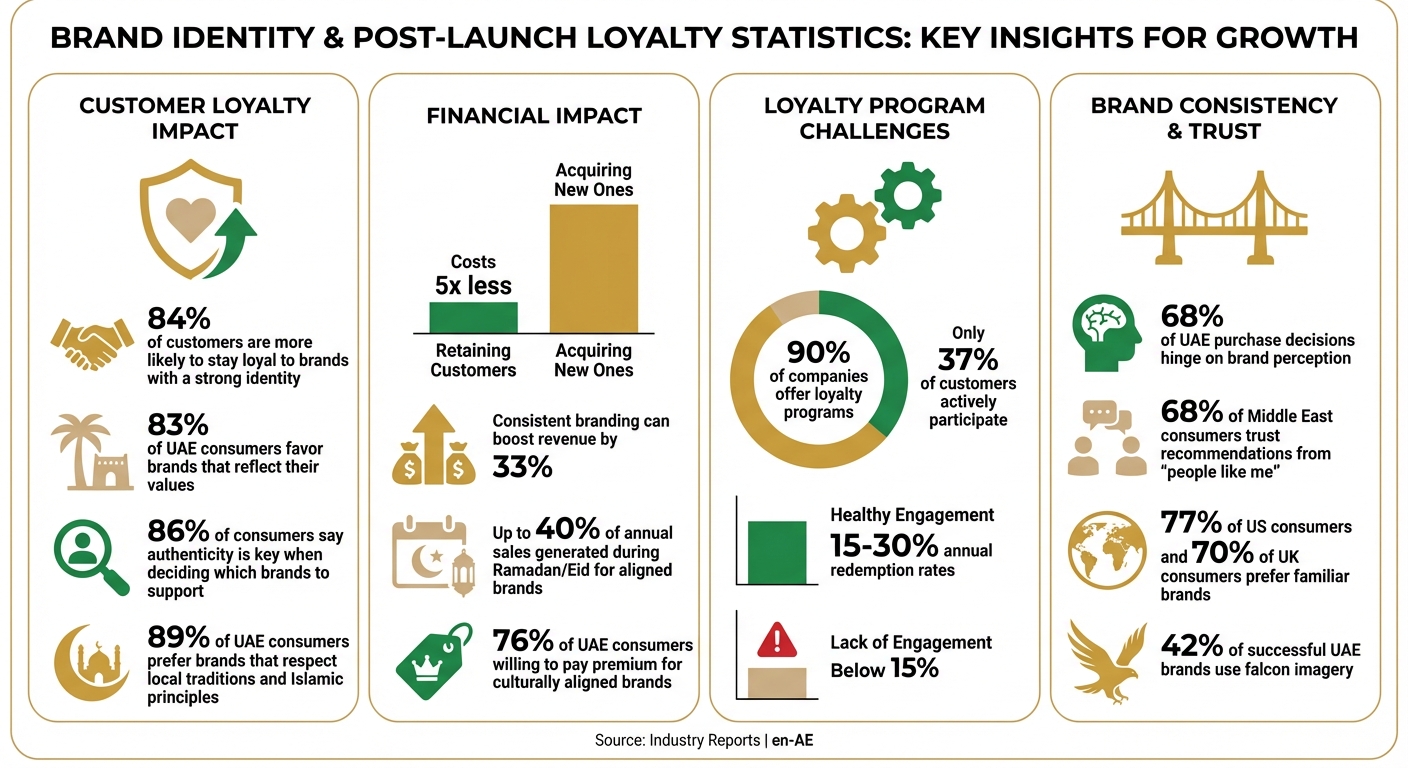
Brand Identity Impact on Customer Loyalty: Key Statistics and Metrics
Common Problems with Post-Launch Loyalty
Even with a strong brand identity at launch, many businesses face a sharp decline in customer engagement shortly after. The initial buzz fades quickly, and without addressing this, the momentum from the launch can be lost. This often leads to fewer repeat purchases and a drop in overall customer loyalty.
Declining Customer Interest
The post-launch phase is where many brands struggle to maintain traction. While 90% of companies offer loyalty programmes, only 37% of customers actively participate in them. Why the disconnect? Many businesses treat branding as a one-off effort rather than an ongoing relationship. Once the launch campaign ends, communication often stops, leaving customers feeling disconnected.
Another issue lies in overly complicated loyalty programmes. When redemption processes are lengthy or unclear, customers lose interest. While annual redemption rates between 15%-30% are considered healthy, anything below 15% signals a lack of engagement. The problem isn’t necessarily the product – it’s that customers feel no reason to stay connected with the brand after their initial purchase.
Inconsistent Brand Presentation
As customer interest wanes, inconsistent branding can further erode trust. For instance, your social media might come across as casual and fun, but your email campaigns feel rigid and formal. Or, your website design doesn’t match your packaging. These mismatches don’t just look unpolished – they can make your brand seem unreliable.
Consistent branding across all channels has been shown to boost revenue by up to 33%. Yet, many businesses fail to achieve this because different teams or agencies handle separate aspects of the brand. Without a brand toolkit, every touchpoint feels disjointed, and customers lose the sense of familiarity that builds loyalty.
Lack of Emotional Connection
Beyond engagement and consistency, a missing emotional connection often prevents loyalty from taking root. Transactions alone won’t inspire customers to stick around. If your brand doesn’t foster a sense of belonging or shared values, customers are more likely to jump ship for a competitor offering a lower price. In fact, 86% of consumers say authenticity is key when deciding which brands to support.
People want to feel part of something bigger than just a purchase. Brands that lack emotional depth or fail to communicate their mission risk being seen as mere sellers of products. This leaves them competing solely on price and features – a losing game. On the other hand, brands that succeed post-launch are those that make customers feel valued, understood, and aligned with a purpose they care about.
sbb-itb-6cae99a
How to Build Loyalty with Brand Identity
Creating Emotional Connections
In the UAE, brand identity isn’t just about recognition – it’s about building emotional bonds. Loyalty stems from emotions, not transactions. With 83% of UAE consumers favouring brands that reflect their values, it’s crucial to align your brand with cultural pillars like hospitality (Karam), family, and respect. This goes beyond simply selling products; it’s about weaving stories that connect with these values.
Cultural storytelling can turn buyers into active participants. Instead of relying on broad, generic campaigns, focus on embedding your brand into meaningful cultural moments. For instance, Ramadan and Eid are pivotal in the UAE, with many brands generating up to 40% of their annual sales during these times by aligning with community traditions and values.
Visuals play a massive role too. Falcon imagery, for example, is used by 42% of successful UAE brands because it instantly evokes a sense of local heritage. Pairing this with colours like gold, sand, and green – often associated with luxury – creates a sense of trust and authenticity. It’s no surprise that 76% of UAE consumers are willing to pay a premium for brands that feel genuine and culturally aligned. These emotional connections lay the groundwork for a consistent and trusted brand experience across all platforms.
Maintaining Consistency Everywhere
Consistency in branding is crucial – especially in the UAE, where 68% of purchase decisions hinge on brand perception. A scattered or inconsistent identity can confuse customers, while a unified presentation builds trust and comfort.
One key step is bilingual integration. In the UAE, communicating in both Arabic and English is essential. However, this isn’t just about literal translation. Work with native experts who specialise in transcreation to ensure your message resonates emotionally in both languages. A poorly translated campaign can come across as careless, damaging trust instantly.
Develop a comprehensive brand toolkit that covers everything – from logo placement to the tone of voice on social media. Branded templates for emails, social posts, and other materials ensure that, regardless of who creates the content, your brand maintains a consistent look and feel.
"A user should recognise your brand from a post – even before seeing your logo."
By maintaining consistency across all channels, you reinforce the emotional connections established earlier, ensuring your brand remains top of mind.
Matching Your Brand to Customer Values
To turn casual buyers into loyal advocates, your brand must align with their values. In the UAE, 89% of consumers prefer brands that respect local traditions and Islamic principles. This doesn’t mean changing your brand’s core identity – it means tailoring how you present it.
Position your brand as part of the UAE’s cultural fabric. Even global brands thrive here by highlighting their local relevance and commitment. For example, aligning your messaging with national initiatives like UAE Vision 2030 shows that you’re invested in customers’ futures, not just their spending power.
Create a "loyalty loop" by engaging customers during key cultural events, fostering peer-to-peer interactions (such as WhatsApp groups), and rewarding participation with exclusive perks or VIP experiences. In the Middle East, 68% of consumers trust recommendations from "people like me" more than traditional advertising. By creating spaces for customers to connect and share, you transform them into a community of brand advocates who feel a personal stake in your success.
How Brand Husl Implements Post-Launch Identity
Full-Service Branding Solutions
Brand Husl follows a five-step process – Discover, Develop, Design, Deploy, Deliver – to ensure your brand identity is seamlessly carried from strategy to execution. This approach creates a cohesive system that influences every customer interaction, whether it’s through your website, packaging, or sales communications.
The Deploy phase is where the magic happens. It’s all about ensuring consistency across every product, service, and communication channel. In the UAE market, this means aligning everything – signage, packaging, digital platforms, print materials, and even staff behaviour – to reflect your brand identity. Sales teams, for example, are trained to embody your brand’s tone and positioning in every customer interaction.
"Deploy… involves unifying all the products, services, and channels of communication to ensure consistency in everything associated with the brand." – Brand Husl
Brand Husl’s "no silos" policy ensures collaboration across the entire creative team, from the first meeting to the final delivery. This eliminates fragmented messaging and keeps the brand identity intact. By taking this approach, they not only strengthen brand identity but also build long-term loyalty, addressing challenges that often arise after a brand’s launch.
"From our initial meeting, brand strategy through to execution we work as one team. No silos allowed – we’re all creatives here." – Brand Husl
To maintain brand strength post-launch, Brand Husl enforces tailored Look & Feel Guidelines. These guidelines set clear standards for brand consistency, and regular audits ensure your brand remains impactful over time. This integrated approach is designed to keep your brand thriving well beyond its launch.
Case Study: Results from Identity Implementation
Take the story of Nelly Pen, a business owner who entrusted Brand Husl to build her brand from scratch. The agency developed a cohesive branding and design system that ensured her brand communicated consistently across all customer touchpoints. The results? A clear boost in customer engagement and brand recognition.
"Brand Husl successfully implemented my business’s branding and design from the ground up." – Nelly Pen
Brand Husl’s success lies in combining agility with a deep understanding of the UAE market. They know how to navigate cultural nuances while balancing digital innovation with the credibility of print. For industries like real estate, this means focusing on bilingual websites and integrating tools like WhatsApp commerce to connect authentically with local audiences. It’s this dual approach that allows brands to resonate with their target market while maintaining a professional edge.
Measuring and Maintaining Post-Launch Loyalty
Important Metrics to Monitor
Tracking the right metrics is crucial to understanding whether your brand identity fosters loyalty or just creates noise. Start with retention metrics like Repeat Purchase Rate and Customer Retention Rate. These reveal how often customers return, a clear indicator of trust and satisfaction. Complement these with emotional connection indicators like Net Promoter Score (NPS) and Customer Satisfaction (CSAT) scores. Consider this: up to 77% of US consumers and 70% of UK consumers prefer familiar brands, which often translates into deeper trust and more repeat purchases.
Financial metrics also play a key role. Customer Lifetime Value (CLV) shows the total revenue each customer is expected to bring over time, while Average Transaction Value (ATV) helps assess whether your brand can command premium pricing.
On the digital front, monitor search traffic, social media engagement, email open rates, and customer surveys. These metrics help measure brand recall and online visibility. Segment this data by audience type to understand which groups connect most with your brand’s positioning. Together, these insights ensure your brand identity stays consistent and memorable.
Regular Brand Audits
Routine brand audits are essential to prevent "brand drift." Even though 90% of companies offer loyalty programmes, only 37% of customers actively participate, often due to fragmented brand experiences. Conduct monthly audits across all customer touchpoints to ensure your brand remains cohesive and delivers on its promises.
Map the entire customer journey – from initial awareness to post-purchase – to uncover any friction points causing frustration. Assess whether your brand voice and visual identity are consistent across every channel. For example, low redemption rates in loyalty programmes might indicate misaligned rewards. Use tools like post-purchase surveys and NPS scores during audits to gather qualitative feedback. Allow at least 90–120 days post-launch before making significant changes to ensure you’re working with reliable data. Once audits confirm consistency, refine your identity to align with evolving market needs.
Adjusting to Market Shifts
Markets evolve, and your brand identity must adapt while staying true to its core values. Competitive benchmarking can help ensure your identity remains distinct. If you notice declining engagement, it might be time to refresh your brand to reflect emerging trends, such as bold, simplified designs or AI-driven personalisation. However, the key is to retain your values, mission, and promise while updating your visuals and messaging.
Before rolling out changes, test them with smaller customer segments. Use RFM segmentation (Recency, Frequency, Monetary value) to pinpoint "Champions" and "At-Risk" customers, allowing you to tailor strategies effectively. When you’re ready to launch a refreshed identity, ensure it’s implemented across all channels simultaneously to avoid confusion.
Keep in mind that acquiring a new customer can cost five times more than retaining an existing one. Thoughtful updates that preserve the trusted essence of your brand while adapting to market trends can extend post-launch loyalty without the expense of starting from scratch. Evolving your identity thoughtfully ensures your brand remains relevant and trusted in a changing marketplace.
Conclusion
Post-launch loyalty stems from a consistent and culturally aligned brand identity that connects with your audience at every interaction. When all the elements of your brand work together seamlessly, they create familiarity, which builds trust and leads to lasting customer relationships. In the UAE, aligning with cultural values isn’t just a strategy – it’s essential for staying relevant in the market.
Strong branding across platforms produces tangible results, with consumers often willing to pay a premium for products they perceive as well-branded. However, many businesses face challenges maintaining this consistency after launch, which can result in fragmented experiences and eroded trust. The key is to view your brand identity as a dynamic system – one that requires ongoing attention, thoughtful evolution, and an unwavering focus on your core principles. This approach is echoed by local industry experts.
"In the UAE, your brand isn’t what you say it is – it’s what the market believes it to be." – Carril Agency
FAQs
How do I keep loyalty up after launch buzz fades?
To keep customers loyal after the initial excitement of a launch, it’s essential to focus on consistent branding. Your brand identity should remain steady and emotionally appealing across every interaction – whether it’s through visuals, messaging, or customer experiences.
In the UAE, it’s important to align your branding with local culture while maintaining uniformity across both digital and physical channels. Highlight your core values and create meaningful emotional connections to build trust. This approach can transform curiosity into long-term loyalty and advocacy.
What should a UAE brand style guide include?
A UAE brand style guide serves as a blueprint for maintaining consistency in both visual and verbal communication. It includes key visual elements like logos, colour palettes, and typography, ensuring a unified look across all platforms. On the verbal side, it defines the tone of voice and messaging, helping brands communicate effectively.
Given the UAE’s multilingual and multicultural environment, the guide plays a crucial role in resonating with the region’s diverse audience. It also ensures seamless integration across digital platforms, reflecting the dynamic and inclusive nature of the UAE market.
Which loyalty metrics should I track first?
To measure customer loyalty effectively, begin by focusing on emotional connection and trust-building metrics. Look at factors like brand recognition, how consistent your messaging is across platforms, and how customers perceive your brand’s sincerity. These elements play a crucial role in fostering loyalty, as recent research highlights their importance.
Related Blog Posts

BRAND HUSL
We’re a collective of brand strategists, designers, and unapologetic truth-tellers who’ve spent over two decades turning chaos into clarity for businesses across the globe. From global names to fearless startups, we’ve built brands that stick, scale, and sell—without the fluff. Everything we create is rooted in strategy, storytelling, and ROI, because good branding isn’t just pretty—it’s powerful.