

Consistency is the secret to a brand that people trust and remember. Whether you’re managing a website, social media, or a physical store, ensuring your brand looks, sounds, and feels the same everywhere is non-negotiable. Why? Because 68% of professionals believe consistency drives revenue, and 88% of customers are more likely to return to brands they trust.
Here’s what you need to know:
- The Brand Toolkit Essentials Are Key: Create detailed rules for logos, colours, typography, and tone of voice. In the UAE, this includes bilingual standards for English and Arabic.
- Adapt for Local Markets: Use transcreation, not direct translation, to ensure messaging fits cultural norms.
- Regular Audits: Check every touchpoint – digital, print, and in-store – to ensure your brand stays aligned.
- Tools and Training: Use asset management platforms and train your team to follow guidelines effectively.
Consistency isn’t just about looking good; it builds trust, improves recognition, and directly boosts revenue.
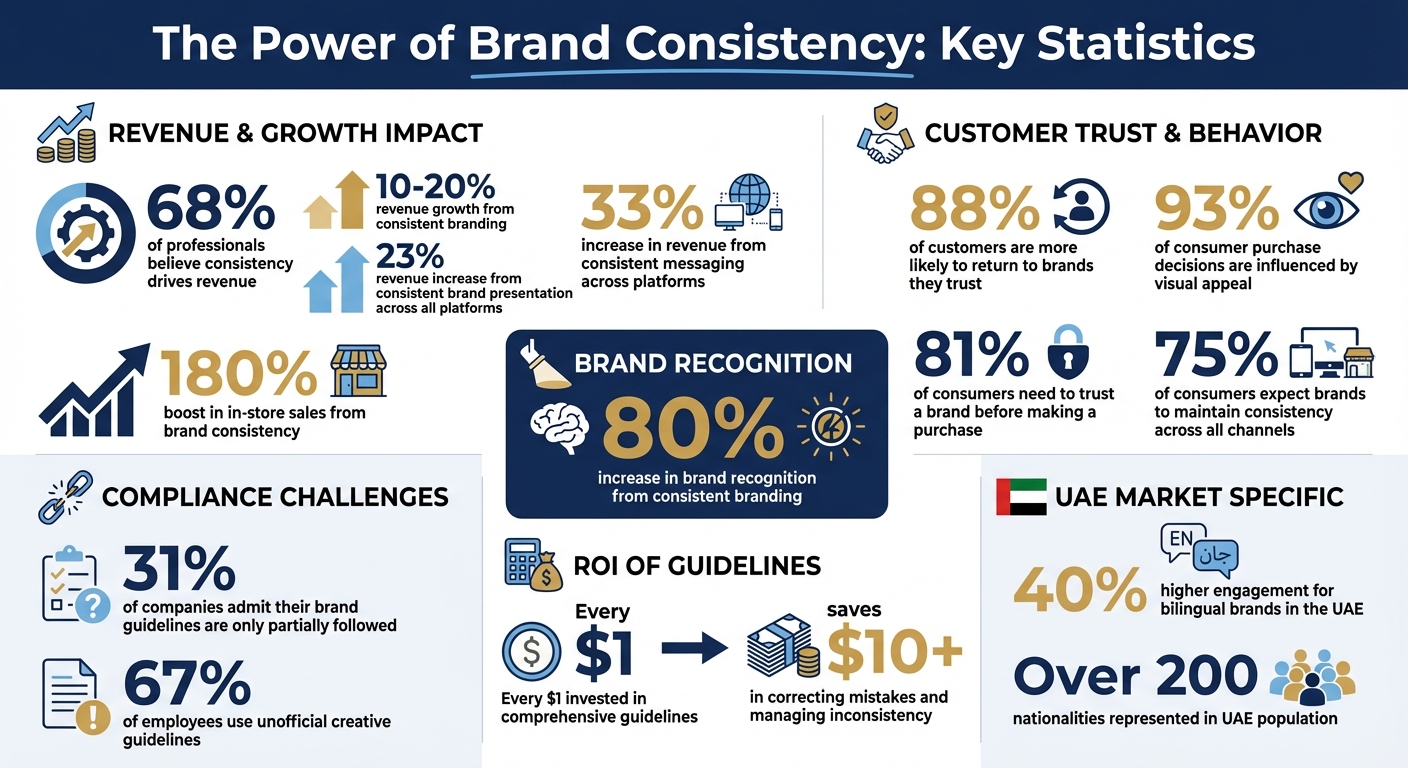
Brand Consistency Statistics and Impact on Revenue and Customer Trust
The Power of Consistency in Branding: How to Stay Memorable
sbb-itb-6cae99a
Creating Detailed Brand Guidelines
Brand guidelines act as a cornerstone for ensuring consistency, especially in a bilingual market like the UAE. They provide a unified framework for in-house teams and external agencies, helping maintain alignment in both visual and verbal branding. Without these guidelines, your brand risks becoming inconsistent, which can confuse customers and weaken recognition.
Start by defining your visual identity. Outline acceptable logo variations – such as primary, secondary, and monochrome – and specify rules for clear spacing and prohibited distortions. Include a comprehensive colour palette with exact codes for digital, print, and merchandise. Typography guidelines should cover approved fonts for both English and Arabic, ensuring that the Arabic script complements your English typeface in terms of weight and style.
Equally important is your verbal identity. Establish a consistent brand voice that reflects your personality, while allowing flexibility to adapt tone to specific contexts. As the UAE Design System 2.0 explains: “The voice stays consistent. The tone adapts to the need or situation”. For the UAE market, specify British English (Oxford) for spelling, Modern Standard Arabic (MSA) for formal content, and standardised navigation terms like “Contact us” for corporate communications.
Use the sections below to define your visual and verbal standards, tailor them to UAE-specific formats, and create a quick-reference Do’s and Don’ts table.
Setting Up Visual and Verbal Identity Standards
When it comes to visual elements, precision is key. Your logo guidelines should include approved dual-language versions for English and Arabic, considering Right-to-Left (RTL) script requirements. Specify minimum sizes to ensure legibility across both digital and print platforms. For colours, include a detailed breakdown of codes for every application. Typography rules should define hierarchies for headlines, subheadings, and body text, along with fallback fonts for digital use.
On the verbal side, document your brand’s voice attributes clearly. Include examples of on-brand and off-brand language to guide tone and style. For instance, aim for a confident, balanced tone and avoid exaggerated claims.
Once these standards are in place, refine them to reflect UAE conventions.
Adjusting Guidelines for UAE Formats and Conventions
The UAE’s population is incredibly diverse, with over 200 nationalities represented. Your guidelines should balance global standards with local practices. For example:
- Use AED for currency (e.g., AED 100).
- Apply the DD/MM/YYYY date format.
- Format numbers with commas as thousand separators (e.g., 1,000).
For bilingual content, establish rules for RTL layouts, affecting everything from logo placement to bullet point alignment. Arabic text typically requires 20–30% more space than English, so layouts should accommodate this difference. Additionally, consider the cultural symbolism of colours – green often represents prosperity and Islam, while white conveys purity and elegance.
Cultural sensitivity in imagery is also crucial. Your guidelines should mandate visuals that reflect the UAE’s diversity, avoid stereotypes, and respect local religious and social norms. Specify that photography should use natural lighting and realistic colours, steering clear of heavy filters or overly processed effects. When overlaying text on images, use a 30% to 60% black overlay to ensure readability.
Building a Do’s and Don’ts Reference Table
A Do’s and Don’ts table can make abstract rules more actionable. Organise the table by key elements such as Logo, Colour, Typography, Imagery, and Voice. Provide side-by-side examples of correct and incorrect applications. For example, show an approved dual-language logo alongside one with misaligned Arabic text, or demonstrate proper RTL formatting for lists and numbers. Highlight common mistakes like using incorrect colour shades, mixing too many font weights, or relying on idioms that don’t translate effectively.
Such a table is invaluable for teams working under tight deadlines. As Spellbrand notes: “The ROI of guidelines is remarkable: every dollar invested in creating comprehensive guidelines saves $10 or more in correcting mistakes, answering questions, and managing inconsistency”. With 67% of employees reportedly using unofficial creative guidelines, a well-designed Do’s and Don’ts table can significantly improve brand consistency. It’s a practical tool that ensures your brand remains cohesive across all touchpoints.
Running Regular Brand Audits
Once your brand guidelines are established, conducting regular audits is essential to ensure your brand identity stays on track. These audits act as a health check, helping you identify any gaps between how you want your brand to be seen and how it’s actually perceived across different channels.
Consistent branding can lead to 10–20% revenue growth and increase brand recognition by up to 80%. This matters because 93% of consumer purchase decisions are influenced by visual appeal. Yet, 31% of companies admit their brand guidelines are only partially followed. That’s why audits aren’t just helpful – they’re necessary.
A good audit framework should focus on three main areas: Brand Identity (visuals and tone), Digital Presence (website and social media), and the Customer Experience Journey. Start by mapping out every touchpoint – your website, social platforms, packaging, signage, and even customer service interactions. Gather all relevant materials in one place and compare them against your brand guidelines.
For the UAE market, it’s especially important to ensure that all materials respect local customs, use metric measurements, and follow regional norms. Reinhard Andersen, Graphic Design Lead at Antikode, explains:
"A brand audit is a detailed analysis of where your brand stands in the current market, how customers see it, and how well it meets your business goals".
Next, dive into the specifics of visual and verbal consistency across all platforms.
How to Check Visual and Verbal Consistency
Start your visual audit by reviewing logos, colour schemes (HEX, RGB, CMYK codes), fonts, and imagery styles. Even small inconsistencies – like a slightly off-colour – can lead to "brand-damaging content blunders".
For verbal consistency, evaluate your brand voice and messaging across all channels, including website copy, social media, email campaigns, and customer service scripts. The goal is to ensure your brand speaks with one clear, unified voice. Even microcopy – those small bits of text like button labels or tooltips – should reflect your brand’s personality.
Mystery shopping can help you assess how well your brand delivers a seamless experience. For example, observe how your digital ads align with in-store signage or packaging. Use a scoring system (on a 1–10 scale) to measure how well each platform matches your guidelines, making it easier to prioritise areas for improvement.
Once internal consistency is confirmed, shift your focus to meeting local market expectations.
Verifying Alignment with UAE Market Standards
The UAE is home to over 200 nationalities, so ensuring your brand aligns with this diverse audience is crucial. Review imagery to ensure it reflects diversity without relying on stereotypes or including content that clashes with local values. Be mindful of hand gestures, symbols, and metaphors that could unintentionally offend or conflict with cultural norms.
For technical aspects, ensure your materials are compatible with Right-to-Left (RTL) scripts, which impact logo orientation, font weight, and layout balance. Colour choices should also be culturally informed – for instance, green symbolises prosperity and Islam in the UAE, while white signifies purity and elegance.
When it comes to messaging, Arabic content should go through transcreation rather than direct translation. This ensures the emotional impact and core message remain intact. As HelloWorldLabel puts it:
"True brand consistency across languages and cultures means ensuring that your brand’s core message, values, and emotional resonance remain intact and impactful, regardless of the language spoken or the cultural context".
Maintaining Visual Identity Across Digital and Print Channels
Ensuring your brand looks cohesive across both digital and print mediums requires regular audits to maintain consistency in visual and verbal elements. The challenge often lies in bridging the gap between the RGB colour model used for screens and the CMYK model required for printing. Digital assets typically operate at 72–150 DPI, while printed materials demand a resolution of at least 300 DPI to avoid pixelated output. File formats also matter: SVG works best for digital designs, while EPS or AI is ideal for print.
Using Consistent Logos, Colours, and Images
To maintain a unified look, create dual colour palettes and document the exact HEX and RGB codes for digital use alongside CMYK and Pantone values for print. Pantone spot colours are especially helpful for achieving precision in print, as they provide more consistency than CMYK alone.
Your logo should have multiple versions tailored for different contexts. This means creating full-colour, monochrome, and simplified icon versions that can adapt to everything from mobile screens to large-scale billboards. Include guidelines for minimum size requirements and prohibited background colours to avoid improper usage.
When it comes to typography, use web-safe fonts or WOFF formats for digital channels but ensure you have licensed OpenType or TrueType versions for print. Stick to 2–3 complementary font families, clearly defining font weights and sizes for headings and body text. If you’re targeting the UAE market, include specific instructions for Arabic layouts to ensure your logo and wordmark maintain balance in right-to-left designs.
To streamline asset management, consider using a Digital Asset Management (DAM) platform. These platforms act as a central hub, ensuring your team always works with the most up-to-date logos, colour guides, and imagery. This eliminates the risk of outdated or incorrect files being used. For example, Brand Husl integrates these standards into ready-to-use templates, making it easier for teams to stay consistent across both digital and print materials without constant oversight.
| Element | Digital Requirement (Web/Social) | Print Requirement (Signage/Packaging) |
|---|---|---|
| Colour Space | RGB / HEX | CMYK / Pantone |
| File Format | SVG, PNG, WebP | EPS, AI, TIFF, PDF/X |
| Resolution | 72–150 DPI (Screen optimised) | 300+ DPI |
| Typography | Web-safe / WOFF formats | Licensed OpenType / TrueType |
| Layout | Responsive / Fluid | Static / Modular Grid |
Keeping Tone of Voice and Messaging Consistent
After establishing visual and audit strategies, maintaining a consistent tone and message is crucial for reinforcing your brand’s identity. Even the most polished visuals lose their effectiveness if messaging feels inconsistent across different platforms. While your brand voice should remain steady, the tone can shift depending on the context. For example, a celebratory tone is ideal for a product launch, but addressing service issues requires a more empathetic approach.
In the UAE, where bilingual communication is the norm, this balance becomes even more important. English dominates business interactions, but Arabic plays a key role in building emotional trust with local audiences. Bilingual brands in the UAE often see up to 40% higher engagement, emphasising the importance of transcreation – not just translating but adapting messages to resonate equally in both Arabic and English. This approach ensures your voice is clear and culturally appropriate across all touchpoints.
Start by determining whether to use Modern Standard Arabic (MSA) or regional dialects, depending on the context. MSA is typically better suited for formal, professional communication, particularly across the GCC, as it reinforces credibility. Additionally, develop a bilingual glossary of approved terms that reflect your brand’s identity. This glossary ensures consistency in product names, features, and calls-to-action across all channels.
Writing Messages That Connect with Your Audience
Just like visuals, your messaging should follow a unified strategy. Tailor your communication to the UAE’s diverse population, which includes over 200 nationalities. For example, Emirati audiences often respond well to heritage-driven, respectful tones with formal language. Western expatriates typically prefer direct, benefit-focused messaging, while Asian expatriates value practical, budget-conscious communication. While your core voice remains the same, adjusting your tone for each group helps build stronger connections.
To keep your team aligned, create clear examples of on-brand and off-brand messaging. For instance, if your voice is "confident but humble", an on-brand message could say: "We’ve helped 500+ companies enhance their data strategy." An off-brand version might read: "We’re the world’s leading revolutionary AI platform." Conduct short, 30-minute training sessions tailored to specific platforms to ensure everyone understands the nuances of your brand voice.
Arabic text often takes up more space than English, so your design templates should account for text expansion. Additionally, Right-to-Left (RTL) formatting impacts not just the text but the entire layout, requiring careful adjustments to maintain visual harmony. During Ramadan, consider shifting from promotional messaging to storytelling that highlights themes like "family", "community", and "respect". Regular team training and a bilingual glossary are essential for maintaining this consistency over time.
Brands that keep their messaging consistent across platforms report a 33% increase in revenue, and 81% of consumers say they need to trust a brand before making a purchase.
Applying Consistency in Physical Stores and Events
After addressing digital and print consistency, it’s essential to focus on how your brand is represented in physical spaces. Whether it’s a retail store, a pop-up shop, or an event booth, these environments are where your brand takes on a tangible form. Just like your online and print materials, your physical spaces should consistently reflect your brand’s identity. Everything – signage, staff uniforms, and even the layout – needs to align with what customers already recognise from your digital presence. In the UAE, with its diverse population of over 200 nationalities, this consistency becomes even more crucial. It ensures that every interaction, no matter the channel, feels cohesive and reinforces trust.
Physical touchpoints, being highly visible and often permanent, carry significant weight. A poorly designed sign or subpar packaging can quickly damage your brand’s credibility. Studies show that consistent brand presentation across all platforms can lead to a revenue increase of up to 23%, while in-store sales can see a boost of as much as 180%.
Standardising Signage, Packaging, and Promotional Materials
To maintain uniformity, your visual identity must remain consistent across all physical elements. Whether it’s a storefront sign, product packaging, or an event banner, your logos, colours, and typography should be identical everywhere. In the UAE, this also means creating materials that cater to both Arabic and English-speaking audiences. Employ transcreation to adapt your messaging in a way that resonates locally, and ensure bilingual signage is reviewed by native Arabic speakers to capture cultural nuances accurately.
Local culture plays a significant role in shaping customer perceptions. Incorporating meaningful symbols and culturally appropriate colour schemes can help your brand connect more deeply with the local audience. Imagery, too, should respect local modesty standards, avoiding anything that might be considered offensive or inappropriate. During key occasions like Ramadan or UAE National Day, adjust your promotional materials to reflect the spirit of the event while staying true to your brand identity.
There are practical examples of how companies achieve this level of consistency. For instance, in 2017, bookmaker Paddy Power improved display compliance from 42% to 100% across its 600 stores by introducing a system where store teams submitted photos of marketing installations for head office approval. Similarly, BMW Group maintains brand consistency across 147 dealerships through a centralised platform that provides standardised content while allowing local teams to add a personalised touch.
For events, consider using services like Brand Husl’s event branding solutions to design visuals that perfectly align with your brand while catering to the specific needs of each event. These efforts ensure your brand remains recognisable and trusted, no matter the setting.
Tracking and Enforcing Brand Standards
Creating a consistent brand experience requires more than just creative efforts – it also demands strong tracking and enforcement systems. Once your brand is established across various channels, maintaining its integrity calls for regular audits. These audits help evaluate how well your visual identity, messaging, and overall guidelines are being followed across platforms. Essentially, they act as a safeguard for consistency.
Research shows that companies with a consistent brand presentation can see revenue growth ranging from 10% to 20% or more. Additionally, implementing automated corrective processes can significantly improve issue resolution rates – from under 40% with manual emails to over 85% within just two weeks. This kind of reliability helps reinforce the trust that 88% of customers consider critical when making repeat purchase decisions.
By combining regular audits with focused employee training, organisations can quickly address and resolve discrepancies, ensuring their brand remains cohesive.
Using Audits and Employee Training
Regular audits should be seen as opportunities to learn, not just as compliance checks. A structured audit framework can help identify key touchpoints and prioritise issues. For example, you could use a weighted scoring system to categorise problems – critical issues like safety risks or major branding errors might score a 10 and demand immediate action, while minor deviations might score between 1 and 2, allowing them to be addressed during routine updates.
"We treat noncompliance as a learning opportunity rather than a failure. The person responsible has to dissect what went wrong in a team meeting, turning it into a lesson for everyone." – Marshal Davis, President, Ascendly Capital
Photo documentation is another vital component. Requiring photos for audit failures removes subjectivity and provides clear examples for training purposes. For physical locations in the UAE, mystery shoppers can offer an objective view of the brand experience. Adjust your audit schedule based on performance – high-performing locations might only need quarterly reviews, while underperforming ones could benefit from bi-weekly assessments to enable more hands-on coaching.
Employee training should also be integrated into daily routines. Assign brand ambassadors within each department to act as internal experts, guiding their peers and advocating for brand consistency. Use tools like templates with built-in "guardrails" that lock in branded elements, making it easier for employees to follow guidelines without starting from scratch. Replace outdated static PDFs with interactive digital portals or asset management systems to ensure everyone has access to the latest resources.
Using Brand Husl‘s Look-and-Feel Guidelines
Brand Husl’s dynamic guidelines make it easier to maintain compliance. These evolving guidelines adapt with your brand while preserving its core identity across all touchpoints. They feature visual "before and after" examples that highlight common mistakes and their corrections, offering teams a clear understanding of expectations without constant oversight.
These guidelines integrate seamlessly into everyday operations by providing ready-to-use templates for marketing materials, signage, packaging, and digital platforms. They also align with AI-powered validation trends, where tools automatically scan websites and social media for guideline breaches, check text for tone alignment, and verify visual elements like typography and spacing. Establishing a cross-departmental task force to oversee adherence and train staff ensures that brand standards become deeply embedded in your organisation. This approach fosters a unified, cross-channel brand experience that resonates with both internal teams and external audiences.
Conclusion
Maintaining brand consistency is essential for building trust and recognition in a market as diverse as the UAE. With over 200 nationalities represented, your brand needs to stand out as a reliable and familiar presence that resonates across this unique landscape.
Research underscores the connection between consistent branding and improved revenue and customer loyalty.
"Your brand is what people say about you when you’re not in the room." – Jeff Bezos
The strategies outlined in this guide offer a clear roadmap for delivering a unified brand experience. From creating detailed brand guidelines tailored to UAE-specific formats and preferences to conducting regular audits and training your team, these steps ensure consistency across digital, physical, and customer service touchpoints. In fact, 75% of consumers expect brands to maintain this level of consistency across all channels.
Start applying these strategies today. Whether it’s conducting a brand audit, refining your guidelines for the UAE market, or using tools to streamline your processes, each action strengthens your brand’s impact and sets the foundation for long-term success.
FAQs
How often should I run a brand audit?
Conducting a brand audit on a regular basis is key to ensuring consistency and building trust with your audience. Experts often suggest doing this at least once a year or whenever there are major shifts in your brand or market landscape. These audits can help pinpoint inconsistencies, confirm alignment with your brand guidelines, and keep all touchpoints unified. This, in turn, strengthens recognition and reinforces your reliability with your audience.
How do I keep English and Arabic branding consistent without direct translation?
To maintain consistency between English and Arabic branding without resorting to direct translation, prioritise transcreation – a process that adapts your content creatively while respecting cultural differences. This approach ensures your core messages, tone, and values connect effectively with audiences in both languages.
Establish detailed brand guidelines that outline tone, visuals, and messaging for each language. Engage professional transcreation services to preserve the essence of your brand, ensuring your message remains impactful and avoids potential misinterpretation.
What’s the easiest way to stop teams using outdated logos and templates?
To keep teams from relying on outdated logos or templates, implement a centralised brand asset management system. This ensures everyone can access the most current assets alongside clear usage guidelines.
By organising assets effectively, setting permissions, and sharing detailed brand guidelines, you can minimise inconsistencies. Plus, it simplifies the process for teams to locate and use approved materials efficiently.
Related Blog Posts

BRAND HUSL
We’re a collective of brand strategists, designers, and unapologetic truth-tellers who’ve spent over two decades turning chaos into clarity for businesses across the globe. From global names to fearless startups, we’ve built brands that stick, scale, and sell—without the fluff. Everything we create is rooted in strategy, storytelling, and ROI, because good branding isn’t just pretty—it’s powerful.