

Your brand’s identity needs regular check-ups to stay consistent and relevant. In the UAE, where 99% of the population is online and 95% use social media, your brand is constantly judged by a diverse audience of over 200 nationalities. A misstep, like using the wrong cultural reference or outdated visuals, can cost you – fines under UAE cybercrime laws can reach AED 500,000 or worse.
Here’s why regular audits matter: 76% of UAE consumers research ethical practices, and 80% avoid brands they don’t trust. This checklist streamlines the process, covering visual consistency, messaging alignment, and audience engagement using a structured brand blueprint. Conduct an audit every 1–2 years or sooner when launching products or facing market changes.
Key Areas to Focus On:
- Visual Identity: Ensure your logo, colours, and fonts work across platforms and respect local meanings, especially in Arabic and English designs.
- Messaging: Align your tone with local values like respect and community. Avoid casual slang and ensure bilingual accuracy.
- Audience Understanding: Define personas for Emirati nationals, Western expats, and Asian expats, tailoring your approach to their preferences.
- Consistency Across Channels: Test digital and print materials to ensure colours, fonts, and layouts stay uniform.
Remember: Regular audits protect your brand’s reputation, build trust, and keep you competitive in a fast-evolving market.
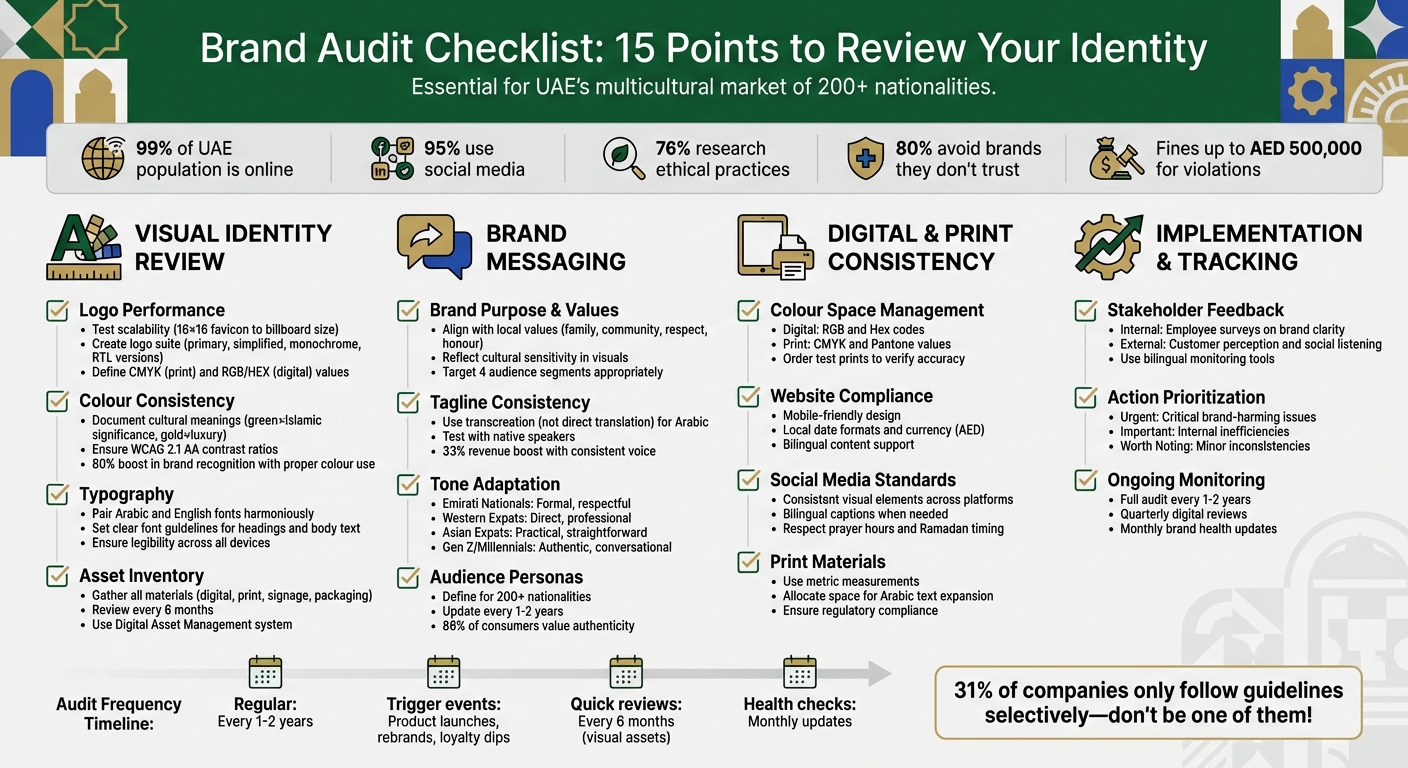
Brand Audit Checklist: 15 Essential Points for UAE Businesses
Step-by-Step Brand Audit Guide for Business Success (Brand Audit 2024)
sbb-itb-6cae99a
Visual Identity Review
Your visual identity is often the first impression your brand makes, and in the UAE’s diverse market, it must shine across all platforms. A logo that looks great on Instagram might pixelate on a billboard, or colours that pop online may print incorrectly on business cards. Here’s a striking fact: 85% of consumers say colour is the main reason they choose a product. That means visual inconsistencies aren’t just an aesthetic issue – they can directly impact your sales.
Start by gathering all your current assets: social media graphics, website elements, printed materials, signage, and packaging. This "visual inventory" will reveal any inconsistencies in your branding. Look for outdated logos, pixelated images, or mismatched colours. Performing this review every six months ensures your brand stays consistent and polished across all platforms.
Logo Performance Across Platforms
Your logo needs to look sharp, no matter the size. Louis Pretorius, a branding expert, puts it clearly:
"Is it scalable? Does it look sharp on both a billboard and a business card?"
Test your logo in its smallest form (like a 16×16 pixel favicon) and its largest (such as exhibition signage). If details blur or disappear, you may need simplified versions.
Create a logo suite that includes variations for different uses: a primary logo, a simplified version for tight spaces, and monochrome, inverted, horizontal, and vertical options. Define CMYK codes for print and RGB/HEX values for digital use. This ensures your colours stay consistent across mediums.
In the UAE’s bilingual environment, your logo must work seamlessly in both Arabic and English. Test how it performs in Right-to-Left (RTL) layouts and adjust as needed when pairing it with Arabic text. A Digital Asset Management system can help centralise approved assets and automatically retire outdated ones, preventing accidental misuse.
Colour Selection and Local Meaning
Colours carry different meanings across cultures, and the UAE has its own unique associations. For example, green symbolises growth and peace globally, but in the UAE, it holds sacred significance in Islamic culture. This is why brands like Emirates NBD prominently feature green. Gold represents wealth and exclusivity, making it a favourite for luxury real estate and hospitality brands. White, often seen in the traditional Emirati kandura, symbolises purity and sophistication.
Colour can boost brand recognition by up to 80%, but only if used thoughtfully. During Ramadan, for instance, green, white, and gold are more culturally appropriate, while red should be used sparingly. Blue conveys professionalism and security, which is why it’s popular with corporate and tech brands like Etisalat.
For digital designs, ensure your colours meet WCAG 2.1 AA contrast ratios. For example, the UAE brand gold (#B68A35) doesn’t provide enough contrast for white text, so opt for a darker shade like #92722A instead. For text on light backgrounds, AEBlack (#232528) offers maximum readability.
Font Choices and Readability
Typography becomes especially important in a multilingual market like the UAE. Your Arabic and English fonts must complement each other in weight, size, and overall style to maintain harmony. Arabic text often takes up more space than English, so your designs need to account for this, especially in fixed-width formats like packaging or social media posts.
Make sure your fonts are legible across devices and fully support Arabic characters to avoid layout issues. For websites, stick to web-safe fonts; for print and signage, use high-resolution typefaces that stay crisp at larger sizes.
Set clear font guidelines: identify primary fonts for headings and secondary fonts for body text, and define when and where each should be used.
"Does the chosen typeface reflect your brand’s tone and character?"
For instance, a law firm needs a very different font style than a children’s entertainment brand. Specify rules for formatting, such as paragraph spacing and kerning, in both Arabic and English. This ensures professional and consistent presentation across all mediums.
Brand Messaging and Audience Alignment
Your visuals might grab attention, but it’s your messaging that builds trust. In the UAE, where 90% of the population are expatriates, your brand voice needs to resonate with a multicultural audience while respecting Emirati traditions. According to a 2023 Brand Middle East survey, 78% of GCC consumers prefer brands that align with their cultural values. This means creating a connection that feels authentic and meaningful.
Communication here leans more formal and respectful compared to Western markets. Using honourifics and avoiding casual slang is essential. Your choice of words reflects your brand’s personality and directly impacts how users perceive you. As the UAE Design System emphasises:
"The number-one goal for our voice is the user and their needs."
It’s also vital to be mindful of religious practices, as Islam plays a significant role in daily life. For instance, avoid marketing during fasting hours in Ramadan. Additionally, Millennials and Gen Z in the UAE expect brands to prioritise authenticity and social responsibility.
Let’s dive into how you can align your brand purpose, craft a consistent tagline, and define your diverse audience.
Brand Purpose and Values
Your mission should reflect key local values – family, community, respect, and honour – since these build trust in the UAE market. Consider these values when addressing your primary audience segments: Emirati nationals, Western expatriates, and Asian expatriates.
| Audience Segment | Recommended Tone | Key Messaging Focus |
|---|---|---|
| Emirati Nationals | Formal, Respectful | Heritage, National Pride, Community |
| Western Expats | Direct, Professional | Benefit-driven, Efficiency, Innovation |
| Asian Expats | Practical, Straightforward | Value-conscious, Reliability, Success |
| Gen Z / Millennials | Authentic, Conversational | Social Responsibility, Genuineness |
Your visuals should also reflect cultural sensitivity. Avoid excessive skin exposure, intimate imagery, or the improper use of national symbols like the UAE flag. Collaborating with local designers can help you steer clear of cultural missteps, such as inappropriate hand gestures or symbols that conflict with Islamic norms. Aim for visuals that are modest, community-oriented, and rooted in local heritage.
Tagline and Message Consistency
A catchy tagline in English might fall flat in Arabic if directly translated. To maintain a cohesive brand identity, focus on transcreation – adapting your message to evoke the same emotional impact in Arabic while ensuring it aligns with cultural norms. Research shows that brands with a consistent voice across platforms see a 33% boost in revenue.
Work with native Arabic-speaking marketers to test your tagline’s resonance in both languages. Additionally, creating a bilingual glossary can help maintain consistent terminology across all materials. Keep in mind that Arabic text often takes up more space than English, so design templates – especially for social media or packaging – should accommodate this difference.
For formal content, use Modern Standard Arabic (MSA) rather than regional dialects unless targeting a specific subgroup. In English, stick to British English conventions (e.g., "licence" instead of "license") to align with UAE government standards. Keep navigation labels and calls-to-action professional – for example, use "About Us" instead of "Who We Are" to maintain credibility.
Target Audience Definition
With over 200 nationalities living in the UAE, defining your target audience is more complex than in more homogenous markets. Your personas should reflect both local and expatriate groups, taking into account their cultural expectations, buying habits, and communication preferences. Are you targeting Emirati families who value tradition and community? Western professionals who prioritise efficiency and innovation? Or Asian expatriates focused on affordability and reliability?
Authenticity matters here – 86% of consumers say it’s a key factor when choosing brands. This means your audience research needs to be thorough, ensuring your communication feels genuine and culturally appropriate. Update your personas regularly – every one to two years – based on customer feedback and market changes. This way, your team can stay aligned with the nuances of each audience group.
Digital and Print Consistency Check
Once your visual identity and messaging are set, the next step is ensuring they remain consistent across all platforms. What looks polished online should translate seamlessly into print to maintain trust and credibility. In fact, a unified brand identity across platforms has been shown to increase revenue by up to 33%. In the UAE, where mobile usage is high and physical retail thrives alongside digital commerce, this consistency is even more critical.
Bridging the Gap Between Digital and Print
Digital and print formats come with their own unique challenges, particularly when it comes to colour and design. Digital platforms use RGB and Hex colour codes, while print requires CMYK or Pantone values to ensure colours remain true to the original design. Without proper documentation of these conversions, colours can appear drastically different in print. For example, a vibrant blue on your website might look dull or off-tone in print if CMYK values aren’t correctly applied.
Your logo also needs to adapt to various formats. Having multiple versions – such as full logos, icon-only designs, and wordmarks – ensures it remains clear and professional, whether it’s on a mobile favicon or a large outdoor banner.
Typography is another area where adjustments are necessary. On digital platforms, body text should be at least 16px for readability, while print materials typically work best with fonts sized between 10–12pt. Additionally, web-safe fonts might not deliver the same impact in print, so choosing fonts that work across both mediums is key. As Arcs & Curves explains:
"Brand guidelines provide a fool-proof method of representing your business in the most concrete and defined way possible, without losing any creative essence or style."
Website and Online Platforms
Your website acts as your brand’s digital home base, so it needs to reflect your identity while meeting technical standards. Make sure it’s mobile-friendly and complies with performance and accessibility requirements. In the UAE, this includes using local date formats, currency symbols, and ensuring bilingual content where necessary.
Every element, from your logo in the header to the colour of buttons and links, should align with your brand guidelines. Test key user functions – like searching for products or booking consultations – to ensure the experience is smooth and consistent. If your brand voice is formal in marketing materials, your website copy should match that tone.
To maintain consistency, consider using a centralised Digital Asset Management (DAM) system. This ensures all teams access the latest approved logos, graphics, and other assets.
Social Media Content and Graphics
Each social platform has its own quirks, but your brand identity should remain instantly recognisable across all channels. Define specific content themes for each platform while keeping consistent visual elements – like your colour palette, fonts, and logo placement – intact. This ensures your audience can identify your brand, whether they’re on LinkedIn or Instagram.
Rather than simply reposting the same content, adjust it to fit the platform’s audience and format while preserving your brand’s visual identity. Profile pictures, cover images, and story highlights should all use approved colours and typography. To maintain a consistent tone, establish response Service Level Agreements (SLAs) for interactions with your audience.
For the UAE market, it’s essential to respect local sensitivities. This includes using modest imagery, timing posts around prayer hours and Ramadan, and providing bilingual captions when needed. Store all approved templates in a shared hub so your team can easily access updated designs. These digital efforts should align with your print strategies for a cohesive brand experience.
Printed Materials and Product Packaging
Physical materials like business cards, brochures, packaging, and signage demand careful attention, as errors can be costly. Always order test prints to verify colour accuracy and typography. Double-check that CMYK values produce the intended results and that text remains legible across different paper finishes.
In the UAE, printed materials should use metric measurements (centimetres, kilograms) and display temperatures in Celsius. Bilingual packaging is also a must, with enough space allocated for Arabic text, which often takes up more room than English. Additionally, ensure your packaging complies with local regulations and is clear enough to photograph well for e-commerce.
A simple "table test" – comparing physical samples with digital screenshots – can reveal discrepancies in colours, fonts, and logos. Brands that maintain consistency in these areas can see up to 20% higher value. To make this process easier, document precise specifications for logo spacing, minimum sizes, and colour values in your brand guidelines. This ensures vendors, whether in Dubai or Sharjah, adhere to the same standards.
| Element | Digital Requirements | Print Requirements |
|---|---|---|
| Colour Space | RGB and Hex codes | CMYK and Pantone |
| File Formats | SVG (vectors), WEBP, JPEG | High-resolution PDF, EPS, AI |
| Typography | Web-safe fonts; 16px+ body | 10–12pt+ body text; high-res fonts |
| Logo Usage | Optimised for small screens | Optimised for large-scale finishes |
| Measurements | Pixels, percentages | Centimetres, millimetres (metric) |
Implementation and Progress Tracking
A brand audit is only effective if its results lead to meaningful action. Without a structured plan, even the best insights might go unused, allowing inconsistencies to persist and harm your brand. For example, 31% of companies admit their brand guidelines are only followed selectively. This highlights how even well-documented standards can fall short without proper execution and monitoring.
Collecting Feedback from Stakeholders
Feedback from those who engage with your brand daily – both internally and externally – is crucial. Employees can provide valuable insights into whether your team understands and delivers on your brand promise. Anonymous surveys, using tools like SurveyMonkey, can help assess areas like brand clarity, accessibility of assets, and messaging consistency.
On the external front, customer and partner feedback sheds light on how your brand is perceived in real-world scenarios. In the UAE, where conversations often occur in both Arabic and English, social listening tools that cater to bilingual audiences are indispensable. Platforms like Instagram, LinkedIn, and industry-specific forums are excellent for tracking sentiment and spotting gaps between your intended brand identity and public perception. As Gert van Santen, VP Corporate Communications at WS Audiology, explains:
"Having access to real-time stakeholder perceptions is something that every company needs to inform their decision-making".
You can also run targeted surveys to gauge brand awareness and trust levels. Comparing these results with your audit findings helps you shape a more focused and actionable plan.
Execution and Ongoing Monitoring
Turn your audit insights into a prioritised action plan by grouping issues into three categories: Urgent (critical problems harming your brand), Important (issues causing internal inefficiencies), and Worth Noting (minor inconsistencies). Assign clear ownership for each task across your marketing, product, and sales teams to ensure accountability. Address each point from your audit checklist with specific actions and measurable goals. For instance, improve website performance to achieve a Largest Contentful Paint (LCP) of 2.5 seconds or better, or set a target to increase brand awareness by a specific percentage.
Budgeting is another key step. Allocate funds in AED for both immediate fixes and longer-term improvements. With priorities and budgets in place, execute changes using a structured 12-week roadmap. Here’s a suggested breakdown:
- Weeks 1–2: Set priorities and align stakeholders.
- Weeks 3–6: Implement quick fixes, such as updating email templates or removing outdated assets.
- Weeks 7–12: Focus on core changes, like redesigning your visual system or refining your value proposition.
Justin Lynch, Brand Consultant at Avlier, advises:
"Ideally, you should be auditing your brand every year".
To maintain consistency between annual audits, consider releasing monthly "brand health" updates. These updates help monitor progress, address any new inconsistencies early, and keep momentum going. Regular tracking ensures your brand identity stays aligned with your business goals while adapting to evolving market conditions.
Conclusion: Maintaining Your Brand Identity
Your brand is more than just a logo or slogan – it’s a dynamic asset that demands ongoing care and attention. In the UAE’s ever-changing market, where Millennials and Gen Z value trust and social responsibility, staying consistent is not just beneficial – it’s essential.
The checklist provided earlier helps ensure your brand remains strong across all areas. Consider this: 80% of consumers will not buy from a brand they don’t trust. A trusted brand doesn’t just attract loyal customers – it reduces marketing costs, boosts sales, and lowers churn rates. Every dirham invested in maintaining consistency pays off by building deeper loyalty and cutting unnecessary expenses.
Make it a habit to conduct a full brand audit every 1–2 years, supplemented by quarterly digital reviews. If you’re launching a new product, rebranding, or noticing a dip in customer loyalty, act immediately with a thorough audit. For ongoing monitoring, monthly brand health updates can help you identify and address inconsistencies before they grow into larger issues.
In the UAE, aligning with local values and customs is critical. Your brand’s visuals, messaging, and core values must resonate with the local audience while adhering to regional norms and regulations. This is where expert guidance can make a real difference. Brand Husl offers tailored brand audits and identity refinement services, designed specifically for the UAE’s competitive and diverse market. Their expertise ensures your brand connects meaningfully with Dubai’s multicultural audience while maintaining global relevance.
"Trust isn’t a nice-to-have – it’s the fuel that powers your brand growth."
Regular audits aren’t just about spotting issues – they’re about safeguarding the trust you’ve worked hard to build. They keep your brand relevant, recognisable, and ready to adapt to changing market conditions. By committing to these steps, you can create a brand identity that’s not only resilient but also deeply trusted and prepared to thrive in the face of future challenges.
FAQs
What’s the fastest way to spot brand inconsistencies across channels?
To spot inconsistencies in your brand quickly, conducting a brand consistency audit is key. This involves examining your visuals, messaging, tone, and user experience across all platforms – think social media, your website, and even customer interactions. The goal? To ensure everything aligns seamlessly, creating a unified and recognisable brand identity.
How do I check if my Arabic and English branding feels equally natural?
To make sure your branding connects seamlessly in both Arabic and English, pay close attention to cultural subtleties, language adjustments, and how your audience perceives your message. Instead of relying on direct translation, opt for transcreation. This approach helps preserve the emotional and cultural depth of your message.
Collaborate with native speakers from your target audience to pinpoint any awkward wording or cultural missteps. Their insights can help you refine your tone and ensure your brand feels genuine and relatable within the UAE’s diverse, multicultural environment.
What should I fix first after a brand audit?
To begin, tackle the areas where your brand seems out of sync or lagging behind. This could mean addressing inconsistencies in your visual identity, refining your brand messaging, or bridging gaps in how customers currently view your brand compared to how you want it to be perceived. The priority here is to bring back clarity and a sense of unity, ensuring your brand delivers a message that resonates with your audience and aligns perfectly with your objectives.
Related Blog Posts

BRAND HUSL
We’re a collective of brand strategists, designers, and unapologetic truth-tellers who’ve spent over two decades turning chaos into clarity for businesses across the globe. From global names to fearless startups, we’ve built brands that stick, scale, and sell—without the fluff. Everything we create is rooted in strategy, storytelling, and ROI, because good branding isn’t just pretty—it’s powerful.